Our verdict
A neighbourhood kiosk-style spot in Valdebebas, one of Madrid's newer residential districts in the Hortaleza borough, EL KIOSKO occupies the kind of low-key format that often punches above its apparent station. With Madrid's serious dining scene skewing heavily toward grand tasting menus and Michelin-recognised rooms, a well-executed neighbourhood option in this part of the city fills a genuinely useful gap for residents and visitors alike.

Pearl is the En Primeur Club membership app, where members save venues, book tables and use the concierge.

The menu
What to order
- Croquetas de jamón
- Patatas bravas
- Empanadilla de pollo
- Huevos rotos
- Berenjenas con miel de caña
Valdebebas and the Neighbourhood Dining Question
Madrid's dining conversation tends to anchor itself in the centre: Salamanca, Chueca, Las Letras, the corridor running from Alonso Martínez down to Lavapiés. The outer residential districts rarely appear in that conversation, even as the city's population has shifted steadily northward. Valdebebas, a planned district developed through the 2000s in the Hortaleza borough, sits near Adolfo Suárez Madrid–Barajas Airport and has the texture of a neighbourhood still finding its dining identity. In that context, a kiosk-format venue on Calle de María de las Mercedes de Borbón is worth understanding not as a destination but as a signal: that even Madrid's newer residential periphery is developing the kind of daily-use dining infrastructure that makes a neighbourhood function.
Kiosk and terrace-format venues occupy a specific register in Spanish urban dining. They are not the tapas bar anchored to a century-old counter, nor the white-tablecloth room with a sommelier and a wine list that runs to forty pages. They sit between those poles, offering a more casual rhythm while still operating within a culture that takes food seriously at every price point. Madrid's version of this format shows up across the city's parks, residential squares, and newer developments, and the leading examples hold their own against the more celebrated rooms by doing fewer things with more precision.
Approaching the Format: What a Kiosk Meal Actually Sequences
The editorial angle that matters most for a venue like EL KIOSKO is the progression of a meal in an open-air or semi-open setting, because that format imposes its own logic on how food and drink move across a table. In Madrid's climate, the sequence often begins with something cold and sharp, designed for the heat: a vermouth, a beer, or a light aperitivo that works against the afternoon sun before the kitchen sends anything substantive. The terrace or kiosk format rewards drinks-first ordering in a way that a formal dining room does not.
From there, the middle of the meal in this kind of venue tends toward shared plates rather than plated courses, raciones or half-raciones that arrive without strict choreography, sometimes overlapping, sometimes staggered by whatever the kitchen is managing at the moment. This is not imprecision; it is a different grammar of eating, one that the Spanish kiosk format has practised for generations. The meal ends not with a composed dessert trolley but with something simpler, coffee, a copa, or the kind of sweet that arrives without much ceremony and signals that the table is yours for as long as you want it.
That unhurried closing rhythm is one of the underappreciated features of this format. Madrid's serious tasting-menu rooms, places like DiverXO or Coque, manage pacing with precision because the kitchen controls every beat. At a neighbourhood kiosk, pacing belongs to the diner, and that shift in control changes the character of the meal entirely.
Where EL KIOSKO Sits in Madrid's Wider Dining Structure
Madrid's restaurant scene in 2024 and 2025 has continued to polarise between the high-investment creative rooms that compete for international attention and the neighbourhood operations that serve residents without ambition for rankings. The creative tier includes venues like Deessa, DSTAgE, and Paco Roncero, all operating at price points that position them against Spain's broader fine-dining circuit, which runs from El Celler de Can Roca in Girona to Mugaritz in Errenteria and Arzak in San Sebastián.
EL KIOSKO operates in a different register entirely. Its address in Valdebebas places it outside the circuits that food writers and ranking committees monitor, which means its value is assessed locally, by the residents who use it regularly, rather than by the international visitor planning a trip around restaurant reservations. That local anchoring is not a weakness; it is the defining characteristic of a format that exists to serve a neighbourhood rather than to perform for an audience.
For comparison, Madrid's serious neighbourhood dining options in more established areas often carry light recognition: a Bib Gourmand, a mention in a regional guide, a reputation that spreads through residential word-of-mouth. Valdebebas is newer and the dining infrastructure is correspondingly thinner, which gives a venue like EL KIOSKO more space to define the category in its immediate geography.
Planning a Visit: Practical Context
| Venue | Format | Price Tier | Booking Pressure | Distance from Centre |
|---|---|---|---|---|
| EL KIOSKO I Valdebebas | Kiosk / neighbourhood | Not confirmed | Low (estimated) | North periphery, Hortaleza |
| DiverXO | Creative tasting menu | €€€€ | High (weeks/months ahead) | Central-north Madrid |
| Coque | Creative tasting menu | €€€€ | High | Central Madrid |
| Deessa | Modern Spanish, creative | €€€€ | Moderate to high | Central Madrid |
The Valdebebas address is most accessible from the Barajas area and from the northern residential zones that expanded in the 2010s. Public transport connections exist via the metro's Line 8, which links the district to the airport and the wider network, though the specific stop proximity to Calle de María de las Mercedes de Borbón requires local verification. For visitors arriving at or departing from Barajas and seeking a meal without travelling into the centre, the district's geography makes it a practical option that central Madrid's restaurant guide does not typically flag.
The Broader Spanish Kiosk Tradition
Spain's kiosk and chiringuito culture has deep roots in outdoor sociability, from the beach bars of the Costa del Sol documented since the mid-twentieth century to the park kiosks of Madrid's Retiro and Casa de Campo. The format travelled into residential districts as cities expanded, adapting to each neighbourhood's rhythms and demographics. In newer planned districts like Valdebebas, the kiosk fills a social function that older neighbourhoods covered through the ground-floor bar on every corner: a place to be outside, with something to eat and drink, without the formality of a restaurant or the transience of a fast-food counter.
That tradition connects EL KIOSKO to a lineage that runs through Spanish urban life at every scale, from the neighbourhood chiringuito to the more ambitious terrace operations that have attracted serious kitchen talent in recent years. Spain's outdoor dining culture has proven resilient precisely because it is not contingent on weather alone; it is a social preference that drives terrace use even on cooler evenings.
For readers whose Spain itinerary extends beyond Madrid, the dining circuit spans venues as different in ambition as Quique Dacosta in Dénia, Aponiente in El Puerto de Santa María, Azurmendi in Larrabetzu, Martin Berasategui in Lasarte-Oria, Atrio in Cáceres, Ricard Camarena in València, and Cocina Hermanos Torres in Barcelona. The neighbourhood kiosk and the three-Michelin-star tasting room are both expressions of the same underlying culture, separated by ambition and price rather than by any difference in the seriousness with which Spaniards approach eating. For international reference points at the ambitious end, Le Bernardin in New York City and Lazy Bear in San Francisco represent comparable investments in format discipline, just in a very different register. See our full Madrid restaurants guide for the complete picture across all formats and price points.
Frequently asked questions
at EL KIOSKO I Valdebebas?
What the kiosk format generally rewards is ordering around the kitchen's pace rather than trying to replicate a structured tasting sequence: start with something that works with a cold drink, let the middle of the meal build through shared plates, and resist the impulse to rush the table. In Madrid's neighbourhood dining culture, the leading use of a venue like this is usually found in its everyday rhythm rather than in any single item.
Do I need a reservation for EL KIOSKO I Valdebebas?
If the venue operates in the kiosk format typical of Madrid's residential districts, walk-in availability is generally higher than at the city's creative tasting-menu rooms, where demand at venues priced in the €€€€ tier means booking weeks or months ahead. That said, Valdebebas has a resident population that uses local dining options regularly, and peak lunch and evening periods on weekends may create demand.
Is EL KIOSKO I Valdebebas suited to visitors staying near Barajas Airport?
The Valdebebas district sits in close proximity to Adolfo Suárez Madrid–Barajas Airport and is connected to the broader metro network via Line 8, making EL KIOSKO a geographically logical option for travellers with layover time or those whose accommodation is in the northern residential zones rather than central Madrid. The kiosk format, with its lower formality and neighbourhood character, suits an unplanned or transitional meal better than a destination restaurant that requires advance planning and a specific state of mind.
Cuisine Context
Comparable venues nearby, for context on price, style, and recognition.
| Venue | Cuisine | Price | Awards | Notes |
|---|---|---|---|---|
| EL KIOSKO I ValdebebasThis venue (the venue you are viewing) | Traditional Spanish Tapas & Mediterranean Small Plates | $30–50 | Not listed | Not listed |
| LaLanda | Traditional Spanish Tapas | $30–50 | Not listed | Nueva Espana |
| Zoko Retiro | Spanish Fusion with Almadraba Tuna | $30–50 | Not listed | Ibiza |
| Patio de Leones | Traditional Spanish Tapas & Tavern | $30–50 | Macarfi 6.1 Food Rating | Recoletos |
| Il Tavolo Verde | Organic Spanish Cafe | Not listed | Not listed | Recoletos |
| Harina | Spanish Café & Bakery | Not listed | Not listed | Jeronimos |
Continue exploring
More in Madrid
Restaurants in Madrid
All restaurants in Madrid →
Bars in Madrid
All bars in Madrid →


Details
- Casual
- Lively
- Cozy
- Casual Hangout
- After Work
- Group Dining
- Standalone
- Beer Program
- Small Plates
- A La Carte
- Beer
- Wine
- Vegetarian Friendly
Current opening hours
- Monday
- 12–4:30 PM, 7 PM–12 AM
- Tuesday
- 12–4:30 PM, 7 PM–12 AM
- Wednesday
- 12–4:30 PM, 7 PM–12 AM
- Thursday
- 12–4:30 PM, 7 PM–12 AM
- Friday
- 12–4:30 PM, 7 PM–12:30 AM
- Saturday
- 12 PM–12:30 AM
- Sunday
- 12 PM–12 AM
Hours can change for holidays and private events. Hours as of .
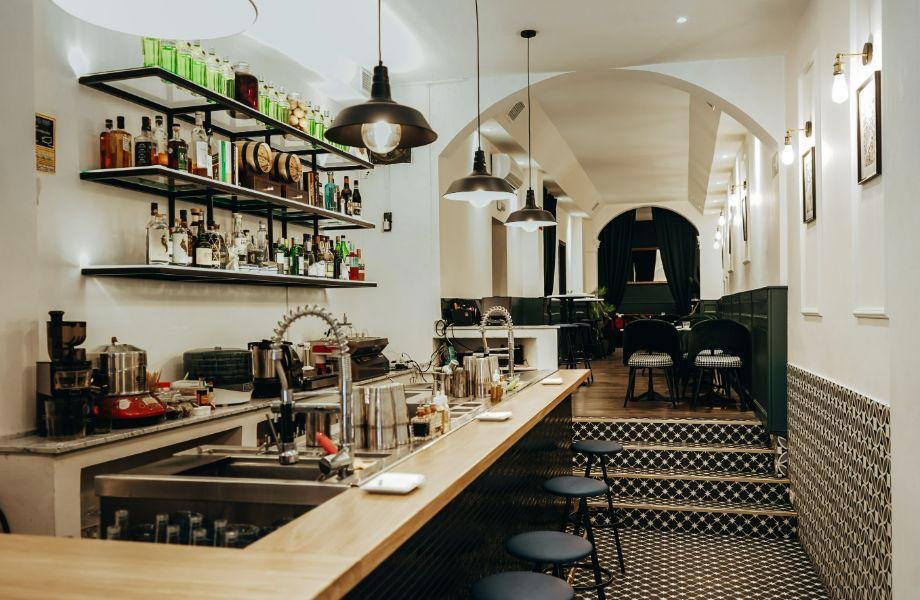
Casual, unpretentious dining environment with a focus on quality food and welcoming service in a snack-bar format.