Au Boeuf
Au Boeuf occupies a prominent address on the Grand Rue in Soufflenheim, a northern Alsatian village better known for its ceramic pottery tradition than its restaurant scene. The cooking draws on the deep Franco-German pantry that defines this stretch of the Bas-Rhin, where the Rhine plain meets forest edge and local sourcing is a matter of geography as much as philosophy. For visitors passing through Alsace's lesser-touristed north, it is a practical and regional anchor.
Pearl is the En Primeur Club membership app — saves, bookings, and concierge access live there. Same editors, same standards.
- Address
- 48 Grand Rue, 67620 Soufflenheim, France
- Phone
- +33388867279
- Website
- boeuf-soufflenheim.com
- Directions
- Get directions
 Saves & bookings on Pearl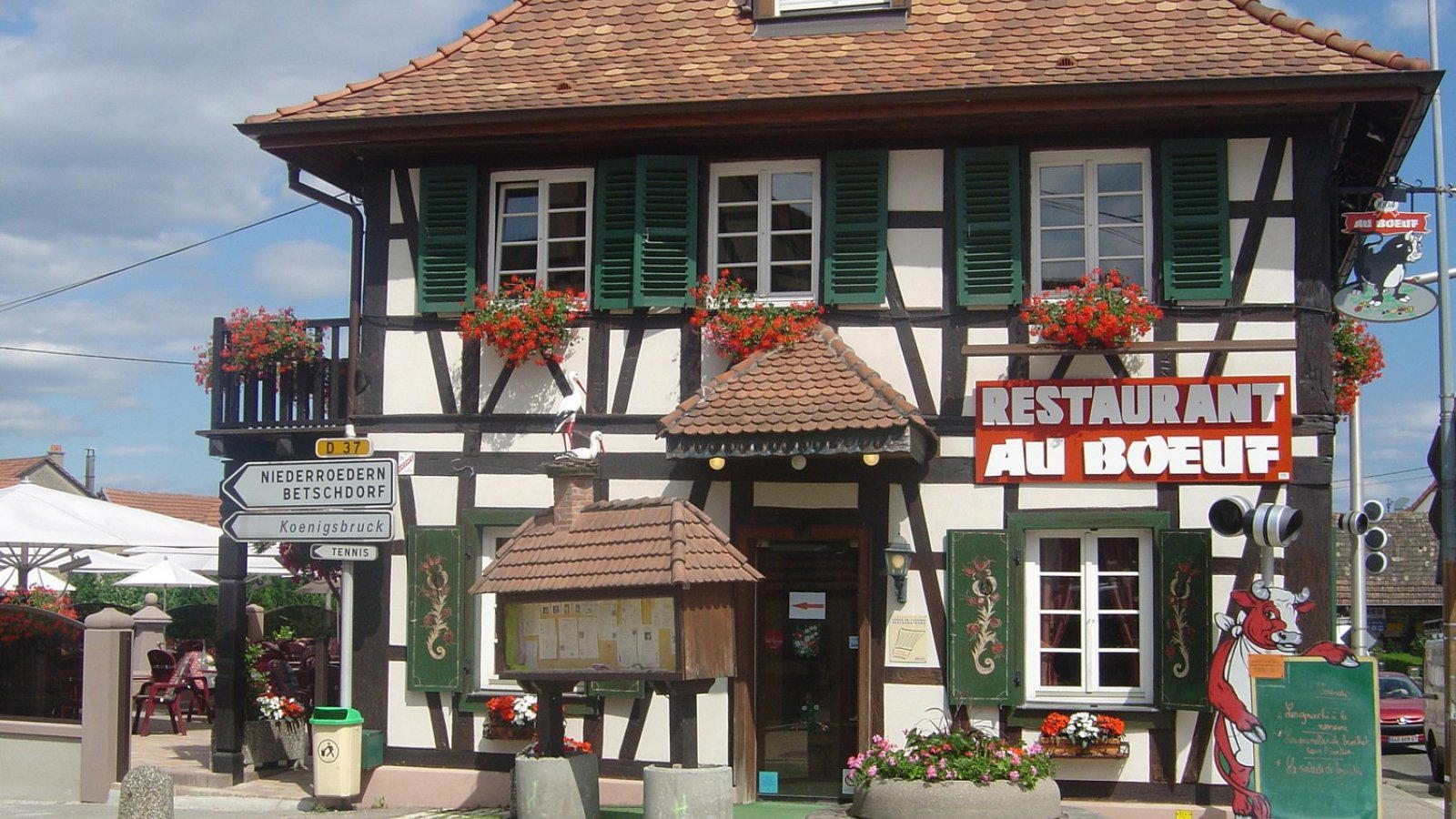
Where the Northern Alsatian Table Begins
Soufflenheim sits in the Bas-Rhin about fifteen kilometres south of Lauterbourg and close enough to the German border that the cultural register shifts perceptibly from French Alsace toward something genuinely hyphenated. The village is primarily associated with its earthenware pottery, a craft tradition that has kept it on regional maps for centuries, but the Grand Rue that runs through its centre has long supported the kind of anchoring local restaurant that every mid-sized Alsatian commune tends to produce: places where the cooking reflects the immediate land rather than any metropolitan ambition. Au Boeuf, at number 48 on that main street, belongs to this category. It functions in a different register entirely, one defined by regional fidelity and the particular pantry of the northern Rhine plain.
The Ingredient Geography of the Bas-Rhin
Understanding what ends up on the plate at a restaurant like Au Boeuf requires understanding the agricultural character of the territory around it. The Bas-Rhin is a department of notable ingredient density. To the west, the Vosges foothills provide forest game, mushrooms in season, and the kind of free-range poultry that Alsatian cooking has historically leaned on. The Rhine plain itself, flat and fertile, supports vegetable cultivation and pig farming that underpins the region's charcuterie traditions. The river and its tributaries have historically contributed freshwater fish, though that element of the table is less dominant than it once was.
This is the sourcing reality that shapes Alsatian cooking in the north of the department: ingredients travel short distances because the geography makes short distances productive. The result is a cuisine that feels place-specific in a way that larger, more cosmopolitan French restaurant traditions often do not. Compare this to the produce-driven sourcing arguments made by destination addresses like Bras in Laguiole, where foraging and terroir sourcing are articulated as a deliberate creative philosophy. In Soufflenheim, the same principle operates, but without the philosophical framing: local sourcing here is simply the default, shaped by what the land around the village reliably produces.
Alsace's larder also carries a strong German imprint. Pork preparations, including baeckeoffe, flammekueche, and the broader charcuterie tradition, reflect centuries of Franco-German cultural overlap. The village's proximity to the border means that the ingredient vocabulary has always drawn from both sides, and a restaurant rooted in this locality would reflect that duality in what it serves and how it prepares it.
Placing Au Boeuf in the Regional Restaurant Hierarchy
The Alsace restaurant scene stratifies sharply. At the apex sit a handful of addresses with sustained Michelin recognition and international reputations, among them Auberge de l'Ill in Illhaeusern, which has held three stars for decades and represents the formal, haute tradition of Alsatian cooking. Below that level, a broader category of respected regional tables operates: places with serious kitchens, loyal local clientele, and cooking that reflects the department's character without reaching for the kind of recognition that demands travel from Paris or abroad.
The restaurant addresses on the Grand Rue suggest a mid-tier positioning in the regional hierarchy, the kind of address where Soufflenheim residents eat for Sunday lunch and visitors to the Alsatian north stop when they want something more rooted than a tourist-facing winstub. France's regional restaurant culture has always depended on this intermediate tier, and some of the country's most instructive eating happens in rooms that have no particular interest in attracting critics. For readers accustomed to the grand statement restaurants featured in our wider France coverage, including Alléno Paris au Pavillon Ledoyen or Troisgros in Ouches, the restaurant operates at a completely different register: it is about geography, not gastronomy as performance.
The Atmosphere a Northern Alsatian Main Street Produces
Main-street restaurants in Alsatian villages share certain environmental characteristics. The architecture of the Bas-Rhin tends toward half-timbering, painted shutters, and interiors that retain wood panelling and tiled floors from earlier eras of construction. The dining rooms are typically warm in the literal sense, designed for the cold months that define this part of France, and the pace of service tends to reflect local rather than metropolitan expectations. Lunch runs long; the rhythm is set by regulars rather than by turnover pressure.
For visitors arriving from Strasbourg, roughly thirty kilometres to the south, Soufflenheim reads as genuinely small-town Alsace: a place where the pottery workshops still draw day-trippers and the restaurant on the main street is not performing a version of the region for outsiders but serving the region to the people who live in it. That is a specific and increasingly uncommon quality in French regional dining, where tourist pressure in more visited areas has reshaped menus and service to meet outside expectations. The northern Bas-Rhin has largely been spared that pressure, and restaurants like Au Boeuf reflect the fact.
Planning a Visit
Soufflenheim is accessible from Strasbourg by road in under forty minutes, and the village sits within a cluster of Alsatian communities worth combining into a longer drive through the northern Rhine plain. The pottery heritage makes it a logical stop on any itinerary covering the region's craft traditions alongside its table. As with most village restaurants in this part of France, advance contact is advisable, particularly for weekend lunch when local demand is highest.
Readers building a wider Alsace itinerary around serious eating should note that the region's most celebrated addresses, including Auberge de l'Ill, sit within range, and the contrast between a three-star destination and a village table like Au Boeuf is itself an instructive read on how French regional cooking distributes across its geography. Elsewhere in France, comparable regional anchoring can be found at Maison Lameloise in Chagny, Georges Blanc in Vonnas, and Auberge du Vieux Puits in Fontjoncouse, each of which translates a specific regional ingredient logic into a recognisable dining identity.
Comparison Snapshot
Comparable venues nearby, for context on price, style, and recognition.
| Venue | Cuisine | Price | Notes |
|---|---|---|---|
| Au BoeufThis venue — the venue you are viewing | Traditional Alsatian French | $$ | Not listed |
| Au Tonneau Fleuri | Traditional French Bistro with Alsatian Flavors | $$ | Salmbach |
| Porcus | Alsatian Charcuterie & Choucroute | $$ | Centre |
| L'Oignon | Traditional French Alsatian | $$ | Centre |
| Le Meisenberg | Traditional Alsatian French | $$ | Chatenois |
| Le Petit Canard | Traditional French Duck Bistro | $$$ | 9th arrondissement |
Continue exploring
More in Soufflenheim
Restaurants in Soufflenheim
Browse all →
Bars in Soufflenheim
Browse all →
Hotels in Soufflenheim
Browse all →
At a Glance
- Rustic
- Cozy
- Classic
- Family
- Group Dining
- Casual Hangout
- Terrace
- Open Kitchen
- Private Dining
Current opening hours
- Monday
- 11:30 AM–9:30 PM
- Tuesday
- 11:30 AM–9:30 PM
- Wednesday
- 11:30 AM–9:30 PM
- Thursday
- 11:30 AM–9:30 PM
- Friday
- 11:30 AM–9:30 PM
- Saturday
- 11:30 AM–9:30 PM
- Sunday
- 11:30 AM–9:30 PM
Hours can change for holidays and private events. Last verified .
Slightly purring atmosphere in a typical Alsatian half-timbered house with a shaded flowered terrace and air-conditioned winstub.