Afhaalcentrum Warung Melatie
On Vierambachtsstraat in Rotterdam's Delfshaven-adjacent west, Afhaalcentrum Warung Melatie represents the city's long-running tradition of Indonesian takeaway culture rooted in post-colonial migration history. Rotterdam's Surinamese and Indonesian communities have shaped the city's everyday food scene for decades, and warung-style counters like this one sit at the working core of that tradition — unpretentious, ingredient-driven, and deeply local.
Pearl is the En Primeur Club membership app — saves, bookings, and concierge access live there. Same editors, same standards.
- Address
- Vierambachtsstraat 80, 3023 AS Rotterdam, Netherlands
- Phone
- +31 10 425 7464
- Website
- warungmelatie.nl
- Directions
- Get directions
 Saves & bookings on Pearl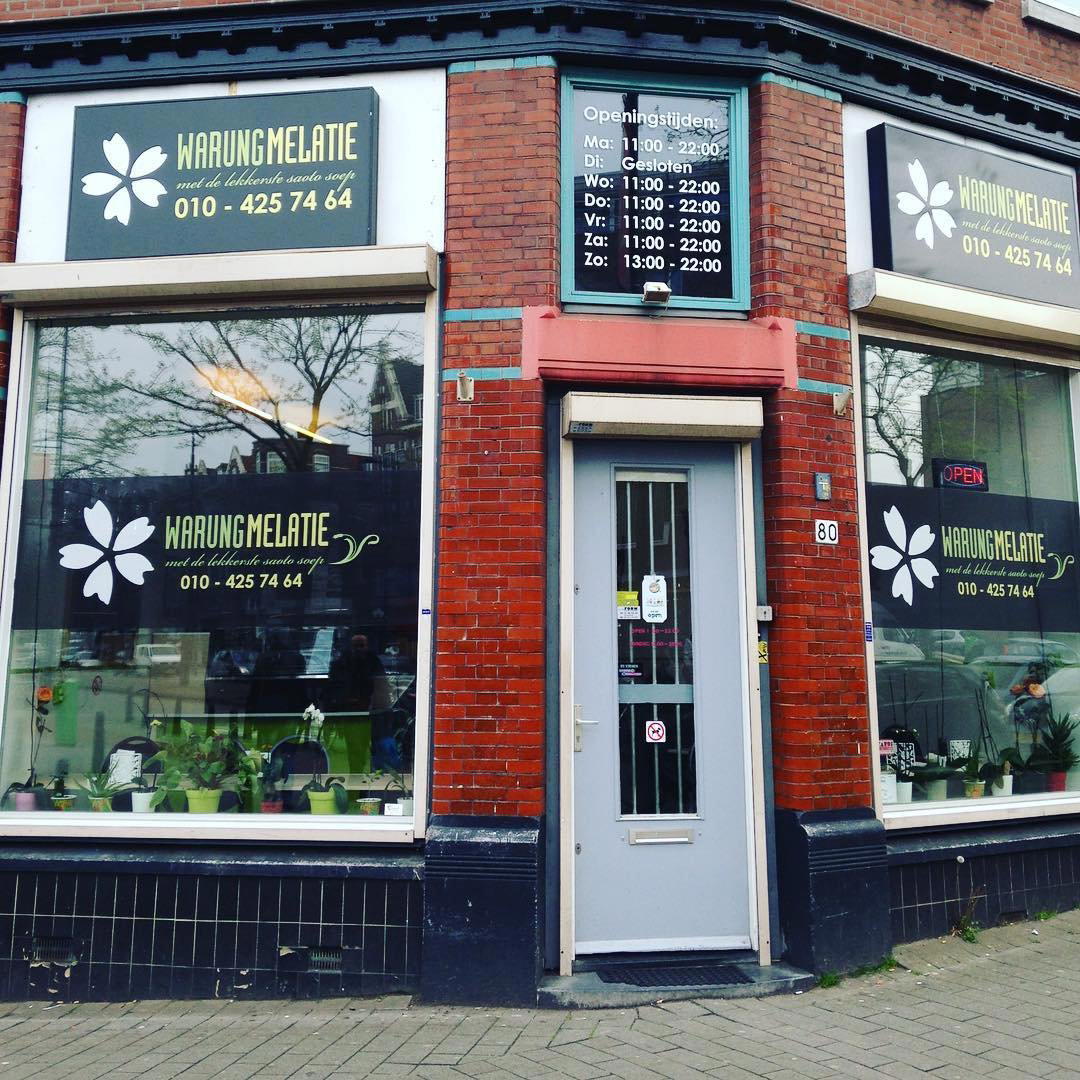
Rotterdam's Indonesian Takeaway Tradition, and Where Warung Melatie Fits
The word warung carries more weight in the Netherlands than it does almost anywhere else in Western Europe. Brought by Indonesian and Surinamese migrants over the course of the twentieth century, the warung format — a compact, counter-led operation focused on rice-table combinations, braised proteins, and sambal-heavy condiments — became embedded in Dutch urban food culture well before the current wave of global cuisine curiosity. In Rotterdam, where post-colonial migration shaped entire neighbourhoods, these counters function less as novelty and more as infrastructure. Afhaalcentrum Warung Melatie, on Vierambachtsstraat in the city's western districts, operates within that tradition.
This part of Rotterdam sits west of the city centre, in a zone where everyday commerce and residential density overlap. The street-level character here is practical rather than curated, this is not the design-forward dining corridor of the Witte de Withstraat, nor the tourist-facing waterfront. A warung counter on Vierambachtsstraat is, by definition, oriented toward a local clientele who know what they want and return for consistency rather than novelty. That orientation matters when assessing what these venues actually do well: the regularity of sourcing, the stability of recipes across years of service, and the depth of a menu built on Indonesian culinary logic rather than adapted to outside expectations.
The Ingredient Logic Behind Warung Cooking
Indonesian cuisine, particularly in its Dutch-diaspora form, draws from a sourcing and preparation tradition that prioritises layered flavour over single-ingredient showcase. Tempeh arrives fermented, not fried to a generic crisp, its soy base carries acidity and depth that varies by producer and fermentation time. Rendang depends on extended dry-cooking that concentrates coconut milk, lemongrass, galangal, and chilli into a coating rather than a sauce; the quality of the result is inseparable from the patience of the process. Sambal, the condiment category that underpins most warung plates, spans dozens of regional variants in Indonesia and functions in Dutch warung culture as both flavour agent and a marker of a kitchen's seriousness.
For a counter-format operation like Afhaalcentrum Warung Melatie, the sourcing reality is typically tied to a network of Dutch-Indonesian specialty suppliers concentrated in cities like Rotterdam, Amsterdam, and The Hague, the three cities with the largest Indonesian-heritage populations in the Netherlands. Ingredients including tempeh blocks, ketjap manis, and fresh aromatics like sereh and daun salam move through this supply network in ways that differ substantially from what a generic Asian grocer might stock. The distinction shows on the plate. A warung that sources correctly produces a nasi rames or gado-gado that reads as coherent rather than assembled, each component calibrated to sit alongside the others.
Where This Counter Sits in Rotterdam's Broader Dining Map
Rotterdam's fine dining tier is anchored by houses like Parkheuvel, FG - François Geurds, and Fred, all operating at the €€€€ tier with tasting menus and Michelin recognition. Amarone and Fitzgerald occupy a comparable register in the Modern French bracket. These venues collectively represent one side of Rotterdam's dining identity: the ambitious, internationally benchmarked end that competes for recognition against De Librije in Zwolle, Inter Scaldes in Kruiningen, and De Nieuwe Winkel in Nijmegen.
Warung Melatie operates at an entirely different register, and that is precisely the point. The Indonesian and Surinamese takeaway sector in Rotterdam represents a parallel food culture with its own lineage, its own quality signals, and its own form of expertise. Recognising both tiers as serious, one formal and award-seeking, the other community-rooted and daily-use, is how a city like Rotterdam actually functions as a food city. The comparison venues referenced above are relevant for a different kind of meal decision. Afhaalcentrum Warung Melatie answers a different question.
Across the Netherlands, the warung tier has received increasing editorial attention in recent years, with publications and food writers noting that Dutch-Indonesian cooking represents one of the country's most historically significant and technically coherent culinary traditions. Venues operating in this category in smaller Dutch cities, from De Lindehof in Nuenen to operations in Staphorst such as De Groene Lantaarn, reflect how regional Dutch food culture sustains itself through specificity rather than convergence. The warung format is its own version of that specificity.
Practical Notes for Visiting
Afhaalcentrum Warung Melatie is located at Vierambachtsstraat 80, 3023 AS Rotterdam. The afhaalcentrum designation in the name signals a takeaway-oriented operation, the Dutch term literally means collection centre or takeaway point, which shapes expectations around seating, service pace, and format. Visitors planning around this counter should treat it as a takeaway-first destination rather than a sit-down dining experience. For context on the wider Rotterdam restaurant picture, including formal reservations and tasting menu venues, our full Rotterdam restaurants guide covers the range from counter dining to multi-course tasting formats.
For those exploring the Dutch fine dining circuit beyond Rotterdam, the broader landscape includes recognised venues such as Tribeca in Heeze, Brut172 in Reijmerstok, De Bokkedoorns in Overveen, De Treeswijkhoeve in Waalre, and De Lindehof in Giethoorn. Internationally, counter-format dining at a high level is well represented by venues like Le Bernardin in New York City and Lazy Bear in San Francisco, though both sit in an entirely different category and price tier.
Continue exploring
More in Rotterdam
Restaurants in Rotterdam
Browse all →
Bars in Rotterdam
Browse all →
Hotels in Rotterdam
Browse all →
Wineries in Rotterdam
Browse all →
At a Glance
- Lively
- Casual
- Casual Hangout
- Solo
- Group Dining
Current opening hours
- Monday
- 12–8 PM
- Tuesday
- Closed
- Wednesday
- 12–8 PM
- Thursday
- 12–8 PM
- Friday
- 12–8 PM
- Saturday
- 12–8 PM
- Sunday
- 12–8 PM
Hours can change for holidays and private events. Last verified .
Casual and bustling takeout atmosphere with consistently crowded service but minimal wait times.
Know Before You Go
- Getting there
- Vierambachtsstraat 80, 3023 AS Rotterdam, Netherlands