영동 설렁탕
Our verdict
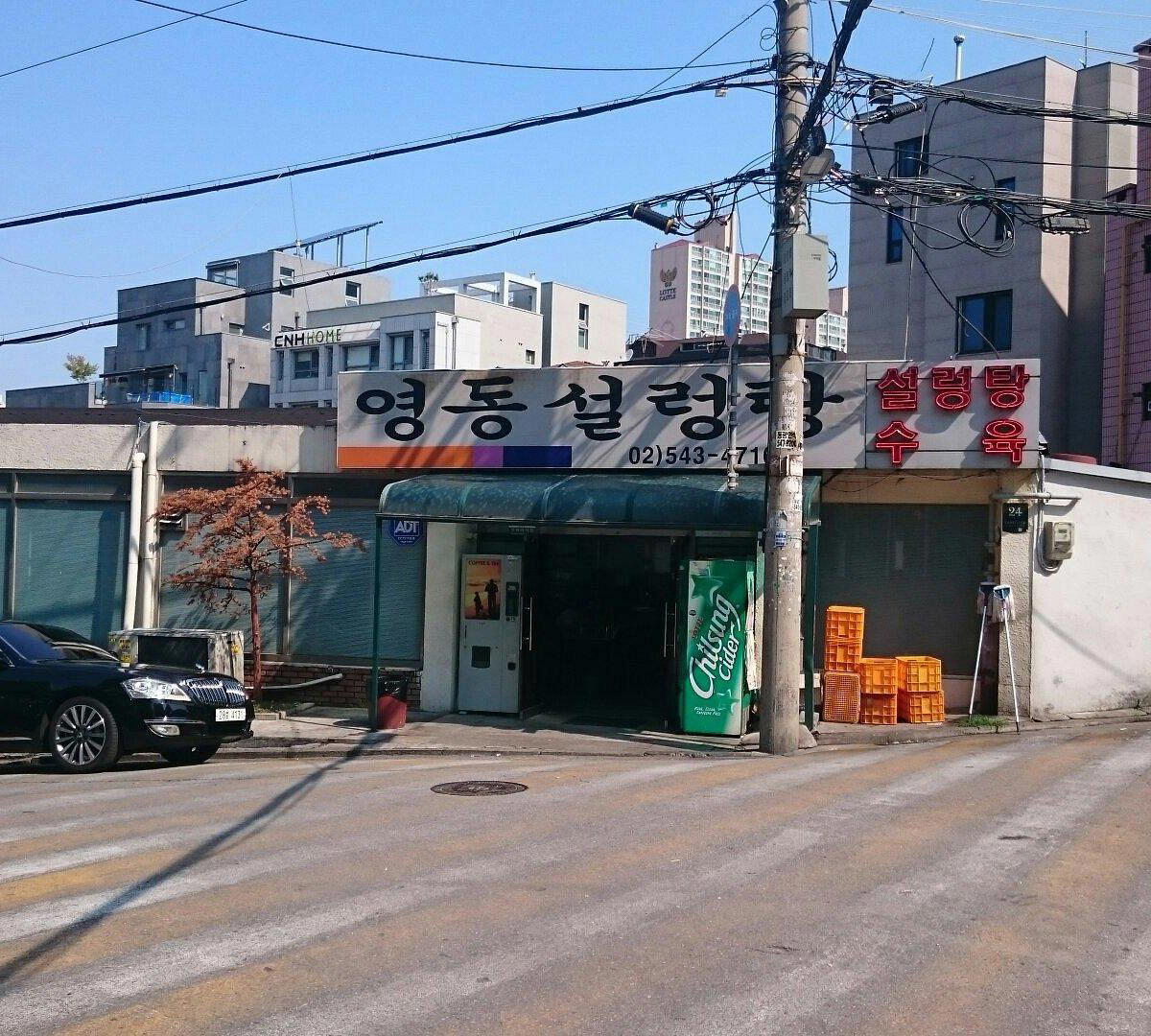
영동 설렁탕 sits in Jamwon-dong, one of Seoul's quieter residential pockets south of the Han River, serving the slow-simmered ox bone soup that has anchored Korean comfort food for generations. The restaurant represents the neighbourhood seolleongtang tradition at its most grounded: minimal theatre, deep broth, and a format that has changed little because there has been little reason to change it.

Pearl is the En Primeur Club membership app — saves, bookings, and concierge access live there. Same editors, same standards.
- Address
- 잠원동, 서울특별시, 서울특별시, 06525
- Directions
- Get directions
The menu
What to order
- Seolleongtang
- Sukyuk
Where Seoul's Broth Culture Takes Its Longest View
In a city that has absorbed every wave of global dining — from the Michelin constellation now clustered in Gangnam to the tasting-menu ambition of places like Mingles and Jungsik (Contemporary) — it is the seolleongtang restaurants that have changed least and perhaps argued their case most quietly. 영동 설렁탕 operates in Jamwon-dong, a residential neighbourhood on the south bank of the Han River where the dining conversation runs toward the practical rather than the performative. The streets here are not lined with chef-driven concept restaurants. They serve a neighbourhood, and that constraint has historically produced a more honest version of Korean everyday food than anything you will find on a tasting-menu circuit.
Seolleongtang itself is one of the most demanding preparations in the Korean kitchen: ox bones simmered for hours, sometimes through the night, until the broth turns milky white from collagen and marrow. The diner seasons the bowl at the table with salt, doenjang, or sliced green onion, a finishing ritual that keeps the kitchen's version neutral and the bowl personal. This is a category of food defined by restraint in production and trust in the eater, which puts it at the opposite end of the spectrum from the plated precision of Soigné (Innovative) or alla prima (Innovative).
The Evolution of a Neighbourhood Standard
The trajectory of seolleongtang restaurants in Seoul over the past three decades illustrates a pattern familiar across Asian food cities: the format that seemed most at risk from modernisation has, in many cases, proven most durable. In the 1980s and 1990s, seolleongtang houses were embedded in every residential quarter of the city, functioning as something between a canteen and a community anchor. As Seoul's dining culture grew more stratified through the 2000s and 2010s, the category split. A handful of long-running operations in central and northern Seoul, Gwanghwamun-area shops in particular, gained documentary attention and queues of visitors. Others, particularly in newer southern neighbourhoods, remained quiet fixtures of local life without ever entering the wider dining conversation.
영동 설렁탕 belongs to the latter cohort. Its Jamwon-dong address places it south of the river, away from the tourist circuits around Insadong or the fine-dining concentration in Cheongdam. The evolution here has not been about reinvention. It has been about the slower, less visible shift in what this kind of restaurant represents as Seoul's food culture has matured: a deliberate counter-position to novelty, where the measure of quality is consistency of broth rather than innovation of format. In a city where Korean cuisine is increasingly exported and reinterpreted, see what Atomix in New York City does with Korean fine dining, or the global reputation built by Le Bernardin in New York City in a parallel French tradition, the neighbourhood seolleongtang house holds a different kind of authority.
That authority is not about awards or chef credentials. It is about the accumulated logic of a kitchen that has made the same preparation long enough to understand its variables: the quality of the bones, the water temperature, the length of the simmer, the balance of ox foot to knuckle. These are not things visible on a plate. They arrive in a bowl.
Seoul's Broader Korean Food Spectrum
Jamwon-dong sits within a wider geography of serious Korean eating south of the Han. Suwon, an hour out, has its own meat traditions, Gobojeong Galbi #1 (가보정 1관) in 수원시 and Doosoogobang in Suwon represent the galbi and slow-cooked pork traditions of that city. Jeju has its own registers entirely: 88돼지 in 제주시 and Black Pork BBQ in Seogwipo centre on the island's black pork, while Badang Lounge in Jeju takes a different direction toward the coastal. Gyeongju offers its own grain and legume traditions through places like Gyeongju Wonjo Kongguk (경주원조콩국) in 경주시 and the baked goods lineage documented at Hwangnam Bread and Busan Steamed Bun in Gyeongju. Busan has its own seafood and stew registers, visible at Mori in Busan and Dining Room (다이닝룸) in 부산광역시.
Within Seoul itself, the high-end Korean table has its own parallel development. Kwonsooksoo (Korean) represents the refined hanshik direction. These are the restaurants that translate Korean culinary logic into a tasting-menu format. Seolleongtang houses operate on entirely different premises, and the fact that both formats exist, and are both taken seriously, says something about the range Seoul now accommodates. For a broader map of where these fit, our full Seoul restaurants guide charts the full spectrum.
Further afield in the Korean fine-dining diaspora, venues like Hinode (히노데) in 서귀포시 show how Japanese technique has been absorbed into the Jeju dining scene, another thread in the broader story of how Korean culinary identity absorbs and adapts external influences while maintaining its own registers.
What the Format Asks of the Diner
Eating at a seolleongtang restaurant requires a different posture than a tasting-menu dinner. There is no prescribed sequence, no chef narrative delivered course by course. The bowl arrives hot and milky, accompanied by kimchi, radish, and rice. The diner decides how to season and in what order to eat. This is food that rewards attention but does not demand it, a format that has always served early-morning workers, late-night returnees, and everyone between. The category has historically held prices at a level accessible across income brackets, though the gap between neighbourhood houses and well-documented central Seoul shops has widened as the latter have acquired reputations that allow for higher throughput and occasionally higher prices.
Know Before You Go
- Location: Jamwon-dong, Seoul (postal code 06525)
- Neighbourhood: South of the Han River, residential Seocho district
- Category: Seolleongtang (ox bone broth soup)
- Price range: Not confirmed, typical neighbourhood seolleongtang houses in Seoul price per bowl in the ₩8,000–₩15,000 range, but verify locally
- Booking: Seolleongtang houses in this category generally operate walk-in; confirm directly
- Hours: Not confirmed, contact or visit to verify
- Phone/Website:Mingles and Kwonsooksoo (Korean) show how different the fine-dining end of the same cuisine operates.
- Should I book 영동 설렁탕 in advance?
- Seolleongtang restaurants in residential Seoul neighbourhoods typically operate as walk-in establishments rather than reservation venues. That said, peak meal times, particularly weekend mornings and lunch hours, can generate queues at well-regarded neighbourhood shops. If you are visiting from abroad and building an itinerary around specific Seoul dining stops, it is worth confirming the current policy directly, as practices vary. For comparison, the tasting-menu venues in Seoul's fine-dining tier, such as Jungsik (Contemporary), require advance booking weeks out.
- What's the signature at 영동 설렁탕?
- The signature of any seolleongtang house is the broth itself, a preparation that cannot be rushed and cannot be faked. The milky white colour that defines a properly made bowl comes from the extended simmering of collagen-rich ox bones, not from any additive. At Jamwon-dong establishments in this category, the broth is accompanied by sliced beef, rice, and banchan. The Seoul seolleongtang tradition is documented in detail across food media, and 영동 설렁탕 operates within that tradition rather than departing from it.
- How does 영동 설렁탕 fit into Jamwon-dong's dining scene, and is it worth visiting from central Seoul?
- Jamwon-dong sits in the Seocho district south of the Han River, a primarily residential area with fewer dedicated dining destinations than Gangnam or the historic northern quarters. For visitors already exploring this part of the city, near the Han River parks or travelling between central Seoul and the southern districts, 영동 설렁탕 represents the neighbourhood seolleongtang tradition in a less touristic context than the well-documented shops near Gwanghwamun. Those making a dedicated trip specifically for seolleongtang might weigh this against the more historically documented central Seoul options, though the Jamwon-dong setting offers a more local register of the experience.
Frequently asked questions
What's the address for 영동 설렁탕?
영동 설렁탕 is located at 잠원동, 서울특별시, 서울특별시, 06525, Seoul.
How does 영동 설렁탕 fit into the broader Korean dining scene south of the Han River?
Jamwon-dong sits in a corridor of serious, workaday Korean eating that runs alongside the more Michelin-focused dining concentrated in Gangnam proper. Seolleongtang restaurants in this area represent a different register entirely — no tasting menus, no chef narrative — just a format that Seoul has refined over generations. 영동 설렁탕's Jamwon-dong location places it within that neighbourhood eating culture rather than the city's fine-dining circuit.
What's the must-try dish at 영동 설렁탕?
Seolleongtang is the reason to come. The format at restaurants like this one in Jamwon-dong is built around a single bowl: ox bone broth, slow-simmered to opacity, served with rice and banchan on the side. The seasoning — salt, scallion, black pepper — is added by the diner at the table, which is standard practice across Seoul's seolleongtang houses.
Should I book 영동 설렁탕 in advance?
No booking information is published for 영동 설렁탕, and seolleongtang restaurants in Jamwon-dong and the broader Gangnam-area neighbourhoods typically operate on a walk-in basis. Arriving outside the 12–1pm and 6–7pm peak windows will generally reduce wait times at this format of Seoul dining spot.
What's the signature at 영동 설렁탕?
The signature is the broth itself. Seolleongtang is defined by hours of boiling ox bones and brisket until the collagen breaks down into a milky, almost cream-coloured stock — a technique that separates it from the clearer gomtang. At a Jamwon-dong address like this, the format is stripped back by design: the bowl is the whole point.
Booking and Cost Snapshot
| Venue | Cuisine | Price | Awards | Notes |
|---|---|---|---|---|
| 영동 설렁탕This venue — the venue you are viewing | Traditional Korean Seolleongtang | $10–20 | Not listed | Not listed |
| 7th Door | Modern Korean Fermentation Fine Dining | $100–150 | 1 Michelin Star · World's 50 Best #49 | Korean, Contemporary |
| Eatanic Garden | Modern Korean Contemporary | $100–150 | 1 Michelin Star · World's 50 Best #26 | Contemporary |
| Onjium | Modern Korean Royal Court Cuisine | Not listed | 1 Michelin Star · World's 50 Best #14 | Korean |
| L'Amitié | Classic French Fine Dining | $100–150 | 1 Michelin Star · La Liste Top Restaurants | French |
| Zero Complex | Modern French Neo-Bistro | $100–150 | 1 Michelin Star · La Liste Top Restaurants | Korean-French, Innovative |
Continue exploring
More in Seoul
Restaurants in Seoul
Browse all →
Details
- Classic
- Rustic
- Lively
- Late Night
- Casual Hangout
- After Work
- Solo
- A La Carte
- Soju
- Beer
- Makgeolli