Su Shien Valley

Relais Chateaux Award
Su Shien Valley sits at the foot of Qingcheng Mountain, one of Taoism's most sacred sites, where dense bamboo forest and mountain mist shape the experience as much as the architecture. Rates from US$277 per night place it in the mid-to-upper tier of retreat-style accommodation in the Chengdu region, where immersion in landscape is the primary offering rather than urban convenience.

Pearl is the En Primeur Club membership app, where members save venues, book tables and use the concierge.
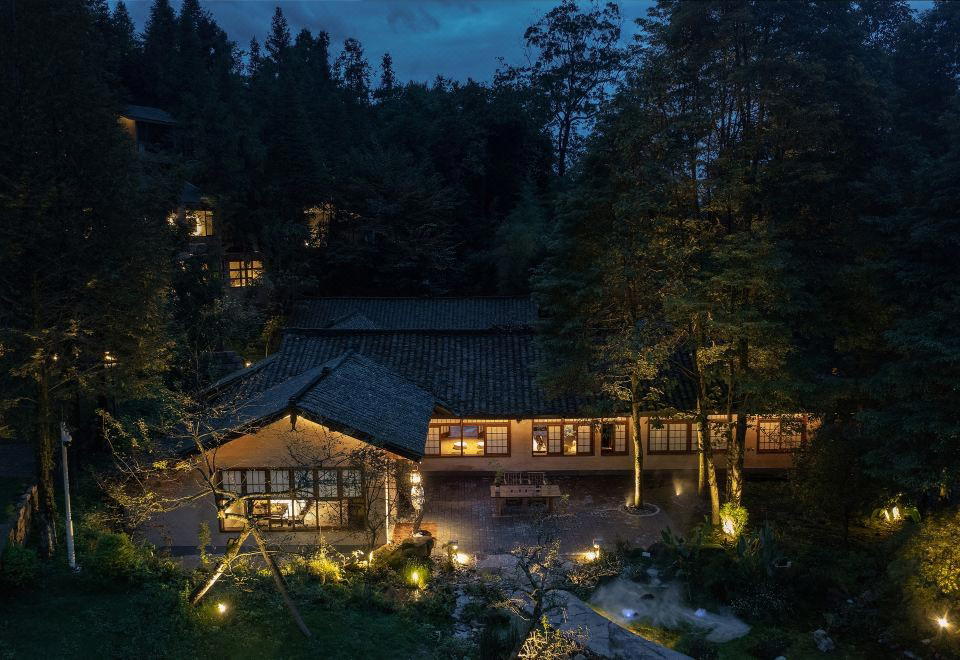
Where the Mountain Does the Work
The approach to Qingcheng Mountain sets the terms before you arrive. The road from Dujiangyan city narrows as it climbs, bamboo pressing in on both sides, the air shifting from the flat Chengdu basin's familiar haze into something cooler and resinous. By the time Su Shien Valley comes into view, the surrounding greenery has already done considerable editorial work on the senses. This is not a coincidence of geography but a structural feature of how mountain retreat properties in this part of Sichuan operate: the site selection is the design decision.
Qingcheng Mountain carries Taoist designation as one of China's four sacred Taoist peaks, and that context shapes every property that positions itself within its boundaries. The mountain draws visitors who are not simply passing through Chengdu's broader tourism circuit but are making a deliberate detour into a slower, more contemplative register. Su Shien Valley sits inside that category, with a location at GPS coordinates 30.9182, 103.3957 that places it deep within the mountain's forested lower reaches rather than at its commercial fringe.
The Architecture of Immersion
The design philosophy legible in mountain retreat properties across this region, and at Su Shien Valley specifically, works by subordinating built form to natural envelope. Rather than imposing a signature architectural statement onto the hillside, the approach favours structures that read as extensions of the forest floor: low profiles, natural materials, and an arrangement that channels views through tree canopy rather than over it. This is a distinct tradition from the grand-terrace luxury of properties like Amanfayun in Hangzhou, which drapes luxury across a heritage village template, or Amandayan in Lijiang, which works with Old Town courtyard typology. At Qingcheng, the forest is the architecture, and the buildings operate as interruptions within it.
Properties in this classification, retreat-format, landscape-dependent, spiritually sited, compete less on amenity lists and more on how completely they dissolve the boundary between interior and exterior. The Sichuan basin's subtropical humidity means that greenery is not a seasonal backdrop but a year-round condition. Moss grows on stone. Canopy filters afternoon light into something diffuse and grey-green. The built environment that works here is one that accepts these conditions rather than resists them, which rules out the glass-and-steel minimalism that reads well in urban contexts like Andaz Shenzhen Bay or JW Marriott Shanghai at Tomorrow Square.
Sichuan Immersion Beyond the Hotpot Circuit
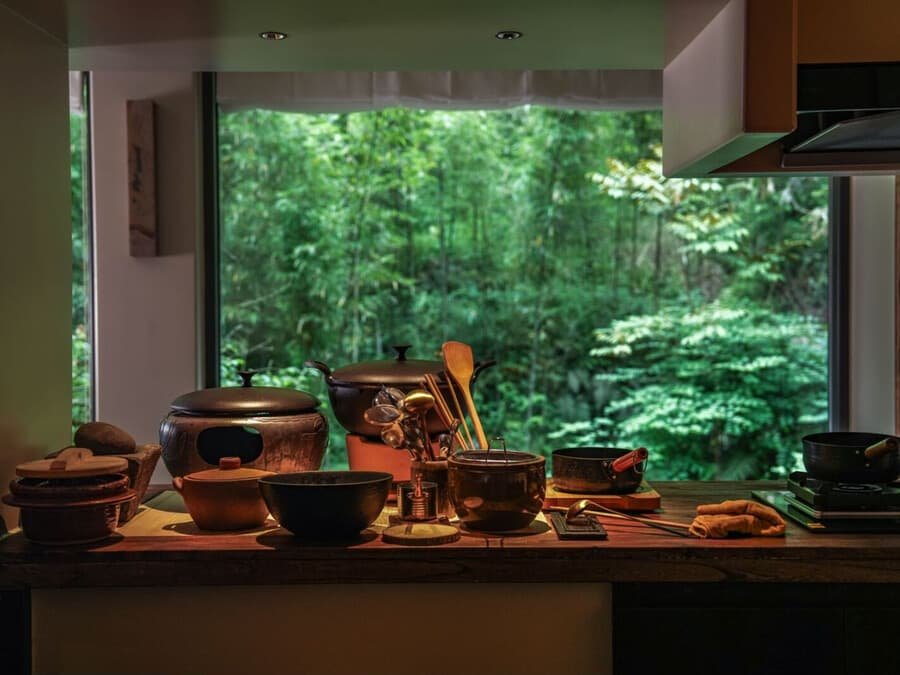
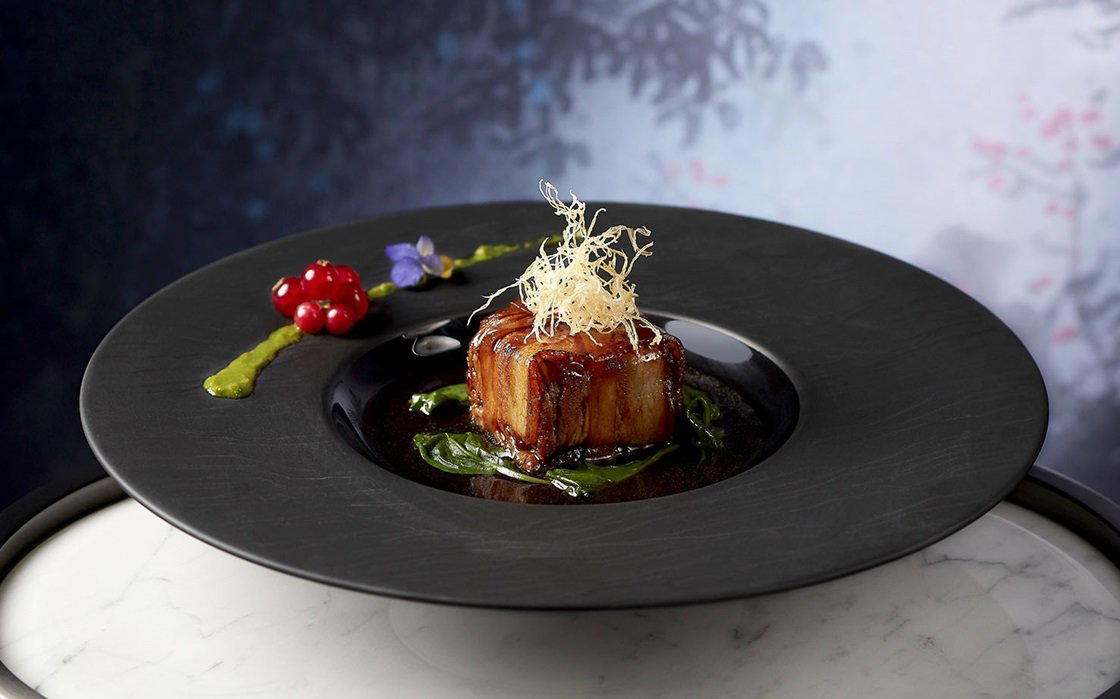
The Chengdu region's reputation rests heavily on its food culture, and that reputation is earned. But Qingcheng Mountain operates at a remove from Chengdu's restaurant density, offering a different register of Sichuan engagement. Mountain temple cuisine, lighter, vegetable-forward, historically tied to Taoist dietary practice, has a centuries-long lineage in this area that sits apart from the mala-heavy mainstream. Properties like Su Shien Valley, positioned as Sichuan immersion experiences, draw on that tradition as a counterpoint to the city's more aggressive flavour register.
For travellers building a Chengdu-region itinerary, this matters because Dujiangyan itself is already on the map for the UNESCO-listed ancient irrigation system at its centre, one of the world's oldest hydraulic engineering projects still in operation. Adding Qingcheng Mountain creates a natural two-stop circuit that covers both the valley floor's engineering heritage and the mountain's spiritual geography. The Qingchengshan Railway Station, accessible from central Chengdu in under an hour by high-speed rail, makes this loop practical without requiring a car. Chengdu Shuangliu International Airport serves as the primary air gateway for international arrivals.
The Retreat Tier in Southwest China
The premium retreat market in China's southwest has developed a recognisable grammar over the past decade. Properties in this tier, rates at Su Shien Valley start from US$277 per night, position against urban luxury hotels not on amenity count but on what they remove: traffic, density, the tempo of city life. The comparison set is less Mandarin Oriental Qianmen in Beijing and more the forest and mountain properties that have proliferated across Yunnan, Sichuan, and Guizhou as China's affluent domestic travel market has developed an appetite for landscape-embedded accommodation.
Within that peer group, proximity to a UNESCO or spiritually significant site functions as a differentiator. Conrad Jiuzhaigou operates adjacent to the Jiuzhaigou Valley World Heritage Site. Banyan Tree Ringha draws its identity from 's Tibetan plateau context. Su Shien Valley's Qingcheng Mountain positioning follows the same logic: the site's spiritual and ecological designation does work that no amenity package could replicate independently. For travellers whose interest runs toward culturally embedded accommodation rather than point-accumulation hotel stays, this positioning is the relevant signal.
For the region's retreat category more broadly, that score is consistent with properties that deliver on atmosphere while operating with a degree of informality in service delivery that larger branded hotels smooth out through standardisation. That trade-off is characteristic of the category, not specific to this address.
Planning a Stay
Access is direct by Chinese transport standards. High-speed rail from Chengdu to Qingchengshan station covers the journey in under an hour, and the station sits close enough to the mountain's base that the transfer is manageable. For international arrivals, Chengdu Shuangliu International Airport is the routing point. Spring and autumn are the preferred seasons on Qingcheng Mountain: summer brings heavy humidity and high visitor volumes associated with Chinese national holidays, while winter reduces crowd pressure but also limits the forest's full visual register. The property's coordinates, 30.9182, 103.3957, place it on the mountain's more sheltered lower flanks.
Rates from US$277 per night position Su Shien Valley at the entry point of the regional premium retreat tier rather than its apex, which makes it a more accessible entry into the format than comparably positioned properties in Yunnan or on Hainan Island, such as 1 Hotel Haitang Bay in Sanya. For a broader map of Sichuan and southwest China accommodation at this tier, the full Dujiangyan guide covers the relevant context. Those extending the trip into other Chinese destinations might also reference Green Lake Hotel Kunming for a city counterpoint in Yunnan, or Elite Spring Villas in Anxi for another landscape-integrated format in a different province.
Quick Comparison
Comparable venues nearby, for context on price, style, and recognition.
| Venue | Cuisine | Price | Awards | Notes |
|---|---|---|---|---|
| Su Shien ValleyThis venue (the venue you are viewing) | Chinese courtyard-style mountain retreat harmonizing traditional architecture with modern luxury | $500–750 | Relais Chateaux Award | Not listed |
| Waldorf Astoria Shanghai Qiantan | Modern urban riverside retreat inspired by cruise ship elegance and Art Deco motifs of sail and peacock. | Not listed | Conde Nast Hot List Hotels | Qiantan |
| Songtsam Tacheng Lodge (松赞塔城山居) | Traditional Tibetan architectural marvel blending heritage with modern comforts. | $200–300 | Not listed | Tacheng |
| Park Hyatt Xi'an | Luxury urban Park Hyatt positioned as a sophisticated home-away-from-home for informed global travelers in a major mixed-use commercial district. | Not listed | Not listed | Qujiang District |
| Hebei Grand Hotel | Modern interpretation of classic Chinese courtyards | $1–100 | Not listed | Zhengding |
| Shangri-La Hotel, Fuzhou | Modern luxury tower hotel | Not listed | Michelin Selected | Gulou District |
Recognition history
Dated appearances from independent guides and award organizations, with the underlying list record or original source where available.
Relais Chateaux Award
Relais Chateaux
Continue exploring
More in Dujiangyan
Hotels in Dujiangyan
All hotels in Dujiangyan →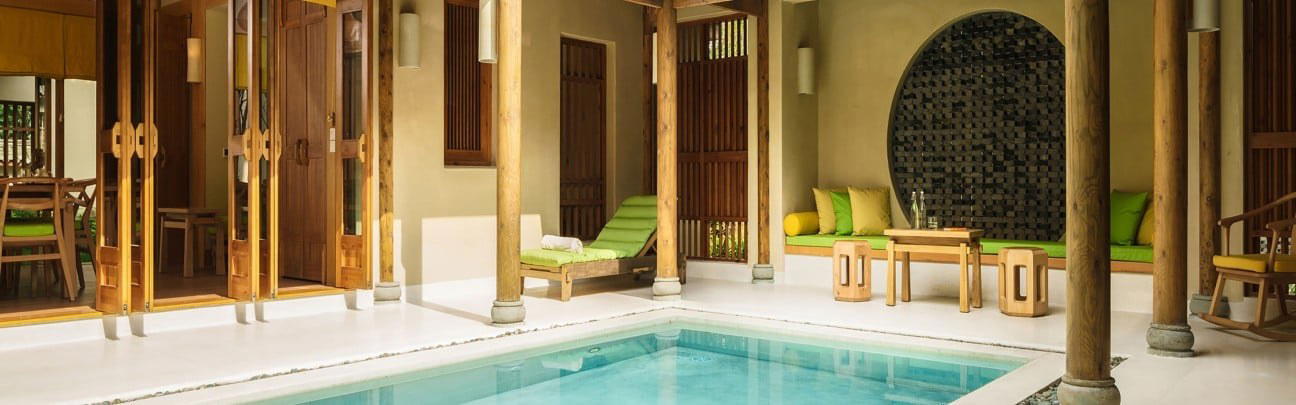
Details
- Quiet
- Scenic
- Elegant
- Intimate
- Rustic
- Sophisticated
- Wellness Retreat
- Romantic Getaway
- Weekend Escape
- Panoramic View
- Private Villa
- Spa
- Wi Fi
- Room Service
- Concierge
- Restaurant
- Air Conditioning
- EV Charging
- Mountain
- Garden
Serene Zen-like atmosphere with natural light, earthy palettes, and profound tranquility amid misty peaks and lush forests, creating restorative environments.