Conrad Jiuzhaigou

Forbes 4-Star
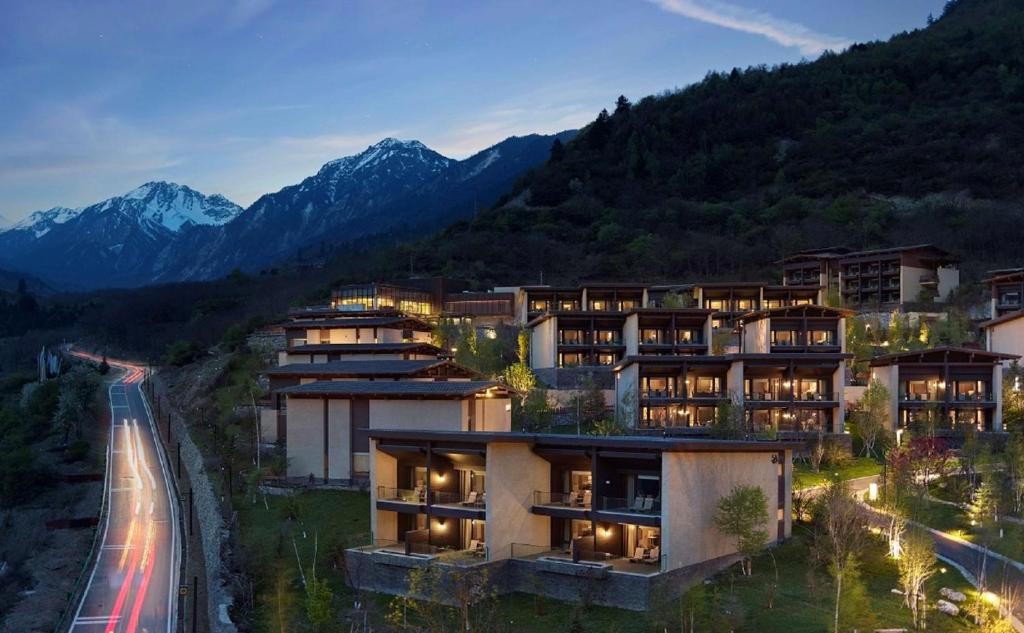
Conrad Jiuzhaigou sits in the Min Mountain foothills within ten miles of the UNESCO-listed Jiuzhaigou Valley, presenting itself first as a cluster of sand-colored village buildings before revealing 161 rooms and villas designed around Amdo Tibetan aesthetics. The property belongs to Hilton's Conrad portfolio and pairs nature-oriented architecture with locally sourced dining at its signature restaurant, Bas. In.

Pearl is the En Primeur Club membership app, where members save venues, book tables and use the concierge.
Where the Min Mountains Shape the Architecture
The approach to Conrad Jiuzhaigou does something that most luxury properties in China's interior do not: it withholds itself. A scatter of low, sand-colored buildings across a hillside reads as a village settlement before it reads as a hotel. That first impression is deliberate. The property draws its design logic from Amdo Tibetan vernacular, a tradition that prizes understated form and deference to terrain over the monumental gestures favored by many international hotel groups operating in the region. Where properties like Rissai Valley, a Ritz-Carlton Reserve in Jiuzhaigou lean into deep-pocketed seclusion, Conrad's approach is legibility through scale and material rather than through grandeur.
The Min Mountains do considerable architectural work here. Floor-to-ceiling windows and spacious private terraces in all 161 rooms and villas are not design flourishes so much as framing devices, orienting the guest's eye toward the rolling foothills that otherwise provide no obvious focal point. Deep-soaking tubs and faux fireplaces anchor the interiors at the opposite register, making the spaces functional retreats from the altitude and temperature shifts that characterize Sichuan's northwest. The furniture sits low throughout, which keeps sightlines to the windows clear and reinforces the property's stated ethos of letting the landscape do the work.
Tibetan Material Culture as Design Vocabulary
Design team's decision to source artifacts and textiles locally rather than apply a generic pan-Asian aesthetic sets Conrad Jiuzhaigou apart from a number of its Hilton-family peers. Original sword handles appear as display objects; wooden furniture is upholstered in boldly patterned fabrics that reference traditional Tibetan weaving; Tibetan motifs recur in wall treatments and floor coverings without tipping into pastiche. This approach places the property in a peer group that includes Amandayan in Lijiang and Amanfayun in Hangzhou, both of which have built their design identities around historical material culture rather than contemporary international luxury codes. Banyan Tree Ringha in takes a comparable position in the Tibetan cultural zone, though it operates at smaller scale and with a more emphatic heritage emphasis.
Flower-patterned rugs and mountain-inspired artworks extend the vocabulary across all 161 keys in a way that avoids repetition without manufacturing variety. The rooms function as a collection of consistent gestures rather than a set of identical templates, which matters at a property where guests are likely to compare notes. At arrival, each guest receives a hada, the white silk scarf that signals welcome and respect in Tibetan custom. The gesture is small, verifiable, and culturally accurate, which is precisely what makes it effective.
Bas. In and the Kitchen as Theater
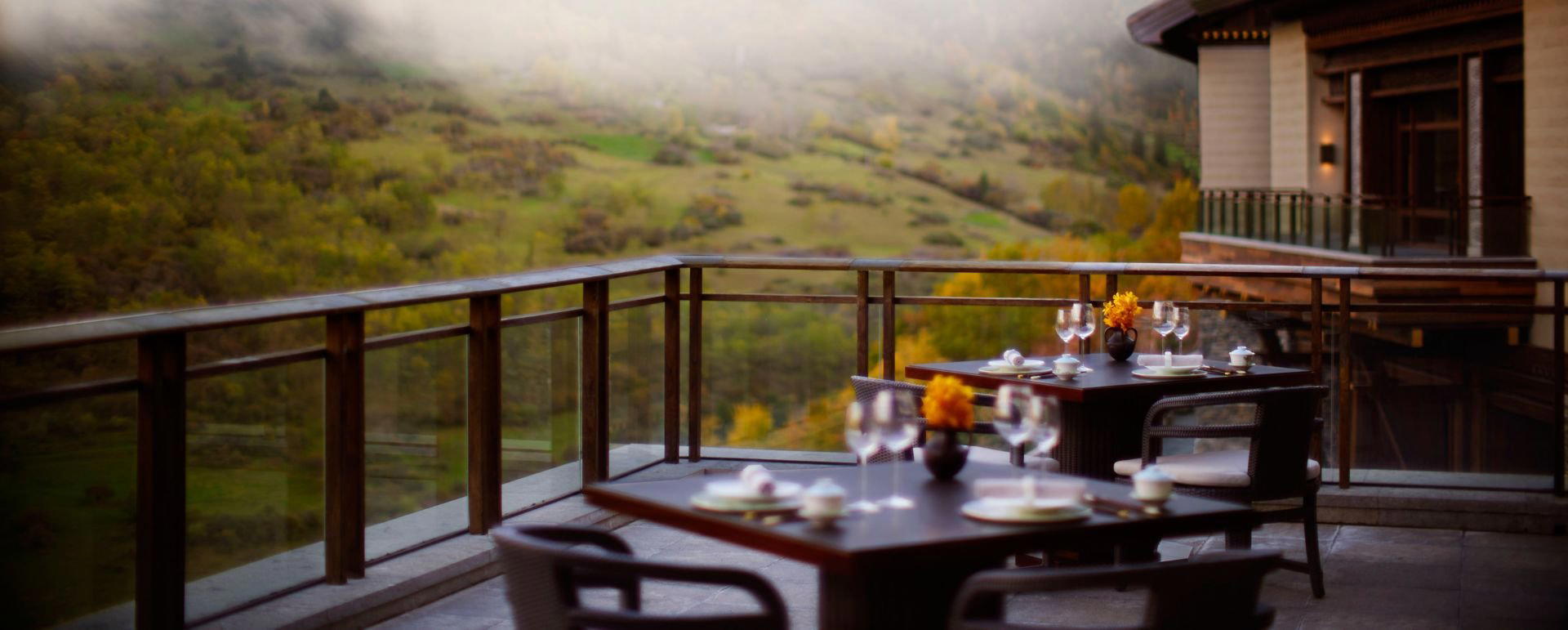
The signature dining venue, Bas. In, continues the property's material logic. Tibetan wood furniture and locally made handicrafts anchor the interior, while live plants and natural materials blur the boundary between room and mountain setting. The restaurant operates with an open, show kitchen as its centerpiece for indoor dining, and a thatched-roof patio for outdoor service where morning breezes off the surrounding hills substitute for any engineered atmosphere. The kitchen sources ingredients locally and prioritizes ethical supply chains, a dining philosophy increasingly common among high-end properties in China's rural and protected-area destinations. Guests who want a broader picture of eating options in the area should consult our full Jiuzhaigou restaurants guide.
The indoor-outdoor split at Bas. In reflects a broader pattern in nature-adjacent luxury hospitality across southwest China, where dining rooms are increasingly designed as thresholds between built and natural environments rather than self-contained fine-dining boxes. Banyan Tree Chongqing Beibei and Elite Spring Villas in Anxi employ similar logic at different price points and landscape contexts.
The Spa and the Case for Slow Exploration
Property's spa reads as an extension of the architectural program rather than an amenity layered on top of it. Treatments draw from locally inspired methods, and the treatment rooms feature floor-to-ceiling windows that maintain the property's consistent relationship with its natural context. The spa is small and intimate rather than a multi-pavilion wellness campus, which positions it correctly for a destination where the primary draw is outside the building. Jiuzhaigou Valley, a UNESCO World Heritage Site, lies under ten miles from the property; the Fairy Pool Scenic Area, a high-altitude cluster of roughly 2,000 alpine lakes and pools, sits under thirty miles away. These are not day-trip distances so much as organizing reasons for the entire visit, and the property's design philosophy is calibrated for guests who will spend their days in the valley and return needing recovery rather than entertainment.
Altitude and remoteness of the Aba Prefecture location mean that Conrad Jiuzhaigou sits in a different competitive context than the Conrad properties operating in China's major urban centers. Conrad Guangzhou, Conrad Tianjin, and Conrad Urumqi each operate against a dense urban hospitality market. The Jiuzhaigou property's peers are more accurately properties like Mohe Youran Mountain Residence in Da Hinggan Ling and Vanke Lake Songhua Yunlu Hotel in Jilin, both of which anchor their offerings around protected natural landscapes in China's less-traveled regions.
Planning a Stay
Property address places it in Lang Zhai Cun, Zhangzha Town, within Jiuzhaigou County in Sichuan's Aba Tibetan and Qiang Autonomous Prefecture. Access typically routes through Jiuzhai Huanglong Airport, which handles seasonal services from several major Chinese cities; overland routes from Chengdu are possible but involve several hours on mountain roads. The Jiuzhaigou Valley itself operates under visitor quotas as part of its UNESCO management framework, so entry tickets to the scenic area should be secured well in advance of arrival, independent of hotel booking. The valley's peak season runs from late summer through autumn when foliage is at its most intense, and the property sees its highest occupancy during this window. Guests traveling for the alpine lakes are often better served by targeting the shoulder periods of late spring or early autumn when crowds thin and conditions remain favorable for walking the boardwalk circuits inside the valley.
Travelers comparing this property against other Hilton-family and premium independent options across China's southwest and broader luxury market may find useful reference points in Mandarin Oriental Qianmen in Beijing, JW Marriott Hotel Shanghai at Tomorrow Square, and 1 Hotel Haitang Bay, Sanya, each of which sits at a different intersection of brand, setting, and design ambition. For mountain-adjacent luxury in the broader region, Xiamen Yunding Resort and Green Lake Hotel Kunming provide useful comparisons at distinct geographic and cultural registers.
How It Stacks Up
Comparable venues nearby, for context on price, style, and recognition.
| Venue | Cuisine | Price | Awards | Notes |
|---|---|---|---|---|
| Conrad JiuzhaigouThis venue (the venue you are viewing) | Modern luxury resort inspired by Tibetan culture | Not listed | Forbes 4-Star | Not listed |
| InterContinental Resort Jiuzhai Paradise | Modern resort with cultural fusion | $100–200 | 1 Michelin Key | Ganhaizi Scenic Zone |
| Rissai Valley, a Ritz-Carlton Reserve | luxury resort with private villas | Not listed | 3 Michelin Keys · Tatler Listed in Best Hotels Asia-Pacific | Jiuzhaigou Valley |
| Hebei Grand Hotel | Modern interpretation of classic Chinese courtyards | $1–100 | Not listed | Zhengding |
| InterContinental Haikou Seaview | Luxury beachfront resort with seaside gardens and marina proximity | Not listed | Michelin Selected | Meilan District |
| Intercontinental Shenzhen Dameisha Resort | Luxury beachfront resort with European-style buildings forming a Mediterranean street. | $200–300 | Michelin Selected | Dameisha |
Recognition history
Dated appearances from independent guides and award organizations, with the underlying list record or original source where available.
Forbes 4-Star
Forbes
Full recognition history (2 entries)
Forbes 4-Star
Forbes
Continue exploring
More in Jiuzhaigou
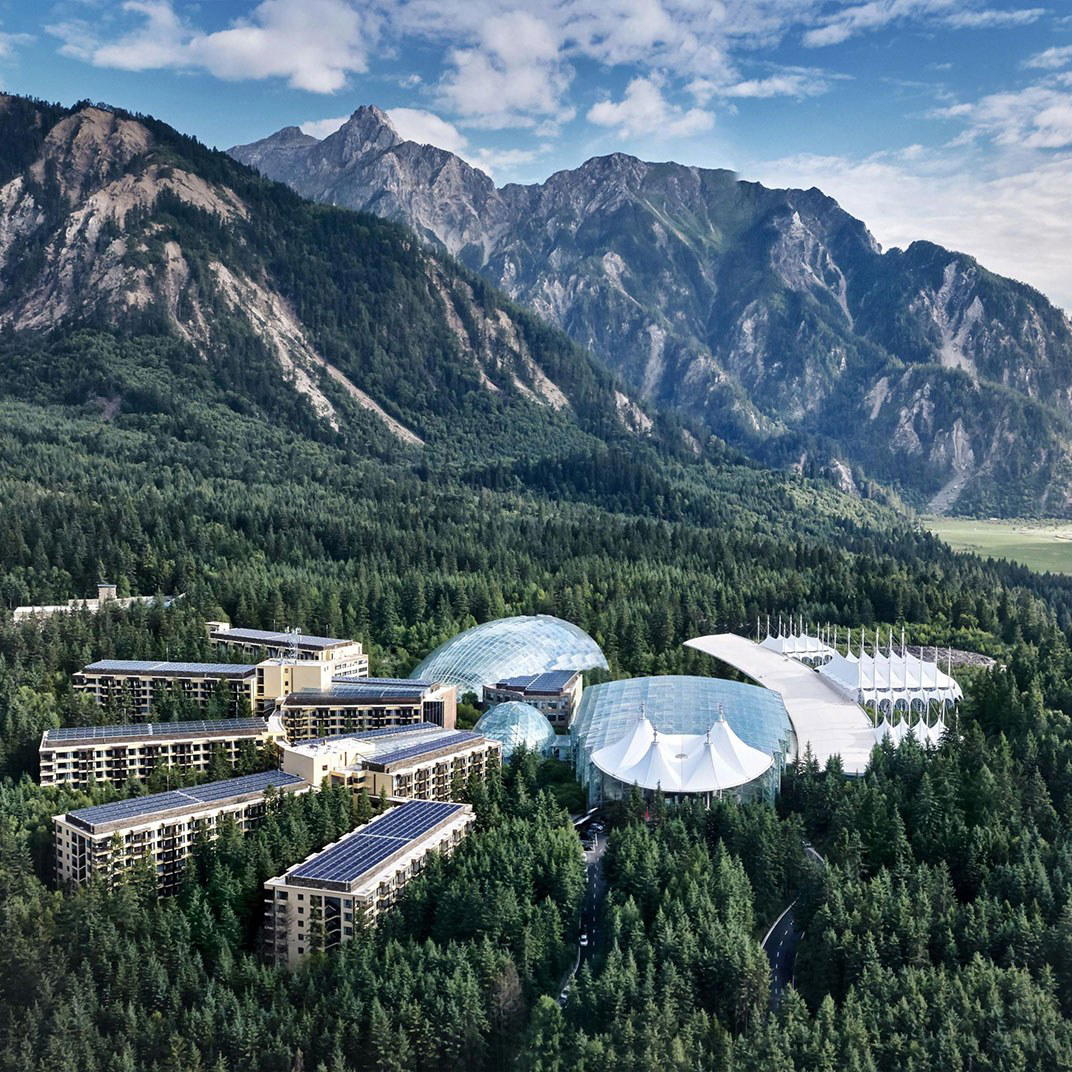
Hotels in Jiuzhaigou
All hotels in Jiuzhaigou →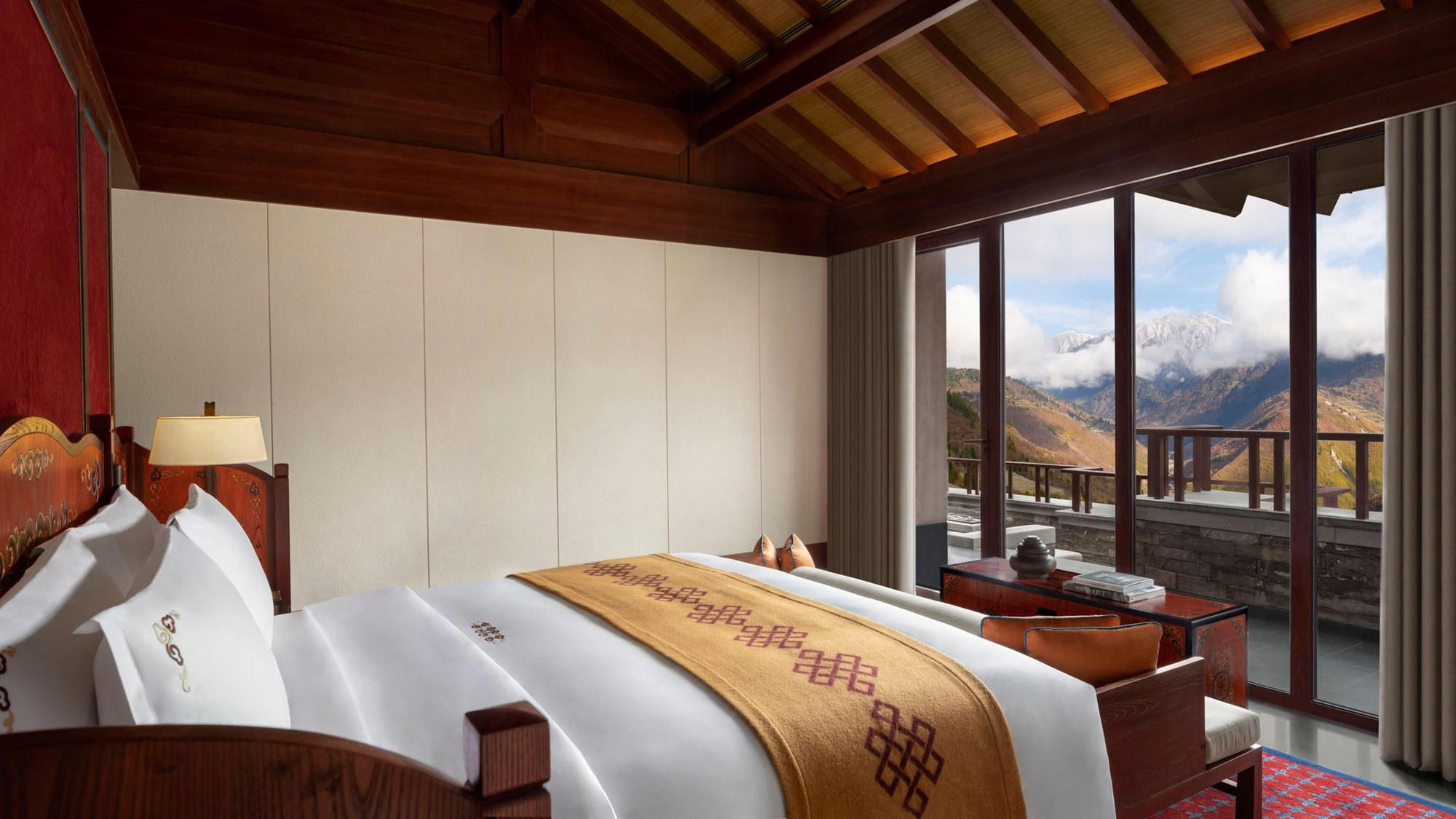
Restaurants in Jiuzhaigou
All restaurants in Jiuzhaigou →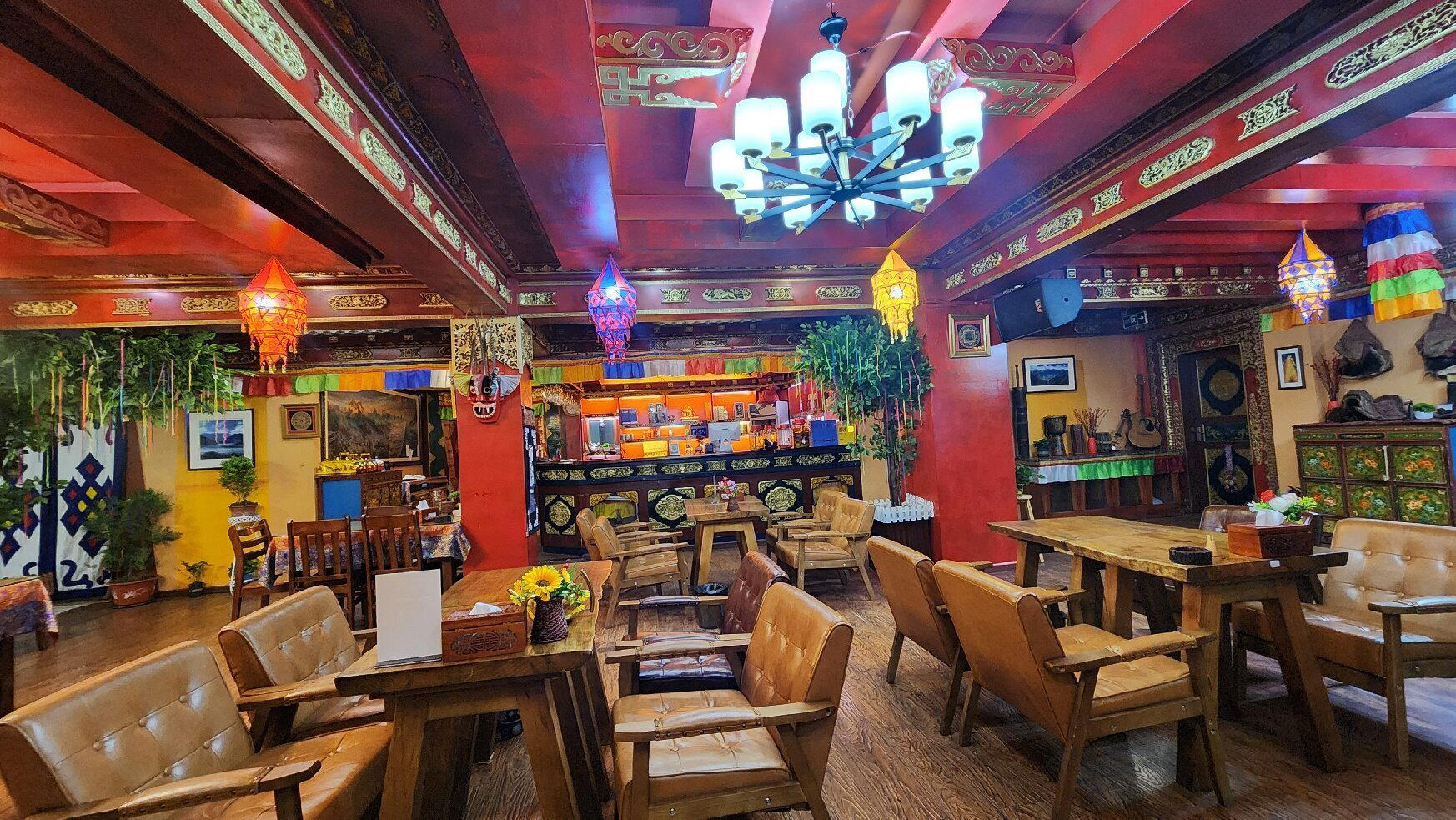
Details
- Quiet
- Elegant
- Scenic
- Sophisticated
- Romantic Getaway
- Family Vacation
- Wellness Retreat
- Weekend Escape
- Panoramic View
- Terrace
- Wi Fi
- Spa
- Pool
- Fitness Center
- Room Service
- Concierge
- EV Charging
- Mountain
- Wheelchair Accessible
- Elevator
Serene and relaxing with quiet streams, soundproofed rooms, and elegant ethnic-inspired interiors.