
Sankara Hotel & Spa Yakushima holds a Michelin One Key recognition for 2025, placing it among Japan's most considered resort properties. Set on Yakushima island, a UNESCO World Heritage site defined by ancient cedar forest and near-constant mist, the hotel positions itself within the small tier of Japanese luxury properties where design, landscape integration, and spatial restraint carry more weight than brand scale.
Pearl is the En Primeur Club membership app — saves, bookings, and concierge access live there. Same editors, same standards.
- Address
- Japan, 〒891-4402 Kagoshima, Kumage District, Yakushima, 麦生字萩野上553
- Phone
- +81 997-47-3488
- Website
- sankarahotel-spa.com
 Saves & bookings on Pearl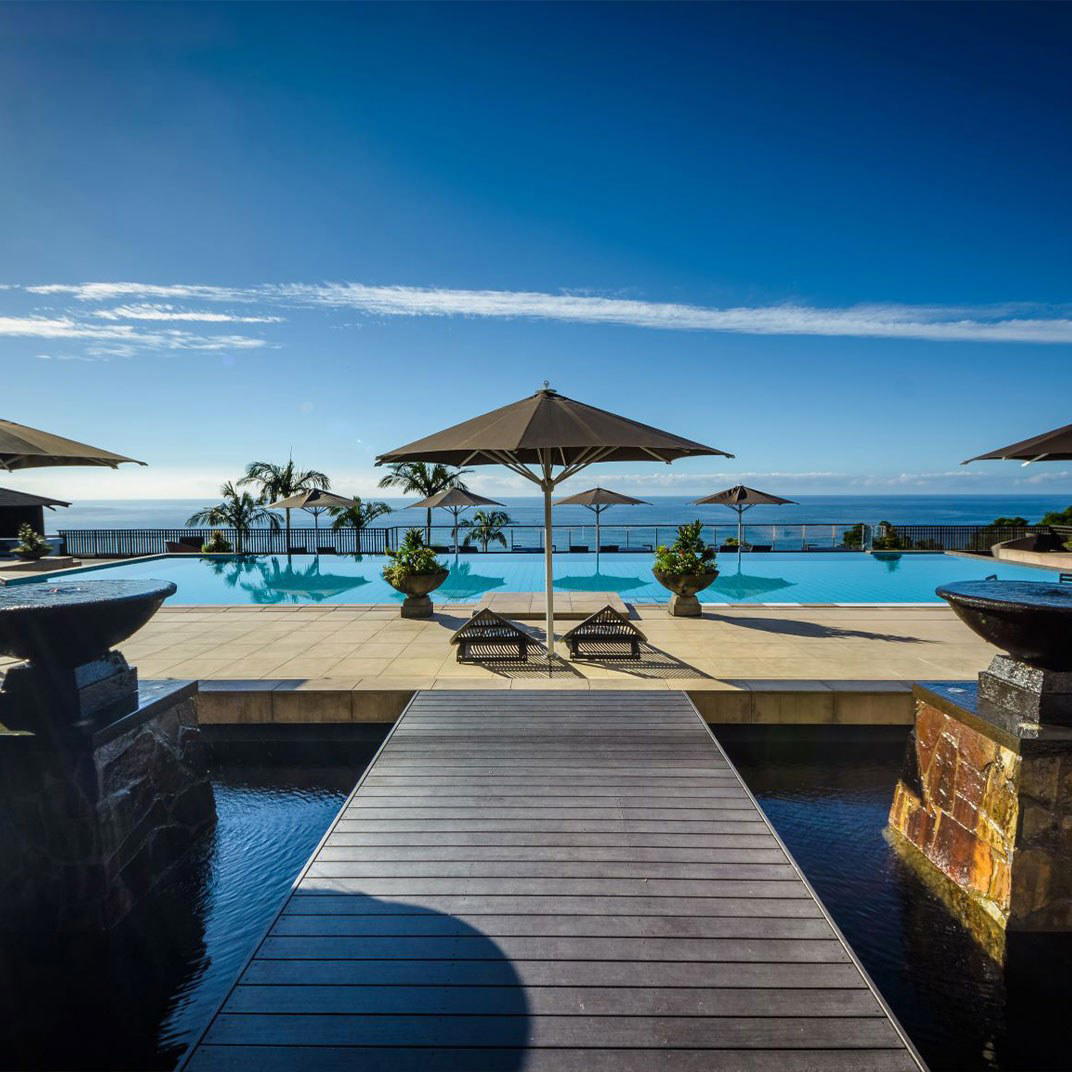
Where the Forest Sets the Architectural Terms
Approaching Sankara Hotel & Spa Yakushima, the landscape makes its conditions clear before any building comes into view. Yakushima island sits roughly 60 kilometres south of the Kyushu coast, and its interior is covered by ancient cedar forest, some of it over a thousand years old, now protected as a UNESCO World Heritage site. Rain falls here on more than 200 days a year. The air carries moisture even in dry spells. Any structure that attempts to dominate this environment will simply lose the argument. The architecture at Sankara does not attempt to dominate. It concedes to the forest on nearly every front, which is why it reads so clearly within Japan's premium resort tier.
Japan's luxury resort category has split over the past decade into two broad camps. One is the large-format international brand hotel, often city-adjacent, heavy on imported materials, and aligned with a global aesthetic readable from Singapore to Milan. The other is a smaller, more location-specific category, where the physical environment dictates material choices, building scale, and spatial rhythm. Sankara belongs firmly to the second group. In this, it sits alongside properties like Amanemu in Mie and Zaborin in Kutchan, both of which treat their natural settings as the primary design brief. The difference at Yakushima is the particular intensity of the landscape: this is not a polished national park, but a genuinely wild island where the cedar canopy, moss, and elevation changes create conditions that few resort designers in Japan have had to work with at this scale.
Low-Profile Architecture as a Design Position
The architectural approach at Sankara reflects the logic of restraint that a site like Yakushima demands. Low-profile structures, natural material palettes, and the deliberate minimisation of hard contrast against the treeline are not decorative choices here, they are responses to an environment that would make any other approach look absurd. This positions the hotel in a specific design tradition within Japanese luxury hospitality, one that draws more from the ryokan sensibility of spatial humility than from the resort language of spectacle and vista-framing. Where a property like Bvlgari Hotel Tokyo announces itself through materials and vertical ambition, Sankara signals quality through what it withholds: height, noise, visual competition with the surrounding forest.
This is not a widespread approach in Japanese premium hospitality. Most high-end rural retreats in Japan achieve landscape integration through traditional architectural references, heavy timber framing, and tatami-centered interior rhythms. Sankara operates in a different register, one that is more contemporary and less explicitly referential to classical Japanese form. Among island or coastal properties in Japan, this positions it close to Jusandi in Ishigaki and Halekulani Okinawa in terms of design ambition, though Yakushima's forest environment creates a distinctly different sensory context from either of those subtropical coastal settings.
Michelin Recognition and What It Implies
The Michelin One Key designation for 2025 places Sankara among Michelin-recognized hotels in Japan. Within the One Key category in Japan, the range is wide, covering well-positioned urban business hotels on one end and genuinely compelling destination properties on the other. Sankara's inclusion signals that Michelin's inspectors read it as the latter: a property where location specificity, design coherence, and the quality of the guest experience justify recommendation to a traveller making a deliberate choice rather than a convenient one.
Properties like Fufu Nikko, Asaba in Izu, and Nishimuraya Honkan in Kinosaki-cho all appear in the Michelin selection, pointing to a sustained editorial interest in Japan's destination inn and resort category beyond the traditional urban focus. Sankara sits within this acknowledged cohort, differentiated primarily by its island location and the unusual ecological status of Yakushima itself.
Getting There and Planning the Stay
Reaching Yakushima requires either a ferry from Kagoshima on Kyushu or a short flight via Yakushima Airport, which receives connections from Kagoshima and Osaka. Neither option is as frictionless as arriving at a bullet-train-accessible resort like Fufu Kawaguchiko or Fufu Kyu-Karuizawa. That access complexity is part of the proposition. Yakushima draws travellers who have specifically committed to the island experience, which filters the guest profile toward those genuinely interested in the natural environment rather than those seeking a convenient weekend retreat from a major city.
The island's trekking routes, particularly those leading into the old-growth cedar zones designated under the UNESCO listing, represent the primary activity draw. Sankara sits in a position to serve as a base for this, though guests should be aware that the mist and rainfall that define Yakushima's atmosphere are not occasional atmospheric effects but structural features of the climate. Packing and scheduling accordingly is practical advice, not a caveat. For those who prefer more accessible island luxury in Japan's southern arc, The Hiramatsu Hotels & Resorts Ginoza in Ginoza offers a different register entirely, with Okinawa's infrastructure and clearer weather patterns. For a remote island context closer in spirit to Yakushima's commitment to natural immersion, GOTO RETREAT by Onko Chishin in Goto provides useful comparison.
Bookings at Sankara are essential and should be made well in advance. The island's relative inaccessibility means that last-minute availability is rare during peak periods. Those comparing Sankara against other design-led rural retreats in Japan should also look at Benesse House in Naoshima, Sekitei in Hatsukaichi-shi, Satoyama-Jujo in Niigata, Nasu Mukunone in Nasu, Kamenoi Besso in Yufu, and Atami Izusan Karaku in Atami. For those interested in international comparisons of destination resort properties with strong design credentials, Higashiyama Niseko Village, a Ritz-Carlton Reserve offers a northern Japanese contrast, while The Fifth Avenue Hotel in New York City, Badrutt's Palace Hotel in St. Moritz, and Hôtel de Paris Monte-Carlo show how differently premium hospitality reads when the natural environment is not the defining variable.
Fast Comparison
Comparable venues nearby, for context on price, style, and recognition.
| Venue | Cuisine | Price | Notes |
|---|---|---|---|
| Sankara Hotel & Spa YakushimaThis venue — the venue you are viewing | Luxury eco-resort with villas scattered through forested grounds | $$$$ | Not listed |
| KAI Miyajima | Luxury oceanfront onsen ryokan showcasing Miyajima and Itsukushima Shrine from the opposite shore. | $$$$ | Miyajimaguchinishi, Hatsukaichi |
| Ki Niseko (木ニセコ) | Contemporary alpine resort blending Japanese elegance with sustainable luxury. | $$$$ | Hirafu |
| Machiyado Ichiryu | Modern Japanese ryokan in renovated townhouse | $$$$ | Old Town |
| Tekefue | luxury ryokan | $$$$ | Minamioguni |
| Regent Kyoto | An upper-luxury urban retreat that integrates a historic Kyoto garden and century-old ryotei into a small-scale, heritage-rich estate in the Okazaki cultural district. | $$$$ | Okazaki |
Recognition history
Dated appearances from independent guides and award organizations, with the underlying list record or original source where available.
Michelin 1 Key
Michelin
Continue exploring
More in Yakushima
Restaurants in Yakushima
Browse all →
At a Glance
- Quiet
- Elegant
- Scenic
- Sophisticated
- Intimate
- Romantic Getaway
- Wellness Retreat
- Honeymoon
- Anniversary
- Panoramic View
- Destination Spa
- Spa
- Pool
- Wi Fi
- Fitness Center
- Room Service
- Concierge
- Mountain
- Garden
- Spa
- Pool
- Wi Fi
- Fitness Center
- Room Service
- Concierge
Tranquil and serene with natural wood and stone interiors, high ceilings, and expansive views of forest and sea, fostering profound quiet and harmony with nature.