



Opened in August 2024 in Osaka's Kita-ku district near Umeda, Four Seasons Hotel Osaka earned a spot at #10 in the 2025 Condé Nast Traveler Readers' Choice Awards for Japan within its first year of operation. The property combines skyline-view rooms with a dedicated modern ryokan floor, Michelin-recognized dining, and a full-service spa that positions it among the city's most considered addresses for wellness-focused stays.
Pearl is the En Primeur Club membership app — saves, bookings, and concierge access live there. Same editors, same standards.
- Address
- 2-4-32 Dojima, Kita-ku
- Phone
- 81-0-6-6676-8682
- Website
- fourseasons.com
- Directions
- Get directions
 Saves & bookings on Pearl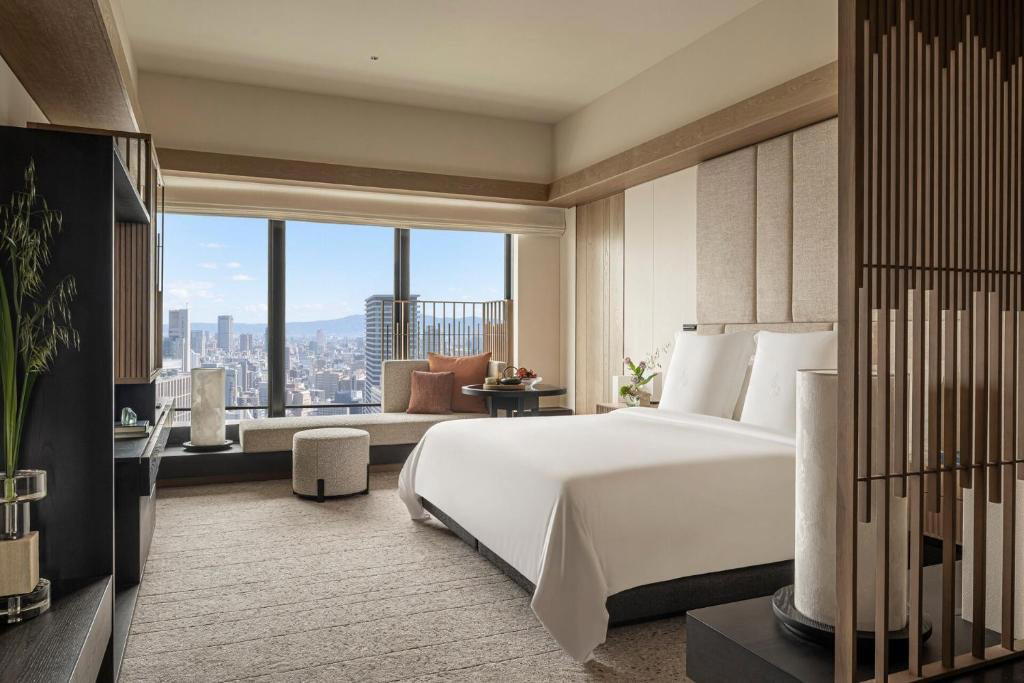
A New Anchor in Kita-ku's Luxury Tier
Osaka's Kita-ku district, the commercial and transit spine of the city anchored by Umeda's rail interchange, has long concentrated the western Japan hotel market's most internationally branded properties. Four Seasons Hotel Osaka is a five-star hotel in Osaka at 2-4-32 Dojima, Kita-ku, with room rates from about $500 per night. It entered a competitive tier that already included Conrad Osaka, InterContinental Osaka, and The Ritz-Carlton, Osaka. What distinguished the Four Seasons entry was not the address alone, but the structural decision to layer a modern ryokan floor directly into a full-service luxury hotel, a format that the Kita-ku market had not previously offered at this price tier. The result is a property that serves both international business travelers seeking skyline rooms and guests specifically arriving for immersive Japanese accommodation, without routing them to separate establishments.
The hotel's rapid recognition, ranked #10 in Japan in the 2025 Condé Nast Traveler Readers' Choice Awards less than twelve months after opening, signals that the market responded to that dual format quickly. For context, that ranking places it inside the upper tier of a country whose hotel culture is among the more studied in the world, competing against properties with decades-long reputations. Other city-center luxury hotels in Osaka, including W Osaka and Hotel New Otani Osaka, occupy distinct niches in the same district; the Four Seasons positions itself through the wellness and cultural immersion angle rather than through design theatrics or legacy brand loyalty.
The Ryokan Floor as a Wellness Architecture
Japan's ryokan tradition operates on principles that align more closely with retreat philosophy than with conventional hotel hospitality. The tatami room, the private ofuro bath, the structured cadence of arrival and departure, these are not amenities bolted onto a hotel stay but a distinct residential grammar. By incorporating a dedicated modern ryokan floor into its structure, Four Seasons Hotel Osaka is making a specific argument: that the retreat experience does not require leaving the city for a mountain onsen town.
The private ofuro bath format, standard on the ryokan floor, reflects a bathing culture in which soaking is considered restorative practice rather than routine hygiene. In traditional ryokan settings across Japan, from the established inns of Nishimuraya Honkan in Kinosaki-cho to the more remote formats of Amanemu in Mie or Gora Kadan in Hakone, the bath anchors the daily rhythm. The Four Seasons adaptation brings that rhythm into a city-center context, which is a different proposition to what properties like Asaba in Izu or ENOWA Yufu in Yufu offer in more removed natural settings. Neither is superior, they answer different travel intentions, but the Four Seasons format is notable for making the ryokan experience accessible without requiring a separate journey.
The full-service spa extends the wellness infrastructure beyond the room level. In the broader luxury hotel spa market, the credibility gap between a spa that exists as a revenue amenity and one that functions as a genuine program anchor is significant. The hotel's Michelin-recognized dining component, combined with its spa and ryokan floor, suggests a coherent wellness architecture rather than a collection of isolated features. The Star Wine List recognition for 2026 adds a further dimension: a wine program at this level implies a food-and-beverage operation that is taken seriously as a destination in its own right, not simply a hotel convenience. For guests who treat dining as part of the recovery and restoration cycle, eating well as an element of a considered stay rather than a separate activity, that credential matters.
Dining, Wine, and the Michelin Signal
Osaka's dining reputation needs little external validation. The city's density of Michelin-starred restaurants, across kaiseki, sushi, tempura, and ramen formats, has made it among the more studied food cities in Asia. A hotel dining program operating within that context is measured against a severe local standard. The Michelin recognition attached to Four Seasons Hotel Osaka's dining places it inside that conversation rather than adjacent to it, a meaningful distinction in a city where guests can eat extraordinarily well two blocks in any direction.
The Star Wine List recognition for 2026 places the wine program in a comparable set that includes some of Japan's more deliberately curated hotel wine lists. In a country where sake and shochu dominate indigenous beverage culture, a hotel wine list that earns specialist recognition has generally made deliberate choices about sourcing, depth by region, and staff training. For guests planning multi-day stays that incorporate the spa, ryokan floor, and dining, the wine program functions as an integrated element rather than an afterthought. See our full Osaka restaurants guide for the broader dining context around the hotel.
Positioning Within Japan's Luxury Hotel Field
Japan's luxury hotel market in 2024 and 2025 has sharpened into clear categories: international brand flagships in major urban centers, small design-led properties in secondary cities, and rural or coastal retreat formats in natural settings. Four Seasons Hotel Osaka sits firmly in the first category but borrows vocabulary from the third. That crossover is increasingly common in Japanese urban luxury, HOTEL THE MITSUI KYOTO in Kyoto and Bvlgari Hotel Tokyo in Tokyo each represent variations on the theme of embedding cultural or historical depth into a city-center luxury format.
What the ryokan floor does for the Four Seasons is create a tier within the property. Guests choosing standard rooms with skyline views are staying in a high-end international hotel. Guests choosing tatami rooms with private ofuro baths are staying in something closer to a structured cultural experience with hotel-grade service. That internal differentiation is relatively rare at the city-center scale and gives the property a wider range of guest profiles than a single-format luxury hotel would attract. Properties like Fufu Kawaguchiko in Fujikawaguchiko and Fufu Nikko in Nikko deliver the ryokan format in scenic natural contexts; the Four Seasons proposition is urban convenience combined with that experiential depth.
For travelers building Japan itineraries that span city and retreat experiences, the hotel also sits logically alongside properties in the wider Kansai and coastal network, including Sekitei in Hatsukaichi-shi, Halekulani Okinawa, Jusandi in Ishigaki, and Benesse House in Naoshima. For international context, Four Seasons' operational approach can be compared against other urban luxury formats the brand operates globally, including properties like The Fifth Avenue Hotel in New York City and the independent luxury tier represented by Aman New York or Aman Venice.
Planning a Stay
The hotel is located at 2-4-32 Dojima, Kita-ku, placing it within walking distance of the Umeda transport interchange, which connects to Shinkansen services at Shin-Osaka and direct rail access to Kyoto, Kobe, and Nara. For guests focused on the wellness program, the internal structure of the stay matters as much as the external itinerary: the ryokan floor and spa together function as a retreat within the hotel, which makes the property work for travelers who want to balance intensive city exploration with deliberate recovery time. Guests who have found the design-led, independent style of Cuvée J2 Hôtel Osaka by Onko Chishin or the accessible positioning of Centara Life Namba Hotel Osaka more suited to their priorities will find the Four Seasons operates at a different scale and service register, with the full-service spa and Michelin-recognized dining adding meaningful infrastructure for longer or wellness-oriented stays. The Hotel Granvia Osaka offers another comparison point for travelers weighing integrated transit convenience against the Four Seasons' cultural programming depth.
Recognition, Side-by-Side
Comparable venues nearby, for context on price, style, and recognition.
| Venue | Cuisine | Price | Awards | Notes |
|---|---|---|---|---|
| Four Seasons Hotel OsakaThis venue — the venue you are viewing | Fusion of traditional Japanese ryokan and modern luxury high-rise | $$$$ | 5-Star | Not listed |
| Osaka Marriott Miyako Hotel | High-rise luxury tower hotel | $$$$ | 5-Star | Abeno |
| Cuvée J2 Hôtel Osaka by Onko Chishin | Champagne-themed luxury boutique with one room per floor | $$$$ | 5-Star | Chūō |
| Candeo Hotels Osaka The Tower | High-rise tower hotel with sky spa focus | $$$$ | 5-Star | Kita |
| The St. Regis Osaka | Cosmopolitan residential style with state-of-the-art amenities | $$$$ | 5-Star | Chūō |
| Osaka Excel Hotel Tokyu | Osaka Kaleidoscope concept blending lively opulence with city night views | $$$ | 4-Star | Chūō |
Recognition history
Dated appearances from independent guides and award organizations, with the underlying list record or original source where available.
Forbes 4-Star
Forbes
Star Wine List
Star Wine List
AFAR Best New Hotels
AFAR
Michelin 1 Key
Michelin
Continue exploring
More in Osaka
Hotels in Osaka
Browse all →




Bars in Osaka
Browse all →




Restaurants in Osaka
Browse all →




Wineries in Osaka
Browse all →
At a Glance
- Elegant
- Sophisticated
- Modern
- Quiet
- Honeymoon
- Romantic Getaway
- Business Trip
- Wellness Retreat
- Rooftop Pool
- Infinity Pool
- Destination Spa
- Panoramic View
- Spa
- Pool
- Fitness Center
- Room Service
- Concierge
- Wi Fi
- Skyline
- Spa
- Pool
- Fitness Center
- Room Service
- Concierge
- Wi Fi
Serene and tranquil with dark moody lighting on ryokan floors, natural light in spa areas, and mesmerizing skyline views creating a sophisticated Japanese-inspired retreat.