Tabelog 100 #29
Our verdict
Yakiniku Jambo Hongo occupies a first-floor address in Bunkyo City, placing it within a quieter residential and academic quarter of Tokyo rather than the high-density yakiniku corridors of Shinjuku or Shibuya. The Hongo address signals a neighbourhood-focused operation serving a local crowd rather than a destination-driven tourist circuit. Planning a visit requires working around limited public information on hours and booking channels.

Pearl is the En Primeur Club membership app, where members save venues, book tables and use the concierge.
The menu
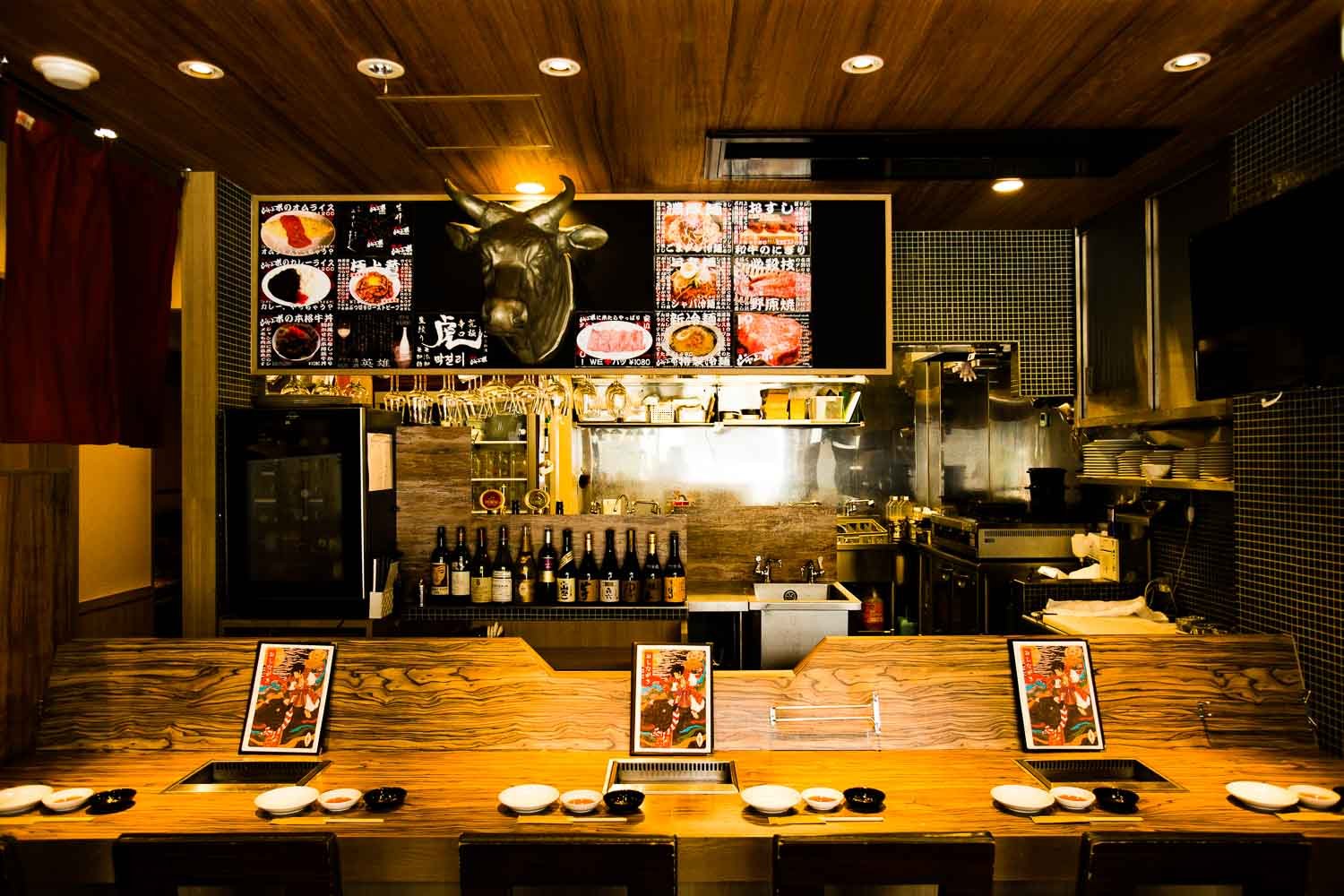
What to order
- Noharayaki
- Wagyu Nigiri
- Zabuton
- Kainomi
Yakiniku in Tokyo's Academic Quarter
Tokyo's yakiniku scene has long been tiered between high-gloss tasting-menu operations in Ginza and Roppongi and neighbourhood grills that run on repeat custom rather than destination traffic. Bunkyo City sits firmly in the second category. Home to the University of Tokyo's Hongo campus and a dense network of long-established residential streets, the area generates a dining culture shaped by academics, long-term residents, and local workers rather than by tourism indexes or Instagram reach. Yakiniku Jambo Hongo sits within that context, on a 3-chome address that places it well outside the circuits that deliver out-of-towners to the city's higher-profile grills. For venues like Harutaka or RyuGin, location is part of the signal, the difficulty of finding them is engineered. In Hongo, the low profile is simply what the neighbourhood produces.
What the Address Tells You Before You Arrive
The logistics of visiting Yakiniku Jambo Hongo begin with the address itself. Hongo 3-chome is served by the Tokyo Metro Marunouchi Line and the Toei Oedo Line, making it accessible from central Tokyo without significant transfer complexity, but the walk from either exit passes through a streetscape of university buildings, small independent shops, and quiet residential blocks rather than the retail corridors that typically signal dining destinations. The building is listed as a first-floor unit, which in Tokyo's restaurant geography often indicates a compact operation embedded in a mixed-use building rather than a freestanding venue. That structural context shapes expectations usefully: this is not a space designed around theatrical presentation or theatrical scale.
Tokyo's neighbourhood yakiniku operations frequently run on walk-in culture supplemented by repeat customers who know the rhythm of the house. Attempting to book through third-party reservation platforms is one option; walking the address during early evening service hours is another. Neither path is guaranteed. Compared to venues like L'Effervescence or Sézanne, where booking infrastructure is extensive and documented, Jambo Hongo requires a different kind of planning discipline: patience, flexibility, and comfort with incomplete information.
The Yakiniku Format as Context
Yakiniku as a dining format carries its own set of expectations that travel independently of any individual venue. The genre is participatory by design: diners cook cuts of beef, offal, and sometimes pork or chicken over a tabletop grill, with the kitchen's contribution expressed through the quality and preparation of the raw product rather than through finished plating. At the higher end of the Tokyo market, this format has been refined to a point where Wagyu provenance, aging protocols, and cut sequencing operate with the same rigour applied at kaiseki counters. At neighbourhood level, the format retains its social, informal character, with the grill functioning as a communal object rather than a performance stage.
Bunkyo's dining culture aligns naturally with the latter register. The area does not produce the concentration of high-specification tasting operations found in Azabu or Nishi-Azabu, where venues like Crony operate at the French-Japanese intersection. What it does produce is a density of independent, operationally lean restaurants where consistency and local reputation matter more than award cycles. In that context, Jambo Hongo reads as a neighbourhood yakiniku grill in the most functional sense: a place where the format itself is the draw, not an elaborated version of it.
Planning Your Visit: What to Know
The absence of a published website or phone number is the defining logistical fact here. For visitors accustomed to the booking infrastructure that surrounds Tokyo's higher-profile restaurants, the three-month advance windows at omakase counters, the concierge-mediated reservations at Harutaka, the online systems at Sézanne, Jambo Hongo operates in a different register entirely. Japanese reservation aggregators such as Tabelog or Gurunavi are the most productive starting points for confirming current hours and availability. Google Maps listings for the address may carry user-submitted hours, though these should be treated as approximate rather than authoritative.
The Hongo 3-chome area is easily combined with visits to other Bunkyo landmarks, including the Koishikawa Korakuen garden and the broader university precinct, which makes an early evening arrival a natural fit after an afternoon in the neighbourhood. Visitors travelling from other Japanese cities might use Jambo Hongo as a contrast reference point against the more elaborated dining operations elsewhere in the country, such as HAJIME in Osaka, Gion Sasaki in Kyoto, or Goh in Fukuoka. The contrast is instructive: Tokyo's dining range extends from Michelin-chasing tasting menus all the way to unpublicised neighbourhood grills that operate without a digital presence of any kind.
For those building a broader Japan itinerary that includes less-documented regional spots, similar planning discipline applies to venues like 一本木 仲川制 in Nanao, 湖畔荘 in Takashima, or 羽根屋 in Nishikawa Machi, where the information gap is a feature of how the venue relates to its community rather than an oversight. The same applies to 夕仙山乃 in Sapporo and akordu in Nara, each of which occupies a specific local register that resists easy generalisation. Our full Tokyo restaurants guide maps the city's dining tiers more comprehensively, from neighbourhood staples to Michelin-tracked counters.
For international reference, the gap between a neighbourhood yakiniku grill and a high-profile tasting destination is not unlike the distance between a local brasserie and a three-star restaurant in New York City terms. Venues like Le Bernardin or Atomix operate with full booking infrastructure and documented service protocols. Jambo Hongo does not, and that distinction is not a deficiency so much as a description of what kind of operation it is.
Frequently asked questions
Is Yakiniku Jambo Hongo child-friendly?
Yakiniku as a format involves table-top grilling with open flame, which requires attentive supervision for young children regardless of venue. Yakiniku Jambo Hongo sits in Hongo 3-chome, a residential and academic neighbourhood rather than a tourist district, suggesting a predominantly local adult clientele.
What is the atmosphere like at Yakiniku Jambo Hongo?
The address places it firmly in Tokyo's Bunkyo City, a ward defined by universities, research institutions, and long-established residential blocks rather than nightlife or tourist traffic. That geography tends to produce grill rooms oriented around repeat neighbourhood customers, functional, low-key, and convivial rather than theatrical. The ground-floor 1F positioning in a local building reinforces that read.
How do you get to Yakiniku Jambo Hongo and is walk-in dining typical for this type of Tokyo neighbourhood grill?
Yakiniku Jambo Hongo is located at Hongo 3-chome in Bunkyo City, Tokyo, a stop served by both the Tokyo Metro Marunouchi Line and the Toei Oedo Line. Because no website or phone number is published, advance reservations through conventional channels are not an option, which positions walk-in as the de facto method. Neighbourhood yakiniku grills of this type in Tokyo's academic quarters typically turn tables across a dinner service, so arriving at opening time improves your chances of being seated.
What should I order at Yakiniku Jambo Hongo?
In Tokyo's neighbourhood yakiniku tradition, the standard approach is to work through a progression of offal, short cuts, and premium beef slices in that order, letting the grill temperature stabilise before the more delicate pieces arrive. Asking staff for the house recommendation is both practical and consistent with how local regulars operate at this type of Hongo-area grill.
Where is Yakiniku Jambo Hongo located?
Yakiniku Jambo Hongo is located at Japan, 〒113-0033 Tokyo, Bunkyo City, Hongo, 3 Chome−38−1 イワシタビル 1F, Tokyo.
Cuisine and Awards Snapshot
Comparable venues nearby, for context on price, style, and recognition.
| Venue | Cuisine | Price | Awards | Notes |
|---|---|---|---|---|
| Yakiniku Jambo HongoThis venue (the venue you are viewing) | Premium Yakiniku with A5 Wagyu | $50–100 | Tabelog 100 #29 | Not listed |
| Akasaka Tan-tei | Okinawan Kaiseki | $100–150 | Not listed | Akasaka |
| Ningyocho Imahan Nihombashi Takashimaya S.C. Restaurant | Traditional Japanese Wagyu Sukiyaki & Shabu-Shabu | $50–100 | Not listed | Chūō |
| 萬屋おかげさん | Traditional Japanese Izakaya | $50–100 | Tabelog 100 #89 | Shinjuku |
| Unazen | Kanto-style Unagi (Eel) | $30–50 | Tabelog 100 #83 | Sumida |
| Yakiniku Horumon Kinju Hanare | Yakiniku & horumon with Morioka-style cold noodles | $50–100 | Tabelog 100 #48 | Minato |
Recognition history
Dated appearances from independent guides and award organizations, with the underlying list record or original source where available.
Tabelog 100 #29 · No. 29
Tabelog · Tabelog 100 - Yakiniku - TOKYO - 2025