At Kupferschmiedgasse 1b in Vienna's first district, this Würstelstand occupies a category that the city takes seriously: the street-level sausage stand as social institution. Vienna's Würstelstände are licensed, regulated, and deeply embedded in the fabric of after-hours and lunchtime street life. This one sits at the edge of the Innere Stadt, where the density of foot traffic and the formality of the surrounding architecture make the contrast particularly sharp.
Pearl is the En Primeur Club membership app — saves, bookings, and concierge access live there. Same editors, same standards.
- Address
- Kupferschmiedgasse 1b, 1010 Wien, Austria
- Phone
- +434315129300
- Website
- wuerstelstand.eatbu.com
- Directions
- Get directions
 Saves & bookings on Pearl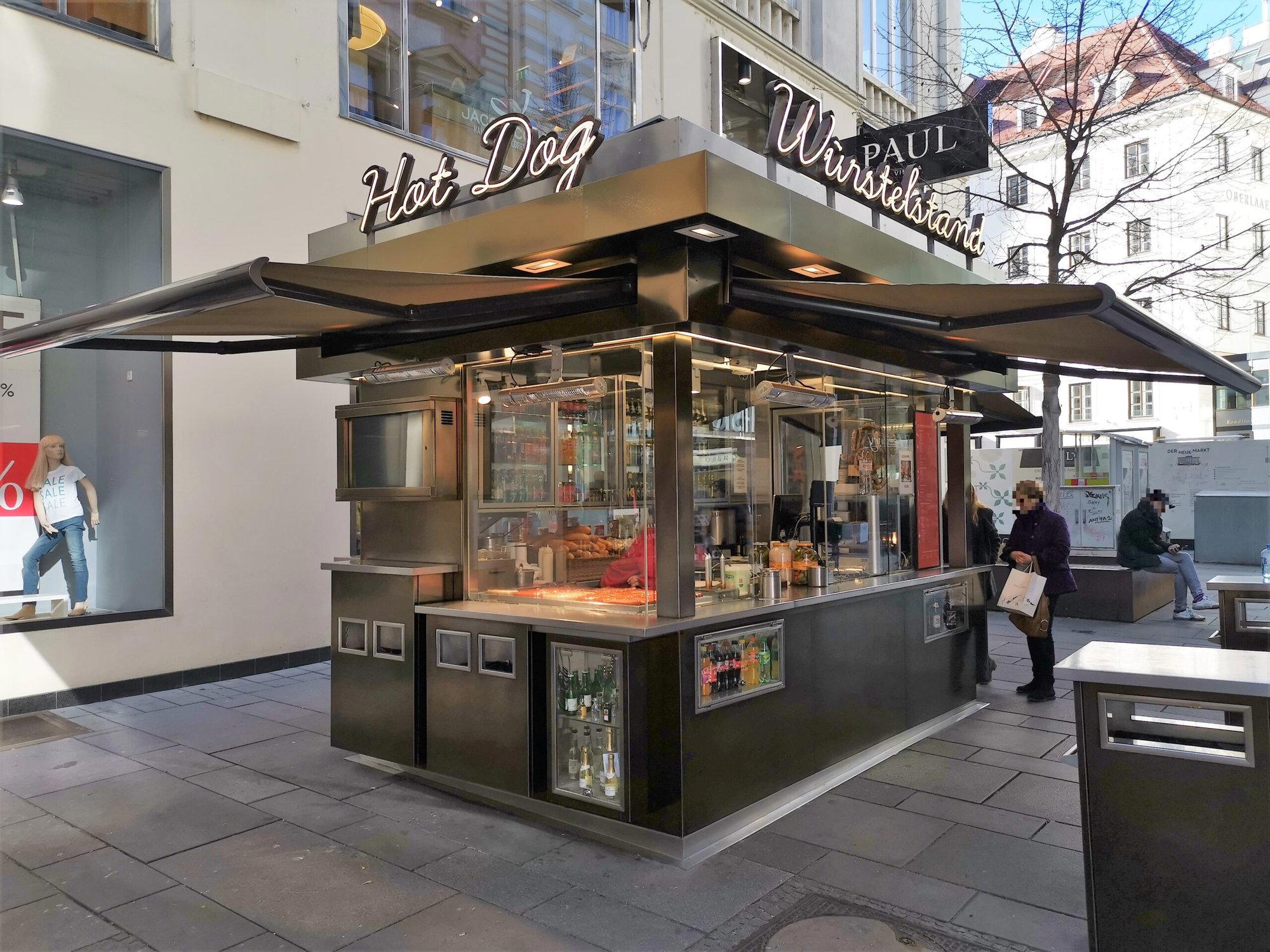
Where the First District Pauses
Würstelstand Kupferschmiedgasse is a traditional Austrian sausage stand in Vienna's 1st district. The Würstelstand is not an afterthought or a convenience stop, it is a licensed, regulated fixture of the city's public food culture, given the same municipal attention as a market stall or a Kaffeehaus terrace. At Kupferschmiedgasse 1b, in the tight grid of the first district's southern edge, the format plays out against a backdrop of Gründerzeit facades and cobbled lanes that have barely shifted in a century. The Innere Stadt at this corner is dense and formal; the stand itself is not. That contrast is, in many ways, the point.
Steirereck im Stadtpark, Konstantin Filippou, and Amador all operate at the €€€€ tier with tasting menus that demand advance planning and a certain dress-code awareness. The Würstelstand exists in a parallel register: no reservation, no tasting progression, no sommelier. The two registers are not in competition, they answer different questions about what Viennese eating means at different times of day and night.
The Würstelstand as Urban Institution
Understanding the Würstelstand format requires some historical grounding. Vienna's stands gained municipal licensing structures in the early twentieth century, and the model has remained recognisable ever since: a compact kiosk, a heated display of sausages, condiments, and rolls, and a standing clientele that ranges from construction workers at noon to opera-goers at midnight. The city has approximately 220 licensed stands, each with its own geography, regulars, and rhythm. The ones that persist through decades of shifting foot traffic tend to occupy corners or passages with reliable throughput, the kind of spot where a fixed point becomes a meeting marker.
Kupferschmiedgasse runs close enough to the Stephansdom and the Schwedenplatz axis that foot traffic through the area is substantial throughout the day. The first district's population swells dramatically on weekdays with workers and tourists; late evenings bring a different crowd as the opera, concert halls, and hotel bars in the surrounding blocks thin out. The Würstelstand format suits both waves without adjustment.
What the Format Delivers
The core menu logic of any Viennese Würstelstand centres on a short roster of sausage types, Käsekrainer, Burenwurst, Debreziner, Frankfurter, served in rolls or on plates with mustard, bread, and sometimes horseradish. Käsekrainer, the cheese-filled pork sausage with its occasional burst of molten interior, has become the canonical Würstelstand order for visitors; locals often have a more specific preference shaped by years of comparison. Alongside sausages, most stands carry a selection of soft drinks, beer, and spirits, which explains the after-midnight relevance of the format. There is nothing elaborate here, and that is the entire rationale.
Vienna's broader dining spectrum rewards the traveller who holds both registers simultaneously. The same city that produces the kitchen discipline behind Mraz & Sohn's creative Austrian tasting menus, or the precise Modern Cuisine of Doubek, also sustains a street-food format that has not required reinvention in generations. Both are expressions of the same civic seriousness about eating.
Planning and Logistics
The Würstelstand format runs on walk-up access. There are no bookings, no waiting lists, no dress considerations. The planning question is purely logistical: when to go, and from where. For visitors moving between the major first-district cultural sites, the Kunsthistorisches Museum, the Staatsoper, the Burgtheater, the stand at Kupferschmiedgasse 1b sits within a short walk of the historic core. It functions as a reset point between heavier commitments rather than a destination requiring its own scheduling architecture.
The cash-first assumption that applies to most Viennese street food remains a practical baseline until the stand's own payment methods are confirmed directly.
| Venue | Booking Required | Price Tier | Format | Lead Time |
|---|---|---|---|---|
| Würstelstand Kupferschmiedgasse | No | € | Walk-up street kiosk | None |
| Steirereck im Stadtpark | Yes | €€€€ | Tasting menu, restaurant | Weeks to months |
| Konstantin Filippou | Yes | €€€€ | Tasting menu, restaurant | Weeks |
| Mraz & Sohn | Yes | €€€€ | Creative Austrian tasting | Weeks |
| Amador | Yes | €€€€ | Tasting menu, restaurant | Weeks |
Vienna in a Wider Austrian Context
The capital's street food culture operates against a national dining backdrop that skews heavily toward regional fine dining in the countryside. Austria's most decorated kitchens often sit outside Vienna: Döllerer in Golling an der Salzach, Ikarus in Salzburg, Obauer in Werfen, and alpine properties like Griggeler Stuba in Lech and Gourmetrestaurant Tannenhof in Sankt Anton am Arlberg draw serious food travellers out of the city entirely. Others, such as Kräuterreich by Vitus Winkler in Sankt Veit im Pongau, Landhaus Bacher in Mautern an der Donau, Schwarzer Adler in Hall in Tirol, Ois in Neufelden, and Restaurant 141 by Joachim Jaud in Mieming represent Austria's wider regional ambition. The Würstelstand sits at the opposite end of the ambition spectrum, which is precisely why it remains relevant: it is the floor, not the ceiling, of Vienna's food culture, and Vienna has made that floor unusually solid.
Le Bernardin in New York City or Atomix in New York City operate within a city that lacks Vienna's particular tradition of the civic sausage stand as a genuine social equaliser.
Comparison Snapshot
Comparable venues nearby, for context on price, style, and recognition.
| Venue | Cuisine | Price | Notes |
|---|---|---|---|
| Würstelstand KupferschmiedgasseThis venue — the venue you are viewing | Traditional Austrian Sausages | $ | Not listed |
| Zum Scharfen René | Spicy Austrian Sausage Stand | $ | Staatsoper |
| Würstelstand am Hohen Markt | Austrian Street Food Sausages | $ | Stephansdom |
| Zum Goldenen Würstel II | Viennese Sausage Stand | $ | Innere Stadt |
| Leberkas-Pepi | Traditional Austrian Leberkäse | $ | Favoriten |
| Schwegler Stadl | Traditional Viennese Würstel | $ | Rudolfsheim |
Continue exploring
More in Vienna
Restaurants in Vienna
Browse all →
Bars in Vienna
Browse all →
Hotels in Vienna
Browse all →
At a Glance
- Lively
- Well Known
- Casual Hangout
- Late Night
- Standalone
- Street Scene
Current opening hours
- Monday
- 10 AM–10 PM
- Tuesday
- 10 AM–10 PM
- Wednesday
- 10 AM–10 PM
- Thursday
- 10 AM–10 PM
- Friday
- 10 AM–11 PM
- Saturday
- 10 AM–12 AM
- Sunday
- 10 AM–10 PM
Hours can change for holidays and private events. Last verified .
Bustling street kiosk atmosphere with quick service amid lively urban energy.