A Würstelstand is not a restaurant you book, it is a cultural fixture you stumble into, and the one at Schottengasse 6 sits at one of Vienna's most-trafficked intersections near the Schottentor U-Bahn. For travellers mapping Vienna's eating culture, this sausage stand represents the democratic counterpoint to the city's Michelin-dense fine-dining corridor. Cold nights, a Käsekrainer in hand, and a crowd that spans students to suits: this is how Vienna actually eats.
Pearl is the En Primeur Club membership app — saves, bookings, and concierge access live there. Same editors, same standards.
- Address
- Schottengasse 6, 1010 Wien, Austria
- Phone
- +434318772216
- Directions
- Get directions
 Saves & bookings on Pearl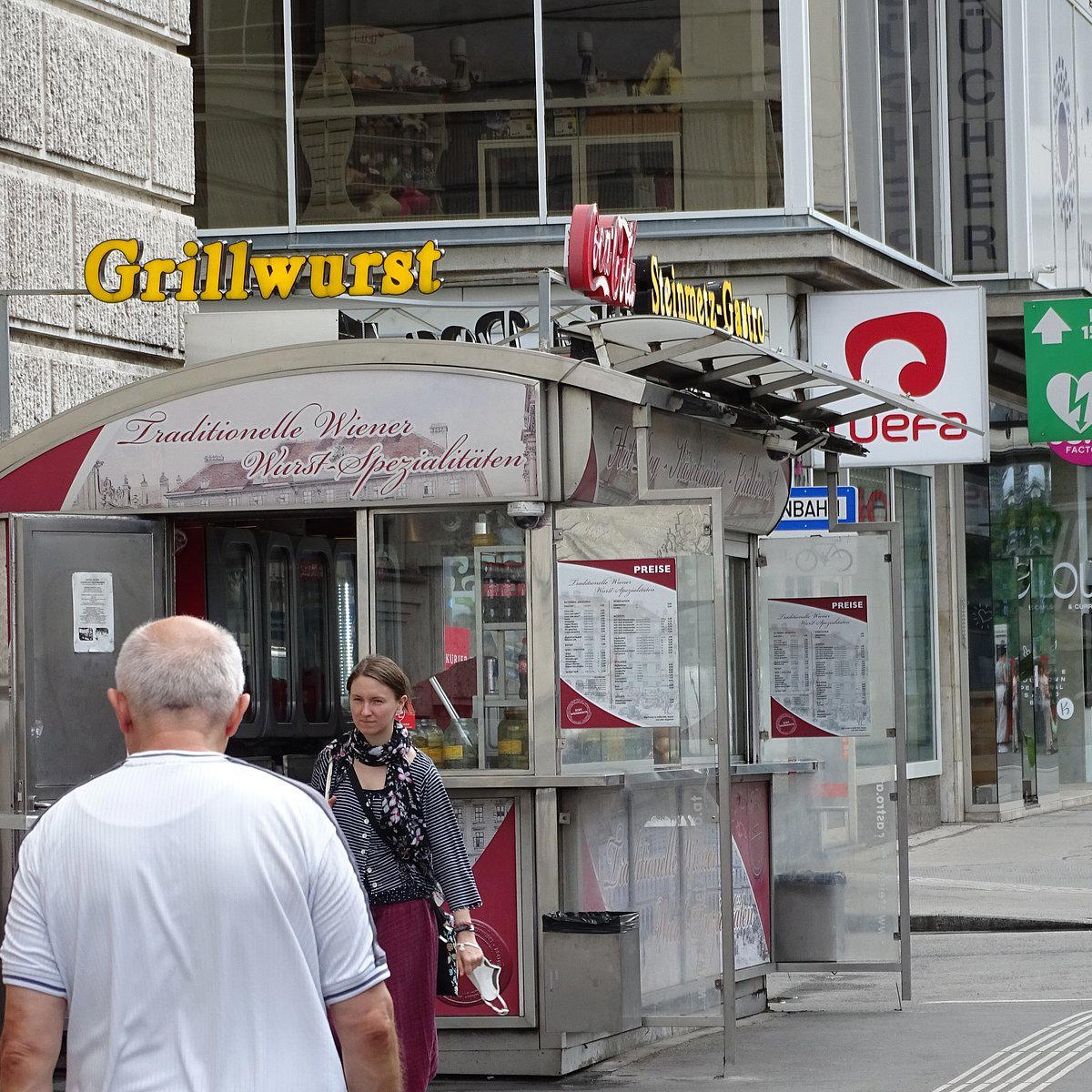
The Stand at the Gate
Late on a weeknight, when the U2 disgorges commuters at Schottentor station and the Ringstraße wind cuts through the Schottengasse, the Würstelstand at number six operates as a kind of urban checkpoint. The smell arrives before the stand comes into view: fat rendering against a hot grill, mustard dispensed from a squeeze bottle, the faint sweetness of steam. Vienna's sausage stand culture is one of the city's most durable social institutions, and the Schottentor location sits at a junction where several worlds overlap, the university quarter, the first district's edge, and one of the Inner City's main transit corridors. It serves Viennese sausages and quick counter service, with a price point around $5 per person.
What a Würstelstand Is, and Why It Matters Here
Austria's Würstelstand tradition occupies a category with almost no equivalent in other European capitals. These are not food trucks, not market stalls, not snack bars in the conventional sense. They are permanent, licensed fixtures with a consistent cast of sausages and a social function that spans every hour from mid-morning to well past midnight. The format has survived generations of food trend cycles for the same reason Vienna's coffeehouse culture has: it answers a specific need with a specific product, and it does not change to accommodate fashion.
The Schottentor stand draws on that tradition directly. Its position near the Votivkirche and the main campus buildings of the University of Vienna places it at a crossroads used by people who need food quickly and without ceremony. In a city where the fine-dining tier is dense and serious, Steirereck im Stadtpark, Amador, and Konstantin Filippou all represent Vienna's upper-bracket creative cooking, the Würstelstand exists at the opposite pole, not as a lesser option but as a different register entirely.
The Sausage Canon and What to Order
Austrian sausage stand menus are narrower than they appear. The decisions are mostly already made for you by tradition, and the craft lies in the sourcing and the grill rather than in any culinary elaboration. The Käsekrainer, a pork sausage with cheese embedded in the filling that blisters and seeps onto the grill as it cooks, is the stand-specific order that separates locals from tourists navigating by instinct. The Frankfurter, served in a small bread roll with mustard, is the entry-level read on quality: how much snap the casing gives, how the fat balances the smoke. Beinschinken on bread with horseradish belongs to the colder months, when the stand's small shelter against the weather earns its keep. These are the benchmarks against which a Würstelstand is judged by regulars, not the menu length.
The condiment protocol matters too. Mild and sharp mustard are standard; ketchup marks you as a tourist to any Viennese observer. The bread roll, or Semmel, should have a genuine crust rather than the soft commercial approximation. At a stand with a long local following, these details tend to hold. Whether they hold here on any given visit is the kind of intelligence that only accumulates through repeated stops, which is precisely how regulars build their relationship with a stand.
Planning Around It: Walk-In Logistics and Seasonal Timing
The editorial angle on the Würstelstand am Schottentor is simple: it is walk-in friendly. This is a walk-in operation by definition, and the logic of when to arrive runs entirely on street-level timing rather than reservation calendars. The busiest windows cluster around the U-Bahn rush hours, morning commuters, early evening departures, and the post-pub hour after midnight when the surrounding bar scene empties.
Mraz & Sohn and Doubek both require advance reservations; the upper-tier tasting menu counters in Vienna operate on waitlists that run weeks to months ahead. The Würstelstand operates without any of that friction, which is partly why it functions as a first and last stop on a Vienna itinerary rather than a planned destination.
Seasonally, the cold months between October and March represent the stand's peak cultural moment. Standing in the dark with a hot sausage and a Pfiff of beer while snow crosses the Schottentor streetlight is an experience that belongs specifically to Viennese winter. Summer visits are possible and common, but the stand loses some of its atmospheric logic when it competes against outdoor seating at the surrounding cafés and the Votivpark. If you are visiting Vienna in the colder half of the year, building a stop here into an evening walk along the Ringstraße or after a performance at a nearby venue costs nothing to plan and delivers a cleaner read on street-level Viennese eating culture than most sit-down alternatives would.
Austria's restaurant culture outside Vienna includes addresses like Döllerer in Golling an der Salzach, Obauer in Werfen, and Ikarus in Salzburg, alongside alpine specialists like Griggeler Stuba in Lech, Gourmetrestaurant Tannenhof in Sankt Anton am Arlberg, and Schwarzer Adler in Hall in Tirol. The gap between a Käsekrainer at Schottentor and a tasting menu at Kräuterreich by Vitus Winkler in Sankt Veit im Pongau or Landhaus Bacher in Mautern an der Donau is not a hierarchy so much as a range, both are positions on a spectrum of Austrian food culture that rewards understanding at every point. Further afield, addresses like Ois in Neufelden and Restaurant 141 by Joachim Jaud in Mieming show how Austria's regional cooking scene operates at a serious level outside the capital's orbit.
Similar Picks
Comparable venues nearby, for context on price, style, and recognition.
| Venue | Cuisine | Price | Notes |
|---|---|---|---|
| Würstelstand am SchottentorThis venue — the venue you are viewing | Viennese Sausage Stand | $ | Not listed |
| Bier & Bierli | Traditional Austrian Beer Hall | $ | Staatsoper |
| Claudias Imbiss zum Alserspitz | Austrian Street Food | $ | Josefstadt |
| Zum Goldenen Würstel II | Viennese Sausage Stand | $ | Innere Stadt |
| Hermann's Würstelstand | Viennese Sausage Stand | $ | Hofburg |
| Maurer Würstelstand | Traditional Viennese Sausage Stand | $ | Mauer |
Continue exploring
More in Vienna
Restaurants in Vienna
Browse all →
Bars in Vienna
Browse all →
Hotels in Vienna
Browse all →

At a Glance
- Lively
- Well Known
- Late Night
- Casual Hangout
- Standalone
- Street Scene
Current opening hours
- Monday
- 9 AM–5 AM
- Tuesday
- 9 AM–5 AM
- Wednesday
- 9 AM–5 AM
- Thursday
- 9 AM–5 AM
- Friday
- 9 AM–5 AM
- Saturday
- 9 AM–5 AM
- Sunday
- 11 AM–5 AM
Hours can change for holidays and private events. Last verified .
Casual street food atmosphere with quick service in a bustling urban location.