
Turkish Ryori Asena brings Turkish cooking into Saitama’s smaller, more selective Asian and ethnic dining circuit, with recognition in Tabelog’s Asian cuisine / Ethnic cuisine EAST “Tabelog 100” 2024. The appeal is cultural as much as culinary: Turkish food’s bridge between Anatolia, the eastern Mediterranean, and the wider Islamic world gives Urawa a dining register that is still relatively scarce in Japan outside major metropolitan centers.
Pearl is the En Primeur Club membership app — saves, bookings, and concierge access live there. Same editors, same standards.
- Address
- 埼玉県さいたま市浦和区仲町1-11-4 アネックスビル 3F
- Phone
- +81488337925
- Website
- urawa.asena.jp
 Saves & bookings on Pearl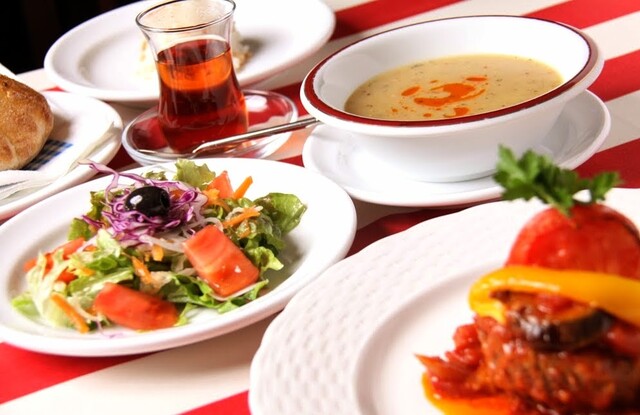
Urawa’s dining rhythm is quieter than Tokyo’s, but that restraint makes its sharper specialist rooms easier to read. Turkish Ryori Asena sits in the part of Saitama’s restaurant culture where a meal is not built around spectacle, celebrity, or tasting-menu escalation. The draw is a cuisine with deep regional grammar: grilled meats, bread, rice, yogurt, herbs, pulses, and the long Ottoman habit of absorbing influence without losing structure.
Turkish cooking occupies an unusual position in Japan’s ethnic dining scene. It is familiar enough through kebab stands and casual plates, yet the broader repertoire remains underrepresented beside Chinese, Korean, Thai, Vietnamese, and Indian cooking. A serious Turkish restaurant therefore carries a different kind of weight. It introduces the table to a food culture shaped by Anatolia, the Balkans, the Levant, and Central Asia, but it has to do so in a Japanese dining market that prizes clarity, portion control, and service discipline.
Turkish cooking in Urawa, read as culture rather than novelty
The restaurant’s 2024 selection for Tabelog’s Asian cuisine / Ethnic cuisine EAST “Tabelog 100” places it inside a curated field that rewards depth in non-Japanese cuisines across eastern Japan. That matters because Turkish restaurants in Japan often get flattened into a narrow image of kebab-shop convenience. A recognized Urawa address pushes the category into a more considered register, closer to the way diners now approach regional Chinese, Vietnamese, Sri Lankan, and South Indian cooking: not as a change of pace, but as a cuisine with its own standards.
The cultural interest lies in how Turkish food handles balance. Acidity, smoke, dairy, spice, grain, and meat are not separate decorative elements; they are the architecture of the table. In Japan, where diners are fluent in set meals and shared izakaya formats, that structure translates well. Turkish Ryori Asena’s value is not that it imports an idea wholesale, but that it gives Urawa a format for eating across several registers at once: family meal, date-night room, halal-aware option, and regional specialist.
Against Saitama peers, the positioning is telling. Unagi Hamana and Wataya sit in higher dinner brackets, while Komorebi Shokudo + works at a lower everyday range. Chinese restaurant HAKUBI and Masuya occupy a middle tier closer to Asena’s dinner economy. The comparison is less about hierarchy than choice: eel, Japanese dining, Chinese cooking, and Turkish food answer different cravings, and Asena gives Urawa a category that is far less common than the others.
A compact specialist room in a city that rewards regulars
Saitama’s stronger restaurants often operate with neighborhood confidence rather than metropolitan performance. That suits Turkish food. The cuisine depends on a sense of sequence and sharing, and the room size here keeps the experience closer to a local specialist than a destination machine. The format is also practical for mixed groups: halal options broaden the audience, wine and cocktails sit alongside the meal, and take-out adds a more casual route into the cooking.
There is a useful distinction between ethnic dining as tourism and ethnic dining as part of a city’s weekly life. Urawa does not need another imported concept dressed for novelty. It benefits more from places that make a cuisine legible enough for repeat use. In that sense, Turkish Ryori Asena’s significance is local: it helps normalize Turkish cooking as a Saitama option rather than a Tokyo detour.
The 2020 opening date also places the restaurant in a generation shaped by difficult operating years. Many small dining rooms that opened around that period had to define themselves quickly, especially outside central Tokyo, where discovery depends on local credibility and platform recognition. Selection in the 2024 Tabelog 100 list gives the restaurant a public signal that reaches beyond Urawa without turning the meal into a trophy hunt.
How to place it within a Saitama food itinerary
For visitors building a Saitama dining day, Asena works better as a cultural counterpoint than as a solitary headline. Pair it with patisserie or bakery stops to see how Urawa and Kita-Urawa move between European technique, everyday Japanese dining, and specialist international cooking. Nearby editorial context starts with Acacier Kitaurawa honten, Acacier Urawa ten, Aki Foods, Bagel Shop vivant, and Beach Story.
Readers mapping the wider city should use Our full Saitama restaurants guide first, then branch into Our full Saitama hotels guide, Our full Saitama bars guide, Our full Saitama wineries guide, and Our full Saitama experiences guide. For broader comparison across Japanese and international dining categories, useful cross-city references include -Grilled beef Sukiyaki- KAMAKURA TANUKIAN 鎌倉 たぬき庵 in Kamakura. 鮪と炭火焼き うお炭 秋葉原店 in Tokyo.cafe in Osaka.know in Kumamoto, (Shoku) Vietnam in Kawasaki, [Curry Senmon Ten] Maruyama Kyoju. in Sapporo, Jōdo Saké Bar in Los Angeles, and Onigiri Time in Pasadena.
The critical read is simple: the restaurant is strongest when viewed as part of Saitama’s maturing specialist-dining map. It is not trying to imitate Tokyo’s high-gloss international restaurants. Its importance is quieter and more useful: a Turkish table in Urawa with award recognition, halal-aware flexibility, and enough category definition to make the cuisine feel settled in the city rather than passing through.
Price and Positioning
Comparable venues by cuisine and price in the same metro.
| Venue | Cuisine | Price | Notes |
|---|---|---|---|
| Turkish Ryori AsenaThis venue — the venue you are viewing | Urawa, Turkish Grill | $$ | Not listed |
| Patisserie Rotantikku | Minami Urawa, French Patisserie | $$ | Not listed |
| Jikasei Temomimen Suzunoki | Sayamagaoka, Handmade Flat Noodle Ramen | $$ | Not listed |
| かねかつ | Not listed | $$ | 北浦和 (Kita-Urawa), Traditional Shoyu Ramen & Abura Soba |
| Teuchi Udon Matsuna | Urawa, Handmade Udon | $ | Not listed |
| Inakaya Irori | Not listed | $$ | Urawa-ku, Traditional Japanese Izakaya with Irori Hearth |
Recognition history
Dated appearances from independent guides and award organizations, with the underlying list record or original source where available.
Tabelog 100 #30 · No. 30
Tabelog · Tabelog 100 - Asian cuisine / Ethnic cuisine - EAST - 2024










At a Glance
- Cozy
- Intimate
- Group Dining
- Family
- Celebration
- Casual Hangout
- Private Event
- Standalone
- Private Dining
- Terrace
- Beer Program
- Corkage Allowed
- Local Sourcing
A cozy, intimate, small-scale neighborhood restaurant with a relaxed atmosphere suited to lingering lunches, family meals, and small gatherings.