
Tonkatsu Aoki Daimon ten belongs to the serious Tokyo tonkatsu category: compact, counter-led, pork-cutlet focused, and recognised in Tabelog 100 - Tonkatsu - 2026. The appeal is less ceremony than discipline, with a modest price band, curry on the margins, sake available, and a format that rewards diners who understand how specialised everyday Japanese restaurants work.
Pearl is the En Primeur Club membership app — saves, bookings, and concierge access live there. Same editors, same standards.
- Address
- 東京都港区浜松町1-11-12 KMビル 1F
- Phone
- +81354736403
- Website
- tonkatsu-aoki.com
 Saves & bookings on Pearl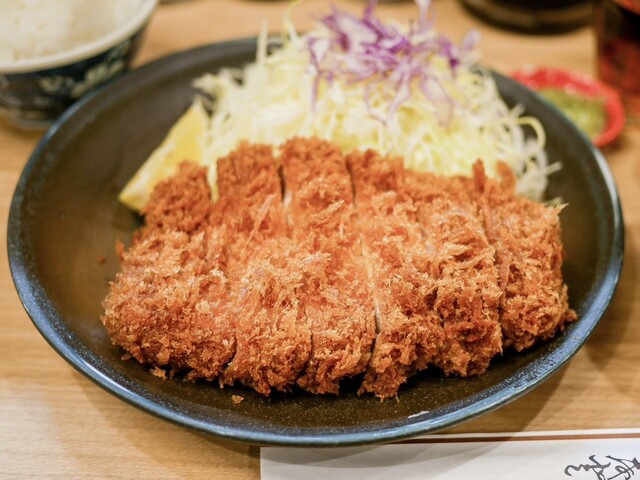
The room follows familiar Tokyo grammar: counter seats close enough to make the fryer part of the performance, tables for small groups, and a pace shaped by lunch breaks as much as destination dining. Abroad, tonkatsu is often comfort food; in Japan its serious end is technical: pork selection, breading, oil management, resting, rice, cabbage, sauce, salt. A restaurant in this category needs consistency more than a long menu.
That frames Tonkatsu Aoki Daimon ten, a compact pork-cutlet and curry address in the Daimon and Hamamatsucho orbit. Its selection for Tabelog 100 - Tonkatsu - 2026 places it in a narrow national conversation about specialist tonkatsu, beyond casual teishoku restaurants. Its Tabelog score of 3.66 reflects Japanese review-site reality: where local regularity matters, a mid-three score can signal serious traction.
Tonkatsu as everyday food with specialist standards
Tonkatsu sits at a useful intersection in Japanese dining: Western-influenced in origin, deeply local in current grammar, and democratic in price compared with sushi, kaiseki, tempura, or wagyu counters. It is simple enough for train-station chains, yet exacting enough to sustain nationally recognised specialists. The difference is repetition: the same cut, fryer, and rice service, executed under pressure.
Within that tradition, the Daimon branch reads as a practical specialist, not a polished tasting-menu room. The category line is Tonkatsu (Pork cutlet), Curry, and the structure is small: 18 seats, including 10 at the counter and 8 at tables. That ratio matters. Counter seating keeps the room direct but not impersonal; diners see the kitchen rhythm, while tables suit pairs or families wanting the same cooking without chef-counter intensity.
The condiment detail is telling. Seven types of salt are listed, making seasoning choice part of the meal rather than leaving sauce as the default. In serious tonkatsu culture, salt changes how pork fat, crust, and rice register, separating this style from the heavier, sauce-led image of fried cutlet abroad. The weekday loin lunch set, available only at lunchtime on weekdays except Saturdays, shows the dish’s workday cadence, not just a weekend queue.
Compared with higher-spend Japanese dining in the same travel circuit, the value is clear. Sushi Hiroya in Hamamatsu sits in a JPY 15,000 - JPY 19,999 bracket, while Shoutai En Shibadaimon ten reaches JPY 6,000 - JPY 7,999 in one listed range. Tonkatsu Iwai, another tonkatsu reference point, appears in the JPY 2,000 - JPY 2,999 bracket. Tonkatsu Aoki Daimon ten occupies the lower JPY 1,000 - JPY 1,999 range, making its Tabelog 100 recognition more interesting: distinction comes from category precision, not luxury pricing.
The Daimon-Hamamatsucho setting favours speed, repeat visits, and restraint
Daimon and Hamamatsucho are not built around the dining mythology of Ginza or Roppongi. The area is connective tissue: offices, train lines, airport-bound travellers, temple approaches, and weekday foot traffic that rewards confident service over theatre. Here, tonkatsu makes cultural sense: substantial without becoming an occasion, specialised without requiring a long sitting, and suited to solo counter dining or small groups.
The address, 東京都港区浜松町1-11-12 KMビル 1F, places the restaurant on Minato’s Hamamatsucho side rather than in a visitor-only leisure district. The nearest-station note points to Daimon Station, with Hamamatsucho also in walking range, fitting the practical Tokyo pattern of eating near transport without defaulting to station-building compromise. Parking is unavailable: arrive by rail, not car.
The operation is stricter than many travellers expect from a low-price restaurant. Reservations are unavailable, payment is effectively cash-only because credit cards, electronic money, and QR code payments are not accepted, and private rooms are absent. These constraints are common in small Japanese specialists prioritising throughput, repeatability, and low overhead. For visitors: plan around the queue, bring yen, and treat the room as a meal stop rather than a lingering appointment.
Current pattern is Tuesday to Saturday service, with lunch and dinner periods listed and Monday and Sunday closed. Hours can change in Japan more often than visitors expect, especially at small restaurants, so avoid building an entire day around a single low-capacity lunch unless the schedule has been checked close to arrival. Take-out is listed, but the core experience remains the counter-and-table meal, where texture and timing matter.
Where it fits in a serious Japan itinerary
For travellers building a Japan dining itinerary, this stop keeps the schedule from becoming only omakase, kaiseki, and hotel dining. Tonkatsu has its own discipline, and Tabelog’s Tonkatsu 100 selection gives the category an evaluative frame visitors can read without a Michelin star or chef biography. The opening date, 2016.1.6, gives the restaurant enough history to suggest it is not a passing novelty in a trend-sensitive city.
The better comparison is with other focused formats across Japan: soba shops, curry specialists, yakitori counters, tempura bars, and regional noodle houses where a narrow menu carries the reputation. Readers mapping that side of the country can cross-reference Honkaku Teuchi Moriya Toukyou ten, Fukumitsu, Kibori, Binshan Li, and Abondance for different expressions of specialisation. Broader planning sits in Our full Hamamatsu restaurants guide, with adjacent rails for Our full Hamamatsu hotels guide, Our full Hamamatsu bars guide, Our full Hamamatsu wineries guide, and Our full Hamamatsu experiences guide.
For a wider Japan-and-beyond reading list, the same editorial logic applies to focused venues such as -Grilled beef Sukiyaki- KAMAKURA TANUKIAN 鎌倉 たぬき庵 in Kamakura. 鮪と炭火焼き うお炭 秋葉原店 in Tokyo.cafe in Osaka.know in Kumamoto, (Shoku) Vietnam in Kawasaki, [Curry Senmon Ten] Maruyama Kyoju. in Sapporo, Jōdo Saké Bar in Los Angeles, and Onigiri Time in Pasadena. The point is not sameness; it is the pleasure of restaurants that make a tight promise and live or fail by execution.
The editorial case for Tonkatsu Aoki Daimon ten is specific: a modestly priced, award-listed tonkatsu specialist with a small room, counter focus, cash-only discipline, no reservations, and enough seasoning detail to reward attention. It is not a grand Tokyo meal. It is a reminder that Japanese dining culture often reaches its sharpest expression through repetition, constraint, and a plate of fried pork treated with seriousness.
Pricing, Compared
Nearby venues at a similar price tier for orientation.
| Venue | Cuisine | Price | Notes |
|---|---|---|---|
| Tonkatsu Aoki Daimon tenThis venue — the venue you are viewing | Not listed | $ | Not listed |
| Unagi Ryori Atsumi | Not listed | $$ | Chuo-ku, Traditional Unagi (eel) Restaurant |
| Honkaku Teuchi Moriya Toukyou ten | Hamamatsucho, Traditional Sanuki Udon | $$ | Not listed |
| Kiyo | Not listed | $ | Naka Ward (Kamoe), Traditional Hamamatsu gyoza & horumon |
| Kohaku | Not listed | $ | Chuo Ward, Hamamatsu gyoza & Chinese dumpling house |
| 彩席かわかみ | Not listed | $$$$ | 第一通り (Daiichi-dori), Shizuoka Kaiseki |
Recognition history
Dated appearances from independent guides and award organizations, with the underlying list record or original source where available.
Tabelog 100 #29 · No. 29
Tabelog · Tabelog 100 - Tonkatsu - 2026
Continue exploring
More in Hamamatsu
Restaurants in Hamamatsu
Browse all →

Bars in Hamamatsu
Browse all →



At a Glance
- Lively
- Classic
- Solo
- Casual Hangout
- After Work
- Standalone
Compact, no-frills tonkatsu shop with an open kitchen, counter seating, and a bustling, casual atmosphere focused on quick meals rather than lingering.