
Tabelog 100 #52
Our verdict
Tonjinchi gives Himi a ramen address with serious national signal rather than tourist-port convenience. Its repeated selection for Tabelog Ramen WEST “Tabelog 100” from 2018 through 2025 places a small Toyama shop inside a competitive western Japan ramen conversation, while the sub-¥1,000 listed budget keeps the experience grounded in everyday eating.

Pearl is the En Primeur Club membership app — saves, bookings, and concierge access live there. Same editors, same standards.
- Address
- 富山県氷見市朝日本町1-30
- Phone
- +81766720104
- Website
- tabelog.com
- Directions
- Get directions
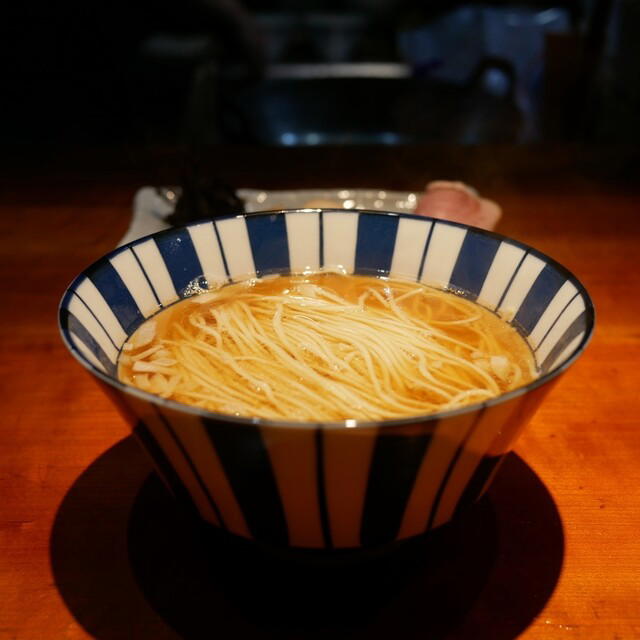
The menu
What to order
- Himi dried sardine (niboshi) ramen
- White soy sauce ramen
- Black soy sauce ramen
Himi’s food identity is often introduced through its coastal setting and everyday local dining rhythms. Tonjinchi sits in a clearly defined lane: a ramen and dining-bar venue in Himi where the appeal is less about spectacle than about a direct, accessible format and a bowl-centered visit.
That matters in Toyama. The prefecture is often discussed through seafood, mountain water, and local sake, but ramen has its own place in the region’s dining map. Shops outside the large-city circuit do not survive on novelty alone; they need repeat use, enough character to travel for, and a format that works for everyday meals. Tonjinchi’s 2025 recognition from Tabelog Hyakumeiten gives it a clearer credential than casual word-of-mouth. In a category crowded with urban specialists, a Himi address making that selection says something about the pull of ramen beyond the usual metropolitan routes.
Himi ramen with a local dining context
The useful way to read Tonjinchi is through Himi itself. This is a city where dining is often framed by seafood, local producers, and small-scale restaurants. Himi Uoichiba Shokudo represents the market-driven side of the city’s appetite, while セイズファーム points toward another part of the region’s table culture. Ramen fits between those poles: less ceremonial than a long meal, more rooted than a transit snack, and dependent on broth discipline, noodle timing, and regular use rather than decorative plating.
The listed category is ramen and dining bar, a pairing that gives the venue a broader register than a pure noodle stop. That is a useful clue to how the place is positioned: not only as a quick bowl, but as a Himi dining option with enough flexibility for different visits. The food budget is listed at - JPY 999 for both lunch and dinner, a notable signal among award-recognized ramen shops, where reputation can push demand faster than the format changes.
That low price bracket also changes the critical lens. At this level, polish is not the point. The question is whether a bowl shop can deliver enough identity, consistency, and local relevance to justify attention in a city already rich in other food reasons to visit. Tonjinchi’s 2025 Tabelog Hyakumeiten recognition answers that with a clear public marker. For travelers building a Himi dining day, the contrast is useful. Seafood can make the obvious argument; ramen here supplies the everyday counterpoint.
A ramen-and-dining-bar format rather than a destination performance
Japanese ramen culture rewards speed, repetition, and precision, but the atmosphere varies sharply by city and by shop. In larger centers, award-listed ramen can feel engineered for queues and turnover. Himi suggests a different context. Tonjinchi is best understood first through its listed identity: ramen and dining bar in Himi, with recognition that makes it stand out without turning it into a formal tasting-menu proposition.
That distinction is worth taking seriously. In smaller Japanese cities, this kind of venue can blur the line between neighborhood utility and destination eating. It is not a hotel dining room, not a market hall, and not a chef-theatre counter. The draw is a ramen and dining-bar experience with enough recognition to pull diners who are already in Himi for the coast, the fish, or the slower Toyama itinerary.
For comparison within the city, Himi Uoichiba Shokudo reads as a seafood-market choice. セイズファーム belongs to another register, closer to a countryside restaurant and winery frame. Tonjinchi is the sharper low-budget ramen move, useful when the day calls for a focused bowl rather than a longer meal.
How to place it in a Himi itinerary
Tonjinchi belongs in a Himi plan that treats the city as more than a quick seafood stop. Its location is Himi, which makes it part of the same city-wide dining conversation as the market, the coast, and the slower Toyama itinerary rather than a separate destination performance.
Practical planning should stay simple. The public listing gives Tonjinchi’s phone number as +81-766-72-0104, and diners should confirm current hours, service details, and payment conditions directly before going. For an award-recognized ramen and dining-bar venue, that kind of check is more useful than assuming a tourist-facing buildout.
Readers mapping the wider city can use our full Himi restaurants guide for nearby tables, then branch into our full Himi hotels guide, our full Himi bars guide, our full Himi wineries guide, and our full Himi experiences guide to build the rest of the trip. For a broader Japan dining sweep beyond Toyama, keep separate notes on other dining rooms across Japan and beyond, while keeping Himi’s own restaurant circuit distinct.
The editorial case is simple: Himi has obvious seafood reasons to visit, but Tonjinchi adds a different kind of proof. It shows how a Toyama ramen and dining-bar venue can earn category recognition while remaining in the everyday price tier. That is the useful signal for travelers who care less about ceremony and more about where a city actually eats.
Frequently asked questions
Is Tonjinchi suitable for children?
Tonjinchi is a ramen and dining-bar venue in Himi. Check the venue's official channels for the latest details before visiting with children.
What should I expect atmosphere-wise at Tonjinchi?
Expect a ramen and dining-bar format rather than a formal dining room. Tonjinchi is in Himi, and the venue is listed for ramen and dining-bar use.
What does dinner at Tonjinchi typically cost?
Pricing at Tonjinchi is listed as - JPY 999 - JPY 999.
Where is Tonjinchi in Himi?
Himi.
Do I need a reservation for Tonjinchi?
Check Tonjinchi’s official channels or call +81-766-72-0104 for the latest reservation and service details.
What has Tonjinchi built its reputation on?
Tonjinchi was recognized by Tabelog Hyakumeiten in 2025. That recognition, plus its ramen and dining-bar format in Himi, is the clearest sign of its standing.
In Context: Similar Options
Comparable venues by cuisine and price in the same metro.
| Venue | Cuisine | Price | Awards | Notes |
|---|---|---|---|---|
| TonjinchiThis venue — the venue you are viewing | Himi niboshi ramen & casual dining bar | $1–10 | Tabelog 100 #52 | Not listed |
| Tonjinchi (貪瞋癡) | Himi niboshi ramen & casual dining bar | $1–10 | Tabelog 100 #52 | Himi |
| Himi Uoichiba Shokudo | Japanese seafood market canteen | $20–30 | Tabelog 100 #54 | Himi |
| セイズファーム | Italian-based Farm-to-Table with Local Toyama Ingredients | Not listed | Not listed | Himi |
| Koja Sobaya | Authentic Miyako Soba | $1–10 | Not listed | Hirara |
| Gyoza Hohei (ぎょうざ 歩兵) | Gyoza specialty shop | $10–20 | Tabelog 100 #38 | Gion |
Recognition history
Dated appearances from independent guides and award organizations, with the underlying list record or original source where available.
Tabelog 100 #52 · No. 52
Tabelog · Tabelog 100 - Ramen - WEST - 2025
Continue exploring
More in Himi
Restaurants in Himi
Browse all →
Bars in Himi
Browse all →
Hotels in Himi
Browse all →
Wineries in Himi
Browse all →
Details
- Cozy
- Solo
- Family
- Casual Hangout
- Standalone
- Local Sourcing
- A La Carte
- Counter Dining
- Shochu
- Wine
- Pescatarian Friendly
A small house-like ramen shop with just 18 seats, counter and table seating in a relaxed, non-smoking space that feels cozy and informal but often energetic due to long lines and high demand.