

Tabelog Bronze #113
Our verdict
Toyama’s seafood economy gives Italian cooking here a sharper local accent than the usual pasta-and-wine template. Himawari Shokudo 2 works in the small-counter, reservation-led tier, with Tabelog Award 2026 Bronze recognition and an eight-seat format that places it closer to regional gastronomy than casual trattoria dining.

Pearl is the En Primeur Club membership app — saves, bookings, and concierge access live there. Same editors, same standards.
- Address
- 1 Chome-5-18 Jinzuhonmachi, Toyama, 930-0008, Japan
- Phone
- +81 76-482-6091
- Hours
- Mon–Fri 6–10 PMSat 12–3 PM, 6–10 PMSun 6–10 PM
- Website
- r930900.gorp.jp
- Directions
- Get directions
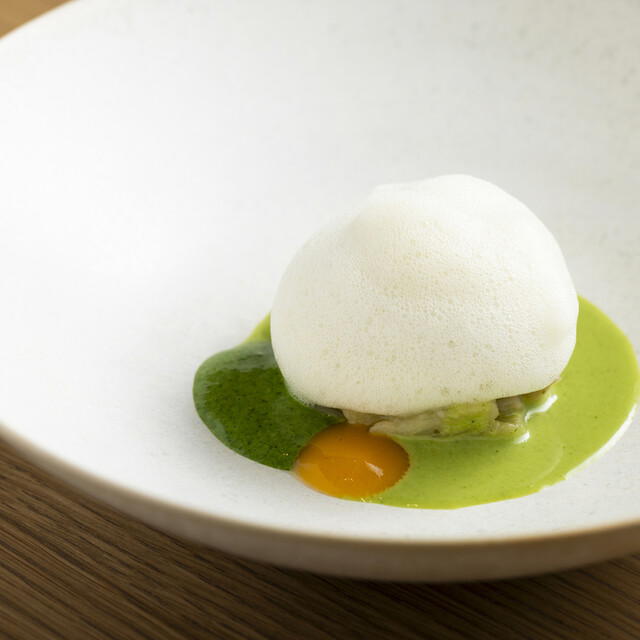
The menu
What to order
- Mountain yam crepe with firefly squid
- Owara Clean Pork roast
- Agnolotti with venison ragu
Approaching a serious small counter in Toyama feels different from arriving at a destination restaurant in Tokyo or Osaka. The city is quieter, the dining room tends to announce less, and the pressure sits on the plate rather than the room. Himawari Shokudo 2 belongs to that Toyama register: compact, counter-focused, and Italian by category, but shaped by a port city whose cooking culture is inseparable from the Sea of Japan.
That regional setting matters. Italian dining in Japan often divides into recognizable camps: Tokyo’s luxury Italian rooms with cellar depth and metropolitan polish, Kyoto’s produce-led kitchens that fold Italian technique into local seasonality, and smaller-city counters where the cook’s access to fish can define the entire experience. Toyama belongs to the last category. The city’s reputation for seafood gives Italian cuisine a different center of gravity, less Roman trattoria nostalgia, less Milanese formality, more dialogue between pasta, wine, and the day’s marine supply.
Toyama seafood gives the Italian format its local grammar
The interesting comparison is not whether a restaurant in Toyama can imitate Tuscany or Naples. It is whether Italian structure can make local ingredients read with clarity. Himawari Shokudo 2 is listed as Italian, with an emphasis on fish and wine, which places it in a category that Japan has refined over decades: Italian as a flexible technique rather than a fixed regional costume. In that context, the venue’s small scale is not a decorative detail. An eight-seat counter changes the rhythm of service, compressing the distance between cooking, pacing, and guest attention.
Regional Italian identity still provides the useful frame. Roman cooking prizes directness, Tuscan cooking leans into grilled meats, legumes, and olive oil, Neapolitan tradition carries tomato, dough, and southern brightness, while Milanese dining is often associated with rice, butter, and northern polish. Toyama does not naturally map onto any one of those regions. Its logic is coastal and seasonal, so Italian here works well when it borrows grammar rather than costume: acidity, olive oil, pasta, wine service, and restrained handling of fish.
The Tabelog Award 2026 Bronze recognition gives that regional conversation a measurable public signal. Tabelog’s scoring culture is demanding in Japan because regular diners use it with unusual intensity; a 3.99 score in a provincial city places the restaurant in a serious national conversation without needing the theatrics that often surround capital-city dining. Among comparison points beyond Toyama, Lito occupies a similar dinner price band, while VENTINOVE sits lower. Fogliolina della Porta Fortuna, il AOYAMA, and cenci suggest how wide Japan’s Italian field has become, from regional counters to city restaurants with a more established Italian fine-dining vocabulary.
A counter restaurant, not a trattoria postcard
The room format pushes the experience away from the democratic clatter of a neighborhood trattoria. Counter seating is a Japanese answer to intimacy: it turns timing, portioning, and temperature into part of the meal’s architecture. In a city where sushi, kappo, and small kaiseki rooms have long taught diners to read the counter as a serious stage, Italian cooking can borrow that discipline without pretending to be Japanese cuisine.
That is the distinction that makes Himawari Shokudo 2 more interesting than a broad claim about Italian food in Toyama. The restaurant is not merely serving an imported cuisine in a regional city; it sits inside a Japanese dining habit that rewards small capacity, chef-facing service, and ingredient specificity. The wine emphasis reinforces the European side of the equation, while the fish focus keeps the table anchored in Toyama rather than in a generic Italian fantasy.
Within Toyama’s broader dining scene, that puts it in a different lane from the city’s more casual and traditional addresses. For local restaurant context, Boteyan and Boteyan Tanaka speak to a more everyday side of Toyama dining, while Cave Yunoki, Daimon, and Daruma help map the city’s range. The useful way to read the restaurant is as part of a smaller, higher-commitment tier: fewer seats, tighter pacing, and a meal built for diners who care about the difference between Italian category and Italian thinking.
How to place it in a Toyama itinerary
For travelers, Toyama works better as a food city when it is treated on its own terms rather than as a stop between Kanazawa and the alpine route. The restaurant’s recognition and scale make it a planned dinner rather than a spontaneous fallback, especially for visitors building a short stay around one serious meal. Its smart-casual tone also signals a level of formality, but the counter format keeps the experience closer to focused dining than ceremony.
The practical decision is whether the trip needs Italian cooking that reflects Toyama rather than Italian cooking that is lifted into another city unchanged. Diners looking for a broad à la carte evening, private-room comfort, or a vegan menu will find better fits elsewhere. Diners interested in Japan’s regional Italian movement, where local seafood and wine service define the meal, have a clear reason to put this on the schedule.
For wider planning, use our full Toyama restaurants guide alongside our full Toyama hotels guide, our full Toyama bars guide, our full Toyama wineries guide, and our full Toyama experiences guide. For a broader Japan dining comparison outside Toyama, note how specialized formats stretch across the country, from -Grilled beef Sukiyaki- KAMAKURA TANUKIAN 鎌倉 たぬき庵 in Kamakura and. 鮪と炭火焼き うお炭 秋葉原店 in Tokyo to.cafe in Osaka.know in Kumamoto, (Shoku) Vietnam in Kawasaki, and [Curry Senmon Ten] Maruyama Kyoju. in Sapporo. For Italian reference points beyond Japan, 112 Eatery, Italian in Minneapolis and 8 1/2 Otto e Mezzo Bombana (Hong Kong), Italian in Hong Kong show how elastic the category becomes once it leaves Italy and enters a serious local dining culture.
Frequently asked questions
Is Himawari Shokudo 2 suitable for children?
Those details are not published. With dinner service in Toyama and a smart casual dress code, it reads more like an adult dining room than a casual family spot. Check the venue's official channels for the latest details.
What is the atmosphere like at Himawari Shokudo 2?
Himawari Shokudo 2 is a small Italian room in Toyama with counter seating and just 8 seats, so the feel is focused rather than loose or noisy. Its Tabelog 2026 Bronze award and reservation-only format place it in a more serious dining tier than an everyday trattoria.
What type of food is Himawari Shokudo 2 known for?
Himawari Shokudo 2 serves Italian cuisine.
What's the price range at Himawari Shokudo 2?
Pricing at Himawari Shokudo 2 is listed as JPY 20,000 - JPY 29,999.
What are Himawari Shokudo 2's hours?
Hours at Himawari Shokudo 2: Mon: 6–10 PM; Tue: 6–10 PM; Wed: 6–10 PM; Thu: 6–10 PM; Fri: 6–10 PM; Sat: 12–3 PM, 6–10 PM; Sun: 6–10 PM.
Where is Himawari Shokudo 2 in Toyama?
Himawari Shokudo 2 is located in Toyama.
How It Stacks Up
Comparable venues by cuisine and price in the same metro.
| Venue | Cuisine | Price | Awards | Notes |
|---|---|---|---|---|
| Himawari Shokudo 2This venue — the venue you are viewing | Modern Italian with Toyama Ingredients | $100–150 | Tabelog Bronze #113 | Not listed |
| シンポジウム | Vegetable-Focused Italian Regional Cuisine | $100–150 | Not listed | Hommachi |
| ラ・ロカンダ・デル・ピットーレ環水公園 | 薪窯ピッツェリア | $30–50 | Not listed | Minatoirifunecho |
| 寿司栄 華やぎ | Traditional Japanese Sushi Omakase | $100–150 | Not listed | Taromaru Nishimachi |
| GEJO | Sushi Omakase | $150–200 | Tabelog 100 #74 | Higashiiwasemachi |
| Tempura Koizumi Takano | Seasonal Kansai-style Tempura Omakase | $100–150 | Tabelog 100 #79 | Toyama Station area |
Recognition history
Dated appearances from independent guides and award organizations, with the underlying list record or original source where available.
Tabelog Bronze #113
Tabelog
The Japan Times Destination Restaurants Destination Restaurants Selection #6
The Japan Times Destination Restaurants
Continue exploring
More in Toyama
Restaurants in Toyama
Browse all →
Hotels in Toyama
Browse all →
Wineries in Toyama
Browse all →
Details
- Intimate
- Elegant
- Cozy
- Sophisticated
- Date Night
- Special Occasion
- Celebration
- Chefs Counter
- Private Dining
- Sake Program
- Extensive Wine List
- Local Sourcing
- Street Scene
- Omakase
- Tasting Menu
- Wine
- Vegetarian Friendly
Current opening hours
- Monday
- 6–10 PM
- Tuesday
- 6–10 PM
- Wednesday
- 6–10 PM
- Thursday
- 6–10 PM
- Friday
- 6–10 PM
- Saturday
- 12–3 PM, 6–10 PM
- Sunday
- 6–10 PM
Hours can change for holidays and private events. Last verified .
Cozy counter seating facing a high kitchen wall with a long window offering street views; sophisticated yet simple atmosphere focused on the culinary experience.