
Teuchi Shimada puts handmade udon and soba into Minami-Aoyama’s polished dining grid without turning the format into ceremony. Its Tabelog 100 Udon EAST selections in 2020, 2022, and 2024 place it in Tokyo’s serious noodle conversation, while the izakaya structure, sake and shochu focus, and late dinner rhythm make it read as a neighborhood dining room rather than a quick lunch counter.
Pearl is the En Primeur Club membership app — saves, bookings, and concierge access live there. Same editors, same standards.
- Address
- 東京都港区南青山3-13-3
- Phone
- +81334030201
- Website
- tabelog.com
 Saves & bookings on Pearl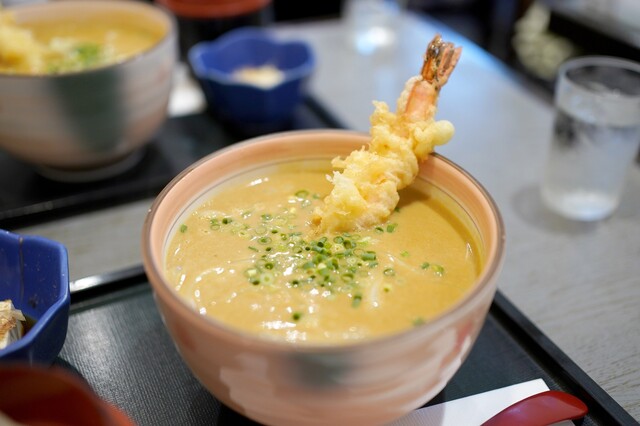
Minami-Aoyama usually announces dining through design: glass-fronted boutiques, narrow staircases, small signs that assume the guest already knows where to look. In that setting, handmade noodles carry a different kind of confidence. The room does not need the hush of Ginza sushi or the choreography of a kaiseki counter; the point is craft held inside an everyday format, with udon, soba, fish-led izakaya cooking, sake, and shochu sharing the same table.
Tokyo’s serious noodle culture is often split in the visitor’s imagination: ramen for speed and intensity, soba for Edo restraint, udon for comfort. That reading misses how competitive the city’s udon tier has become. Tabelog’s Udon 100 lists have turned the category into a mapped field of specialists, and Teuchi Shimada’s selections for TOKYO in 2020 and EAST in 2022 and 2024 put it in that conversation. The listed score of 3.63 is not the point on its own; the stronger signal is repeat selection across multiple cycles in a category where handmade technique is easy to claim and harder to sustain.
Handmade noodles with an izakaya cellar logic
The more interesting reading here is not simply “go for udon.” It is that Tokyo’s better noodle houses increasingly blur the line between meal and drinking table. Teuchi Shimada is listed across udon, soba, and izakaya categories, and the drinks program is explicitly built around sake and shochu. That matters because udon restaurants aimed only at turnover rarely need much cellar thinking. A sake-and-shochu spine changes the meal’s pacing: fish, shared plates, noodles at the end, and a table that can run closer to an evening session than a bowl-and-exit stop.
That structure also explains why curry udon has become part of the restaurant’s public identity. The kitchen notes a renewed soup stock prepared from early morning and points to curry udon as a common closing order, while also making clear that the menu is broader than one bowl. The editorial takeaway is simple: treat the noodles as the anchor, not the whole meal. In Aoyama, where nearby dining can lean toward polished French, Italian, Chinese, and kaiseki formats, this is a more grounded counterpoint, especially beside comparison venues such as Radio, MIMOSA, misola, Etruschi, and Aoyama Jin.
For readers mapping a wider Tokyo itinerary, this address sits in a useful middle lane between destination dining and local routine. It belongs in the same research pass as Our full Tokyo restaurants guide, but it solves a different problem from tasting-menu planning: a handmade noodle meal with enough drink structure to justify dinner. Those building a fuller city plan can cross-check the surrounding trip architecture through Our full Tokyo hotels guide, Our full Tokyo bars guide, Our full Tokyo wineries guide, and Our full Tokyo experiences guide.
Why Aoyama makes the format sharper
Omotesando and Minami-Aoyama reward restaurants that know exactly what role they play. Luxury retail, gallery traffic, office lunches, and residents all overlap here, which means a noodle house cannot rely only on novelty. The format has to work twice: fast enough for lunch, substantial enough for dinner. Teuchi Shimada’s published budgets reflect that split, with lunch in the JPY 1,000 to JPY 1,999 range and dinner in the JPY 4,000 to JPY 4,999 range. In Tokyo terms, that places the restaurant below the city’s prestige-counter economy and closer to the category of craft-led everyday dining.
The 84-seat scale is another useful signal. Many acclaimed Tokyo food addresses trade on tiny capacity; this one works with a larger footprint, including a second-floor tatami room without partitions. That does not make it casual in the careless sense. It means the value lies in consistency across volume, a harder test for handmade noodles than an eight-seat performance format. Private use is listed for groups of 20 to 50, which further explains the banquet rhythm: the restaurant can function as both noodle specialist and social dining room.
There are practical frictions, and they are worth respecting. Lunch is cash only, individual bills are not offered, and QR code payments are not accepted. Credit cards listed include JCB, AMEX, and Diners, while transportation IC cards, iD, and QUICPay are accepted. Parking is unavailable, which is normal for this part of the city; the Tokyo Metro approach is the sensible plan. The published transport note places it a four-minute walk from Omotesando Station, a useful detail in a neighborhood where the wrong exit can add unnecessary time.
Tokyo noodle research can quickly become sprawling, so comparisons should stay functional rather than decorative. Curry-focused travelers may also look at 3 Chome no Curry Ya San or [Curry Senmon Ten] Maruyama Kyoju. in Sapporo; casual-format readers may file 2D Cafe separately from noodle planning. For broader Japanese dining contrasts, see 124. KAGURAZAKA (Yakitori), 12/10 Shinjuku ten. 鮪と炭火焼き うお炭 秋葉原店, and -Grilled beef Sukiyaki- KAMAKURA TANUKIAN 鎌倉 たぬき庵 in Kamakura. Outside Tokyo, different casual craft registers appear at.cafe in Osaka.know in Kumamoto, (Shoku) Vietnam in Kawasaki, [ki:] in Kyoto, Jōdo Saké Bar in Los Angeles, and Onigiri Time in Pasadena.
Know Before You Go
- Area: Minami-Aoyama, near Omotesando Station.
- Recognition: Selected for Tabelog 100 Udon TOKYO 2020 and Tabelog 100 Udon EAST 2022 and 2024.
- Format: Handmade udon and soba with izakaya-style dining.
- Drinks: Sake and shochu are part of the listed focus.
- Budget: Lunch is listed at JPY 1,000 to JPY 1,999; dinner at JPY 4,000 to JPY 4,999.
- Payments: Lunch is cash only; no individual bills; QR code payments are not accepted.
- Room: 84 seats, with tatami seating on the second floor.
- Family note: Children are welcomed, with specific dinner-time limits and advance contact advised for some days.
Comparable Spots
Comparable venues by cuisine and category.
| Venue | Cuisine | Price | Notes |
|---|---|---|---|
| Teuchi ShimadaThis venue — the venue you are viewing | Udon & soba izakaya with handmade noodles | $$ | Not listed |
| Toyama Shiroebitei (富山白えび亭) | Toyama White Shrimp Tempura Bowls | $$ | Marunouchi |
| Shio Ramen Shinka | Traditional Shio Ramen | $$ | Machida |
| Sora to Mugi to | Organic Vegan Bakery & Café | $$ | Shibuya |
| 隼 | Japanese Cuisine | Not listed | Minato |
| Hototogisu | Michelin-Starred Seafood Ramen | $$ | Shinjuku |
Recognition history
Dated appearances from independent guides and award organizations, with the underlying list record or original source where available.
Tabelog 100 #16 · No. 16
Tabelog · Tabelog 100 - Udon - EAST - 2024















At a Glance
- Lively
- Cozy
- Classic
- Casual Hangout
- After Work
- Group Dining
- Family
- Solo
- Standalone
- Sake Program
Bustling, izakaya-like noodle house with a casual, classic feel; an 84-seat space including a non-partitioned tatami room upstairs, suited to groups and families rather than quiet, intimate dining.