Our verdict
A neighbourhood parrilla on the Chamartín edge of Madrid, Tanguito occupies the kind of corner site that defines a residential dining scene rather than a tourist circuit. The format is rooted in the Argentine and Spanish tradition of live-fire cooking, where the grill itself is both method and statement. For visitors looking beyond Madrid's tasting-menu tier, it represents a practical entry point into the city's carnivore-serious dining culture.

Pearl is the En Primeur Club membership app, where members save venues, book tables and use the concierge.
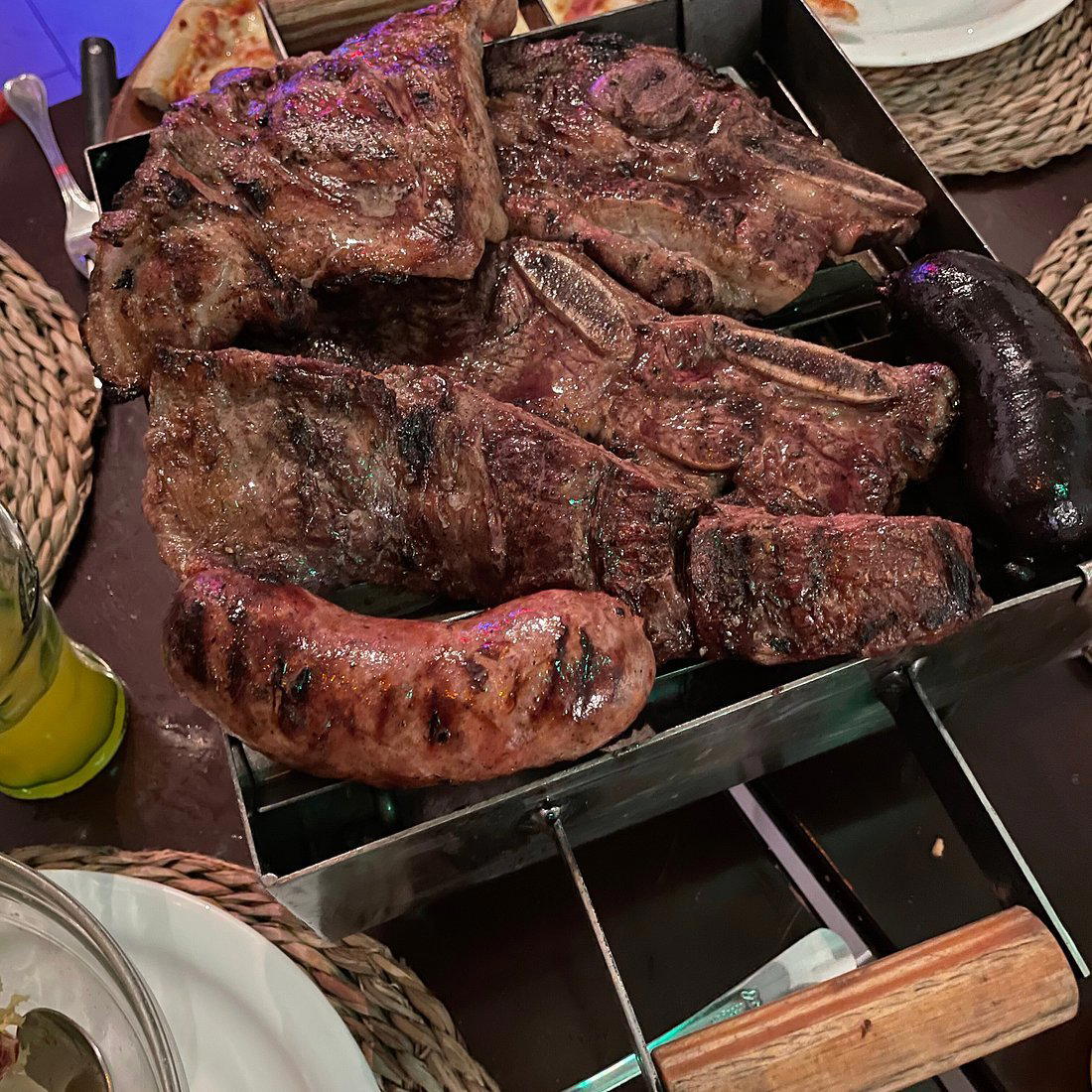
The menu
What to order
- Parrillada variada
- Milanesa napolitana con papas fritas
- Empanadas argentinas
- Creole sausages
- Roast strips
A Corner in Chamartín, and What It Signals About Madrid's Grill Culture
The parrilla format has a specific logic in Madrid: it does not compete with the tasting-menu restaurants that dominate Spain's critical conversation, and it does not need to. Where venues like DiverXO, Coque, and Deessa define one end of the city's dining spectrum, the neighbourhood grill house operates on a different register entirely: a physical space built around the fire, the cut, and the ritual of sharing meat at a table that was not booked three months in advance. Tanguito Parrilla, positioned on the corner of Calle de Eugenio Salazar in Chamartín, belongs to that second tradition.
Chamartín itself is a telling address. North of the Salamanca district and away from the tourist-facing restaurant corridors of Centro and Malasaña, it reads as a working residential neighbourhood, the kind of area where a parrilla fills a genuinely local role rather than performing one. That geographical fact matters when reading what Tanguito is for: it serves the block, the barrio, the regular table of four on a Tuesday evening, not a curated dining destination marketed to in-bound visitors.
The Space and What It Communicates
A corner site in Spanish dining carries specific spatial implications. Two exposed facades mean natural light enters from multiple angles, and street-facing windows create the visual transparency that differentiates a neighbourhood room from a closed, occasion-only dining box. The parrilla tradition, whether its roots are Rioplatense Argentine or Castilian, builds its interior identity around the grill itself: the physical structure of the fire station, the smoke, the rhythmic ordering of the cook's work. These elements are not decorative additions to the room; they are the room's reason for existing.
In that sense, Tanguito's corner address at Esquina García Luna positions the dining experience within a very legible spatial grammar. Guests approaching from either street axis get the full view of a working restaurant, not a curated entrance sequence designed to signal exclusivity. The format suggests counter sightlines to the grill area, shared tables where the smell of charcoal arrives before the plate does, and a noise level calibrated to conversation rather than reverence. This is the physical vocabulary of a parrilla, and it is a deliberate one.
Compare this spatial logic against Madrid's current tier of high-investment tasting rooms. DSTAgE and Paco Roncero both operate spaces where the architecture signals ceremony and controlled progression through a fixed menu. The parrilla inverts that model: the space signals availability, informality of service rhythm, and a menu structure built around selection rather than sequence. Neither model is subordinate to the other; they answer different questions about how people want to eat.
Live Fire as Format, Not Flourish
The parrilla, in its South American form, carries a long tradition of treating fire not as a technical tool but as the primary agent of flavour. The Argentine and Uruguayan asado tradition that informs venues carrying the parrilla name is built on specific practices: the distance of meat from coals, the management of radiant versus convective heat, the sequencing of cuts across an evening service. This is a discipline with its own technical depth, even if it operates without the written-out tasting menus and wine pairings that define Madrid's most decorated rooms.
Spain's own live-fire tradition, particularly prominent in the Basque Country and increasingly influential in Madrid's restaurant culture, converges with that South American lineage at venues like Tanguito. The result is a dining format that rewards knowledge of the product, the cut, and the fire, rather than deference to a chef's narrative arc. Restaurants like Arzak in San Sebastián and Azurmendi in Larrabetzu represent the technically complex end of that Basque fire lineage, while the parrilla format in Madrid operates at the other end of the same cultural axis: rigorous about the fire, informal about the frame around it.
Where Tanguito Sits in Madrid's Dining Picture
Madrid's restaurant scene in 2024 contains a pronounced bifurcation. At the prestige end, venues including El Celler de Can Roca in Girona, Martin Berasategui in Lasarte-Oria, and Mugaritz in Errenteria represent Spain's contribution to the global fine-dining conversation. Within Madrid itself, the tasting-menu circuit draws international attention. Below that tier, and in some ways more representative of how the city actually eats, is a dense layer of neighbourhood specialists: the taberna, the casa de comidas, the parrilla. Tanguito operates in this second layer, and for visitors building a complete picture of Madrid's dining character, that layer is as informative as the Michelin-decorated rooms.
The Chamartín location places it in company with other northern-district neighbourhood restaurants that serve a local clientele rather than a visitor one. This is not a limitation; it is a descriptor. The same spatial and cultural logic applies to strong neighbourhood parrillas across Spain's cities, from Barcelona's Gràcia district to Valencia's Ruzafa, where the most reliable meals often happen at restaurants that have no particular interest in being discovered by anyone outside the postal code.
Visiting: Practical Orientation
Tanguito Parrilla is located at Calle de Eugenio Salazar 31, on the corner with García Luna, in the Chamartín district of Madrid (28002). The Chamartín area is accessible from central Madrid by metro on lines 1, 4, and 10, with the Avenida de América interchange providing a practical connection point from most central locations. The corner address makes the venue easy to identify on foot from either approach street.
For visitors building a broader Spain itinerary, the country's live-fire and creative cooking scenes intersect in ways worth planning around. Aponiente in El Puerto de Santa María, Quique Dacosta in Dénia, Ricard Camarena in València, Cocina Hermanos Torres in Barcelona, and Atrio in Cáceres all represent distinct regional expressions of Spanish cooking and pair usefully with a Madrid base. For international reference points on serious fire-led and product-focused cooking, Le Bernardin in New York City and Atomix in New York City demonstrate comparable seriousness about product and format at different price tiers and in very different idioms.
For the full picture of where Tanguito sits among Madrid's dining options across price points and formats, see our full Madrid restaurants guide.
Quick reference: Calle de Eugenio Salazar 31, Chamartín, 28002 Madrid. Accessible by metro lines 1, 4, and 10.
Frequently asked questions
What kind of setting is Tanguito Parrilla?
Tanguito is a neighbourhood parrilla on a corner site in Chamartín, one of Madrid's residential northern districts. The format signals an informal, grill-centred room rather than a tasting-menu environment. It sits well outside the prestige dining tier represented by venues like DiverXO or Deessa, operating instead as a practical, local-facing grill house. Visitors looking for ceremony and a fixed progression through courses will find a different format here; those after a direct, fire-led meal in a non-performative setting will find the address appropriate.
What dish is Tanguito Parrilla famous for?
The parrilla format, rooted in Argentine and Spanish live-fire traditions, centres on grilled cuts of meat as the structural core of the menu. Any parrilla operating within that tradition will typically organise its offer around the quality of the product and the management of the fire rather than a single marquee dish. Contacting the venue directly for current menu information is the reliable approach.
Does Tanguito Parrilla work for a family meal?
Chamartín neighbourhood parrillas generally operate as accessible, multi-generational dining rooms, and the corner-site format at Tanguito suggests a room built for direct group dining rather than intimate occasion dinners. Madrid's residential parrilla scene is structured around shared plates and flexible ordering, which suits family groups better than a fixed tasting menu would. That said, specific capacity, seating arrangements, and service style have not been confirmed; direct inquiry is advisable before planning a larger group visit.
What's the ideal way to book Tanguito Parrilla?
For neighbourhood parrillas in Madrid at this tier, walk-in is often viable, particularly at lunch or early evening, though weekend dinner service at any well-regarded local restaurant can fill quickly. Checking for a Google listing or social presence is a practical first step; the address at Calle de Eugenio Salazar 31 provides a confirmed starting point for direct contact.
What's the standout thing about Tanguito Parrilla?
The combination of a live-fire parrilla format and a genuine Chamartín neighbourhood address is the defining characteristic: this is a grill house that serves a local residential clientele rather than positioning itself within the tourist-facing or prestige-dining circuits of central Madrid. In a city where the narrative tends to concentrate on tasting-menu restaurants and historic tabernas, a direct, well-located parrilla filling a neighbourhood role is itself a distinct position.
Is Tanguito Parrilla representative of Madrid's Argentine-inflected grill scene specifically?
The parrilla name and the Rioplatense grilling tradition that informs it are present across Madrid, where Argentine-style grill houses occupy a small but consistent niche alongside the city's native Castilian roasting tradition. Tanguito's name, derived from the diminutive of tango, suggests an Argentine cultural reference, placing it within that South American lineage rather than the purely Castilian asador format. For visitors interested in how Buenos Aires and Montevideo grill culture has taken root in Spanish cities, Chamartín's residential character makes it a more locally embedded example than the tourist-district parrillas operating in Centro.
Budget Reality Check
Comparable venues nearby, for context on price, style, and recognition.
| Venue | Cuisine | Price | Notes |
|---|---|---|---|
| Tanguito ParrillaThis venue (the venue you are viewing) | Argentine Charcoal Grill | $30–50 | Not listed |
| Arquibar Goya | Spanish Cafe-Bar with Brunch | $20–30 | Goya, Spanish Cafe-Bar with Brunch |
| Mama Uma | Modern Korean Market Food | $10–20 | Chueca, Modern Korean Market Food |
| perretxiCo Chueca | Modern Basque Pintxos Taberna | $30–50 | Chueca, Modern Basque Pintxos Taberna |
| Bosco de Lobos Madrid | Italian Mediterranean with Pizza and Pasta | $30–50 | Chueca, Italian Mediterranean with Pizza and Pasta |
| FINA CATALINA | International Cafe Bar | $20–30 | Universidad, International Cafe Bar |
Continue exploring
More in Madrid
Restaurants in Madrid
All restaurants in Madrid →

Bars in Madrid
All bars in Madrid →


Details
- Rustic
- Cozy
- Casual Hangout
- Group Dining
- Family
- Standalone
- A La Carte
- Gluten Free Options
Current opening hours
- Monday
- Closed
- Tuesday
- 1–5 PM, 8 PM–12 AM
- Wednesday
- 1–5 PM, 8 PM–12 AM
- Thursday
- 1–5 PM, 8 PM–12 AM
- Friday
- 1–5 PM, 8 PM–12 AM
- Saturday
- 1–5 PM, 8 PM–12 AM
- Sunday
- 1–5 PM
Hours can change for holidays and private events. Hours as of .
Casual, meat-focused parrilla atmosphere with a rustic charcoal-grill identity.