
Setagaya’s yakiniku scene rewards restaurants that can handle both serious beef and family-scale occasions without slipping into ceremony. Sumibi Yakiniku Fuchioka sits in that bracket: charcoal grilling, wagyu and gyutan, a compact 30-seat room, and repeated Tabelog 100 recognition from 2018 through 2025. It is better read as occasion dining with local credibility than as a destination built on spectacle.
Pearl is the En Primeur Club membership app — saves, bookings, and concierge access live there. Same editors, same standards.
- Address
- 東京都世田谷区経堂1-5-8 ロイヤルハイツ経堂 1F
- Phone
- +81368044829
- Website
- tabelog.com
 Saves & bookings on Pearl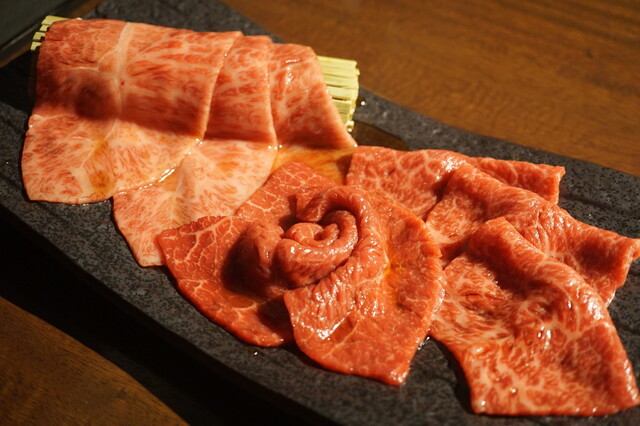
Approaching Kyodo from the Odakyu Line, the mood changes quickly from central Tokyo velocity to Setagaya evening rhythm: station traffic, residential side streets, and restaurants that depend less on passing tourists than on repeat local confidence. In that setting, yakiniku works as occasion dining because it is social by design. The grill sits at the centre, the table controls the pace, and the meal can move from family dinner to birthday gathering without changing format.
Tokyo has many beef rooms that trade on rarity, chef performance, or counter theatre. The more durable yakiniku address has a different grammar: reliable sourcing, steady charcoal management, enough seating flexibility for groups, and a drinks list broad enough to handle wagyu fat without turning the evening into a formal tasting menu. Sumibi Yakiniku Fuchioka belongs to that practical, celebratory side of the category. Its selection for Tabelog 100 in the yakiniku category across multiple years, including 2025, gives it a public credibility signal in a city where neighbourhood beef restaurants rarely need international branding to fill seats.
Charcoal-grilled beef built for shared celebrations
Yakiniku is often misunderstood by visitors as simply Japanese barbecue. In Tokyo, the distinction sits in the control: cuts arrive portioned for quick cooking, diners manage heat at the table, and the meal’s success depends on restraint as much as abundance. A good occasion meal here is not about ordering everything; it is about sequencing richer cuts with leaner ones, using gyutan as a structural anchor, and letting charcoal do its quiet work.
The listed categories, yakiniku and gyutan, place the restaurant in a beef-first tradition rather than a broader izakaya format. That matters for milestone meals. A group can build the evening around wagyu and tongue without asking the kitchen to perform a long-form menu, while the table format keeps conversation in motion. This is why yakiniku remains one of Tokyo’s more democratic celebration formats: it can feel generous without demanding silence, and it lets children, grandparents, colleagues, and serious beef drinkers share the same table logic.
Price also shapes the editorial read. At JPY 8,000 to JPY 9,999 for dinner, the restaurant sits above casual post-work grilling but below the expense tier where beef becomes a trophy exercise. Compared with Tokyo peers in the supplied set, such as Hassho at JPY 2,000 to JPY 2,999 or Garam Masala at JPY 4,000 to JPY 4,999 for dinner, this is a planned evening rather than an easy add-on. It also occupies a different lane from sushi-focused Sushidokoro Kiraku or curry-and-yoshoku addresses such as 3 Chome no Curry Ya San and Yoshoku Bar Ultra. The decision is less “Where can dinner happen?” than “What kind of gathering needs the table to carry the night?”
Kyodo gives the meal a local Tokyo frame
Kyodo is not the shorthand Tokyo most visitors use for dining ambition. That is part of the point. Setagaya’s restaurant culture rewards places that can serve residents repeatedly, not just capture a single itinerary slot. A 30-seat room with table seating, a semi-private room for six, and group seating for eight suits that ecosystem: compact enough to feel personal, structured enough for birthdays, family meals, and small celebrations.
The family-friendly signals are unusually relevant here. Children are welcome, strollers are accepted, and the room includes seating styles that can support mixed-age groups. That changes the category. Many premium Tokyo meals ask diners to conform to a rigid counter or tasting-menu discipline; this one aligns with the Japanese tradition of celebratory beef as a shared table event. Message plates are available for celebrations for JPY 500 excluding tax, which is a small but telling marker of how the restaurant expects to be used.
Recognition should be read with the same local precision. Tabelog 100 is not a global awards machine; it is influential because it reflects Japan’s own restaurant-search culture and category-specific competition. Repeated selection from 2018 through 2025 places the restaurant among a small public group of Tokyo yakiniku names that have maintained enough consistency to stay visible. The 2025 listing gives the current read more weight than an old accolade would.
For broader Tokyo planning, this is a different kind of address from central-city itinerary staples. Readers comparing categories can use Our full Tokyo restaurants guide for dining context, then cross-check the wider city mood through Our full Tokyo bars guide, Our full Tokyo hotels guide, Our full Tokyo wineries guide, and Our full Tokyo experiences guide. Within restaurants, nearby or category-adjacent planning can stretch from. 鮪と炭火焼き うお炭 秋葉原店 and 12/10 Shinjuku ten to 124. KAGURAZAKA (Yakitori), 2D Cafe, and 3 Chome no Curry Ya San.
When the occasion calls for beef, not ceremony
The strongest case for Sumibi Yakiniku Fuchioka is not novelty. It is fit. For a celebration that needs warmth, flexibility, charcoal-grilled beef, and enough structure to feel considered, the restaurant’s format makes sense. The drinks range covers sake, shochu, wine, and cocktails, which gives groups room to split preferences without pulling the meal away from beef. Non-smoking status, card acceptance, and wheelchair accessibility further reduce friction for mixed parties.
This is also where Tokyo’s wider dining range matters. A visitor chasing counter precision might compare sushi or yakitori instead; a relaxed daytime plan could point toward casual cafés or curry shops; a beef-led group meal sits elsewhere. For travel outside the city, the same planning logic extends to -Grilled beef Sukiyaki- KAMAKURA TANUKIAN 鎌倉 たぬき庵 in Kamakura.cafe in Osaka.know in Kumamoto, (Shoku) Vietnam in Kawasaki, [Curry Senmon Ten] Maruyama Kyoju. in Sapporo, [ki:] in Kyoto, Jōdo Saké Bar in Los Angeles, and Onigiri Time in Pasadena.
The editorial verdict is clear: choose this for a Setagaya-based celebration where the grill is the host, not for a hushed tasting-menu evening. The repeated Tabelog 100 selections, the group-friendly seating, and the mid-premium dinner range all point to a restaurant built around shared occasion dining rather than culinary theatre.
Side-by-Side Snapshot
Side-by-side context: comparable cuisine and price.
| Venue | Cuisine | Price | Notes |
|---|---|---|---|
| Sumibi Yakiniku FuchiokaThis venue — the venue you are viewing | Charcoal-Grilled Wagyu Yakiniku | $$$ | Not listed |
| Takano Fruit Parlour | Japanese Fruit Parlor | $$$ | Shinjuku |
| Torafugutei | Premium Tiger Pufferfish (Fugu) Specialist | $$$ | Shinjuku |
| Yakitori Tokoshima | Traditional Yakitori Counter | $$$ | Setagaya |
| Igarashi | Traditional Japanese Fugu Kaiseki | $$$ | Shibuya |
| Hinomaru | Kaiseki Omakase | $$$ | Shinjuku |
Recognition history
Dated appearances from independent guides and award organizations, with the underlying list record or original source where available.
Tabelog 100 #94 · No. 94
Tabelog · Tabelog 100 - Yakiniku - TOKYO - 2025















At a Glance
- Cozy
- Modern
- Intimate
- Elegant
- Date Night
- Group Dining
- After Work
- Special Occasion
- Casual Hangout
- Standalone
- Local Sourcing
A chic, dark-toned charcoal-grill dining room with a calm, local feel—intimate rather than flashy, with closely spaced tables, warm lighting, and the aromas and sounds of yakiniku grilling at each table.