A standing-buffet counter in Vienna's 21st district, Stehbuffet at Franz-Jonas-Platz sits within a city tradition of quick, convivial eating that predates the modern bistro format by generations. The format strips away table service in favour of direct, democratic hospitality, the kind of neighbourhood institution that Vienna's outer districts have sustained long after the centre moved on to tasting menus. For visitors tracking the city's broader dining range, it anchors one end of a spectrum that runs all the way to Michelin-starred rooms.
Pearl is the En Primeur Club membership app — saves, bookings, and concierge access live there. Same editors, same standards.
- Address
- Franz-Jonas-Platz 8, 1210 Wien, Austria
- Website
- stehbuffet.eatbu.com
- Directions
- Get directions
 Saves & bookings on Pearl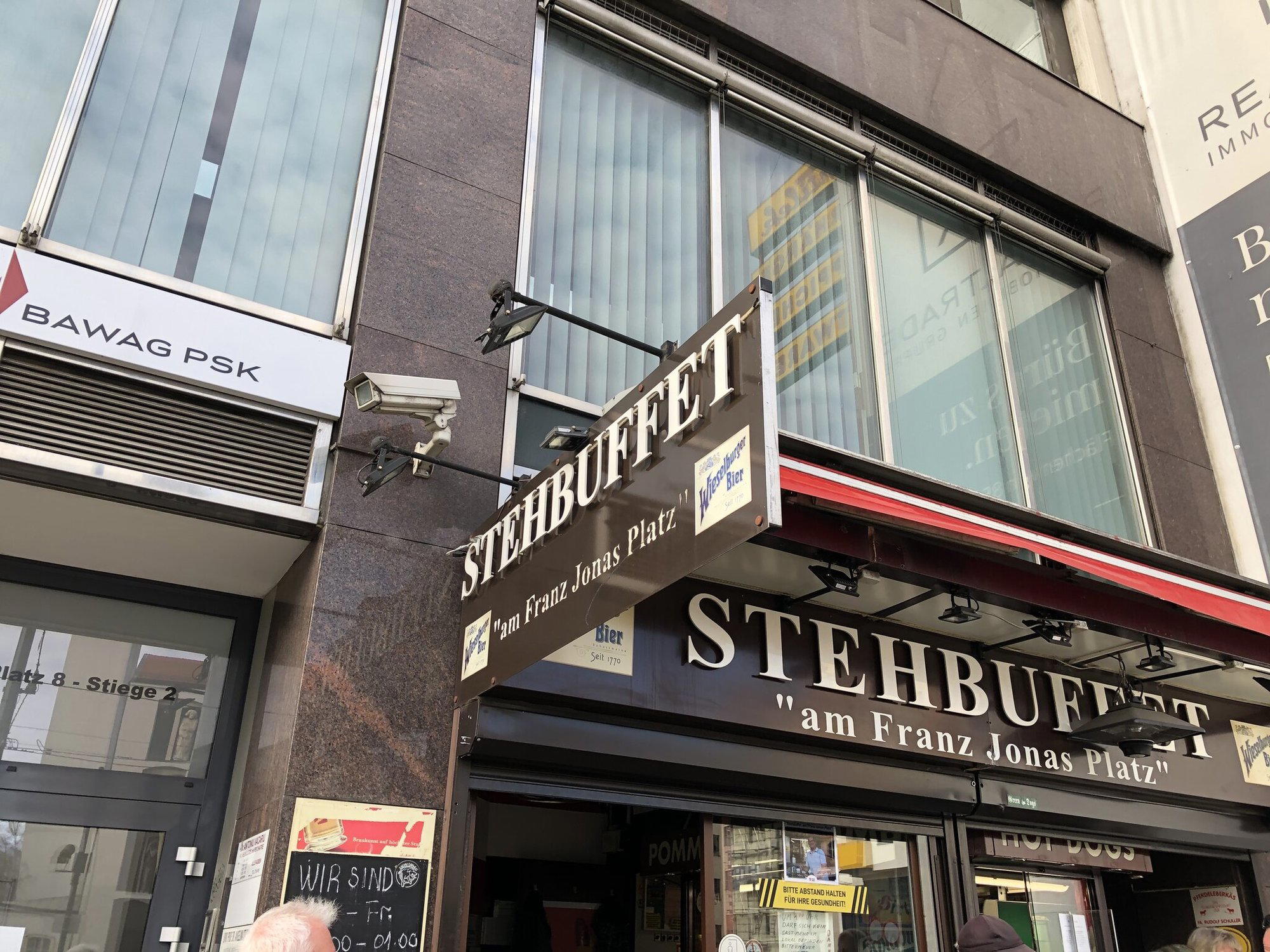
Standing Counters and the Long History of Viennese Fast Hospitality
Long before the word "casual dining" entered the vocabulary of food writers, Vienna had already solved the problem. The Stehbuffet, literally a standing buffet, is one of the oldest formats in Central European urban eating, a tradition rooted in the Austro-Hungarian-era need to feed a working city quickly, cheaply, and without ceremony. Where other European capitals evolved their street-food cultures around markets and cart vendors, Vienna institutionalised the standing counter inside permanent premises, giving regulars a fixed address, a consistent offer, and the social ritual of eating shoulder-to-shoulder with strangers.
Stehbuffet is a restaurant serving Standing Buffet at Franz-Jonas-Platz 8, 1210 Wien, Austria, in Vienna's 21st district (Floridsdorf). Floridsdorf sits north of the Danube, away from the tourist circuits of the first and fourth districts, and its dining character reflects a neighbourhood that has always fed itself rather than performed for visitors. The standing-counter format here is not a design concept imported from a Williamsburg pop-up; it is the original architecture of the place.
The 21st District and What It Tells You About Vienna's Range
Vienna's dining conversation is dominated by the inner districts. Steirereck im Stadtpark sets the creative benchmark in the third district; Amador and Konstantin Filippou anchor the high-end modern European tier closer to the centre; and Mraz & Sohn has made a case for serious cooking in the 20th district. The outer districts, by contrast, have rarely attracted the same critical attention, even though they represent where most Viennese actually eat most of the time.
That gap is editorially significant. A city's dining identity is not only its starred rooms and its celebrated chefs, it is also the formats that sustain daily life for the majority of its residents. The standing buffet in Floridsdorf belongs to that second category, and understanding it is part of reading Vienna accurately rather than selectively. For visitors who have already worked through the higher tiers, Doubek or the creative end of the Austrian scene, a counter like this completes the picture in a way that another tasting-menu room cannot.
The Format and Its Logic
The Stehbuffet format operates on a different hospitality logic than table service. There is no front-of-house choreography in the conventional sense; the counter itself mediates the relationship between staff and guest. This compresses the usual hierarchy between kitchen, floor, and customer into a single, visible transaction. You see what is available, you order directly, and you eat standing, sometimes at a counter ledge, sometimes at a high table if the format allows for it.
This is the opposite of the editorial angle that dominates coverage of places like Ikarus in Salzburg or Obauer in Werfen, where the interplay between chef, sommelier, and a calibrated front-of-house team is central to the experience. At a Stehbuffet, the "team dynamic" is simpler and more direct: the person behind the counter is often the person who prepared the food, and the absence of a sommelier is not an oversight but a structural feature of the format. Wine, if present at all, is typically house-poured and priced accordingly.
That directness is not a lesser experience, it is a different discipline. Running a standing counter well requires its own form of service intelligence: reading a queue, maintaining product quality across a rushed lunch period, and delivering consistency without the buffer of a reservation system or a paced tasting menu. Compared to the extended team structures at rooms like Landhaus Bacher in Mautern an der Donau or Griggeler Stuba in Lech, it is a stripped-back operation, but one with its own demands.
Where Stehbuffet Sits in the Austrian Dining Spectrum
Austria's restaurant culture has two largely separate circuits. The first is the internationally recognised tier of destination restaurants: places like Döllerer in Golling an der Salzach, Schwarzer Adler in Hall in Tirol, Ois in Neufelden, Kräuterreich by Vitus Winkler in Sankt Veit im Pongau, and Restaurant 141 by Joachim Jaud in Mieming, each drawing guests specifically for the cooking and the occasion. The second is the everyday circuit: Gasthäuser, Würstelstände, Beisln, and Stehbuffets that feed the working population without ceremony or advance booking.
Stehbuffet at Franz-Jonas-Platz belongs firmly to the second circuit. It does not compete with the creative output of Vienna's leading kitchens any more than a neighbourhood tabac in Lyon competes with Paul Bocuse, they are answering different questions. The question a Stehbuffet answers is: what does this district eat, today, at lunch, without making a reservation three weeks ahead?
Internationally celebrated counters like Le Bernardin in New York City or Atomix represent one pole of the counter-dining format, technically intensive and highly orchestrated. The Viennese Stehbuffet is the other pole: unscripted, walk-in, priced for daily use.
When to Go and What to Expect
Floridsdorf is most easily reached by U-Bahn (U6 to Floridsdorf station, which is adjacent to Franz-Jonas-Platz), making the journey from the city centre direct for visitors staying in the inner districts. The area around the Platz itself is a transport hub, tram lines converge here, which shapes the buffet's clientele: it is a working lunch crowd, transiting between connections, not a dining-destination audience.
Midday on weekdays is the format's natural peak, with hot prepared dishes rotated through the day. Arriving early in the lunch window gives the clearest picture of what the day's preparation looks like.
Similar Picks
Comparable venues nearby, for context on price, style, and recognition.
| Venue | Cuisine | Price | Notes |
|---|---|---|---|
| StehbuffetThis venue — the venue you are viewing | Standing Buffet | $ | Not listed |
| Royal Balkan Grill | Authentic Balkan Grill | $ | Rudolfsheim |
| Erbsenzählerei | Organic Vegetarian Café | $$ | Margareten |
| Café Schwarzenberg | Traditional Viennese Café | $$ | Staatsoper |
| Suppenbar | Soup and Curry Bar | $ | Alsergrund |
| Merak | Balkan Charcoal Barbecue | $$ | Westbahnhof |
Continue exploring
More in Vienna
Restaurants in Vienna
Browse all →
Bars in Vienna
Browse all →
Hotels in Vienna
Browse all →
At a Glance
- Casual Hangout
Current opening hours
- Monday
- 6 AM–2 AM
- Tuesday
- 6 AM–2 AM
- Wednesday
- 6 AM–2 AM
- Thursday
- 6 AM–2 AM
- Friday
- 6 AM–2 AM
- Saturday
- 6 AM–2 AM
- Sunday
- 6 AM–2 AM
Hours can change for holidays and private events. Last verified .