
SPICE GATE puts Kyoto’s newer curry culture into a compact Kawaramachi setting, with cafe and Asian-ethnic framing rather than the city’s temple-dining formality. Its selection for Tabelog Curry WEST “Tabelog 100” 2024 gives it a clear credential in a category where local reputation matters as much as ceremony.
Pearl is the En Primeur Club membership app — saves, bookings, and concierge access live there. Same editors, same standards.
- Address
- Japan, 〒600-8033 Kyoto, Shimogyo Ward, Ebisunocho, 寺町通仏光寺下る 546番地1 しきさい寺町ビル2F
- Phone
- +81 75-741-7554
- Website
- spicegate.jp
 Saves & bookings on Pearl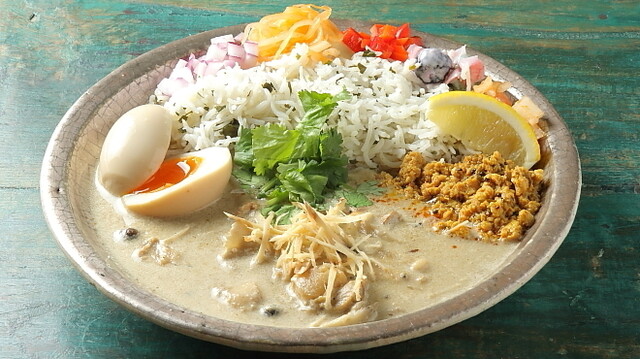
Approaching the second-floor room near Kyoto Kawaramachi, the mood shifts from central Kyoto’s retail flow to a tighter, counter-led curry setting. This is not Kyoto in kaiseki mode. It belongs to the city’s looser modern dining register: compact rooms, solo-friendly counters, cafe hours, and spice-led cooking that sits comfortably beside coffee, rice, and quick evening meals.
That matters in Kyoto, where visitors often overcorrect toward temples, ryokan dinners, and formal Japanese restaurants. The city’s day-to-day eating culture is broader and less ceremonial. Curry shops, kissaten-style cafes, bakeries, standing bars, ramen counters, and specialist sweets houses do much of the practical work between shrine visits and late trains. SPICE GATE fits that rhythm: a small urban restaurant with curry as the anchor and enough all-day flexibility to function outside the usual lunch-or-dinner binary.
Kyoto curry with cafe discipline, not kaiseki theatre
Kyoto curry has its own logic. It is rarely about scale or spectacle; the stronger examples tend to work through restraint, repeatability, and a clear house identity. Here, the public category is curry, cafe, Asian, and ethnic, which places the cooking closer to the city’s contemporary spice-counter movement than to hotel curry or chain comfort food. The Tabelog Curry WEST “Tabelog 100” 2024 selection is the useful signal: it puts the restaurant inside a regional curry conversation rather than merely a neighbourhood convenience slot.
The room’s 22-seat format, split between counter and table seating, also tells the reader how to read the experience. Kyoto’s small restaurants often reward solo diners because the counter is not a consolation prize; it is the default lens for watching pacing, plating, and turnover. In curry, that intimacy changes expectations. The meal is not stretched by courses or ceremony. The point is concentration: a defined spice profile, rice at the centre of the plate, and a service format built for people who may be eating alone, between appointments, or before moving back into the Kawaramachi grid.
Compared with the city’s higher-spend formats, the value proposition is clear. A meal here occupies a lower price tier than formal beef restaurants such as Nikuryori Shibuya or tasting-led Japanese rooms such as Takatsuji Kasui. It also sits in a different lane from cocktail destinations such as Bar Rocking chair or sushi counters such as sushi imagine. The useful comparison is not cuisine-to-cuisine quality; it is role. Kyoto needs places that carry culinary intent without demanding a full evening, and curry has become one of the formats that does that work well.
The drink question is a pacing question
The assigned lens for many premium dining pages is often the cellar: depth, pairings, sommelier logic, and the way a wine list defines the meal’s ambition. SPICE GATE asks for a different reading. There is no publicly useful cellar narrative to hang the experience on, and forcing one would miss the point. In this category, curation shows up less through bottles and more through how the restaurant structures the day: breakfast availability, lunch service, cafe-and-dining hours, and curry that can carry across more than one mealtime.
That all-day rhythm is part of a broader Kyoto shift. Central neighbourhoods around Kawaramachi and Shijo need restaurants that serve residents, domestic travellers, and international visitors without turning every table into a reservation project. Curry is well suited to that pressure because it can be fast without being careless and casual without being generic. The Tabelog score of 3.65, paired with the 2024 Curry WEST selection, suggests a place that has moved beyond simple convenience into recognized specialist territory.
For travellers building a broader Kyoto food map, this is where contrast helps. A day might pair spice-led casual dining with old Kyoto sweets such as Aburi Mochi Honke Nemoto Kazariya, a different register of casual comfort at 551蓬莱, or a more restaurant-driven evening at Abbesses. Nearby modern choices such as 3TOKU6MI Shijo karasuma ten and [ki:] show how varied the city’s casual-to-serious middle tier has become.
How to place it in a Kyoto itinerary
The practical appeal is that the restaurant does not require the same planning psychology as Kyoto’s formal counters. Reservations are unavailable, private rooms are unavailable, and the room is compact, so timing matters more than advance strategy. Non-smoking status, electronic payment options, and counter seating make it unusually legible for visitors who want an efficient meal without reducing Kyoto dining to convenience-store grazing.
Its location near Kyoto Kawaramachi puts it in the part of the city where dining decisions are often made between shopping streets, department stores, river walks, and onward rail movement. That makes it a strong fit for a solo lunch, a casual early dinner, or a reset meal between more structured bookings. Families can make it work if they are comfortable with a small room and curry-focused ordering rather than a spread-out dining room; groups seeking privacy or a long celebratory meal should look elsewhere.
For a wider city plan, use Our full Kyoto restaurants guide alongside Our full Kyoto hotels guide, Our full Kyoto bars guide, Our full Kyoto wineries guide, and Our full Kyoto experiences guide. For cross-city context on how casual Japanese dining travels across formats, compare listings such as -Grilled beef Sukiyaki- KAMAKURA TANUKIAN 鎌倉 たぬき庵 in Kamakura. 鮪と炭火焼き うお炭 秋葉原店 in Tokyo.cafe in Osaka.know in Kumamoto, (Shoku) Vietnam in Kawasaki, [Curry Senmon Ten] Maruyama Kyoju. in Sapporo, Jōdo Saké Bar in Los Angeles, and Onigiri Time in Pasadena.
The editorial read is simple: SPICE GATE is useful because it shows Kyoto outside the postcard frame. The credential is real, the format is compact, and the category is specific. For travellers who already have the temples, tea, and formal dinners covered, this is the kind of curry stop that makes the city feel lived in rather than staged.
What It’s Closest To
Comparable venues for orientation by cuisine and category.
| Venue | Cuisine | Price | Notes |
|---|---|---|---|
| SPICE GATEThis venue — the venue you are viewing | Japanese-style spice curry & dashi curry café | $$ | Not listed |
| ほしぞら | Korean-style Yakiniku | $$ | Shimogyo-ku |
| Kaikado Cafe | Japanese Tea Cafe | $$ | Shimogyō |
| Nakamura Tokichi Honten Kyoto eki ten | Matcha sweets & soba café | $$ | Shimogyō |
| Nakae | Cozy Kyoto Izakaya & Japanese Seafood Tavern | $$ | Shimogyō |
| 京天神 野口 | Traditional Kaiseki | Not listed | Kamigyō |
Recognition history
Dated appearances from independent guides and award organizations, with the underlying list record or original source where available.
Tabelog 100 #64 · No. 64
Tabelog · Tabelog 100 - Curry - WEST - 2024
Continue exploring
More in Kyoto
Restaurants in Kyoto
Browse all →
Bars in Kyoto
Browse all →
Hotels in Kyoto
Browse all →

Wineries in Kyoto
Browse all →
At a Glance
- Cozy
- Modern
- Solo
- Casual Hangout
- After Work
- Standalone
- Design Destination
Current opening hours
- Monday
- 7:30–11 AM, 11:30 AM–9 PM
- Tuesday
- 7:30–11 AM, 11:30 AM–9 PM
- Wednesday
- 7:30–11 AM, 11:30 AM–9 PM
- Thursday
- 7:30–11 AM, 11:30 AM–9 PM
- Friday
- 7:30–11 AM, 11:30 AM–9 PM
- Saturday
- 7:30–11 AM, 11:30 AM–9 PM
- Sunday
- 7:30–11 AM, 11:30 AM–9 PM
Hours can change for holidays and private events. Last verified .
A compact, casual curry café with counter and table seating, relaxed conversational noise, and shelves of spices and packaged curry kits that give it a cozy specialty-grocery feel rather than a formal restaurant.