
SOBA-Shiro Kuro belongs to Tokyo’s small-counter ramen culture rather than the city’s louder destination-dining circuit. Its six-seat counter, repeated Tabelog Ramen TOKYO “Tabelog 100” selections from 2020 through 2025, and Hachimanyama setting make it a precise example of how serious ramen has moved beyond central wards without losing its specialist edge.
Pearl is the En Primeur Club membership app — saves, bookings, and concierge access live there. Same editors, same standards.
- Address
- 東京都杉並区上高井戸1-1-7
- Website
- tabelog.com
 Saves & bookings on Pearl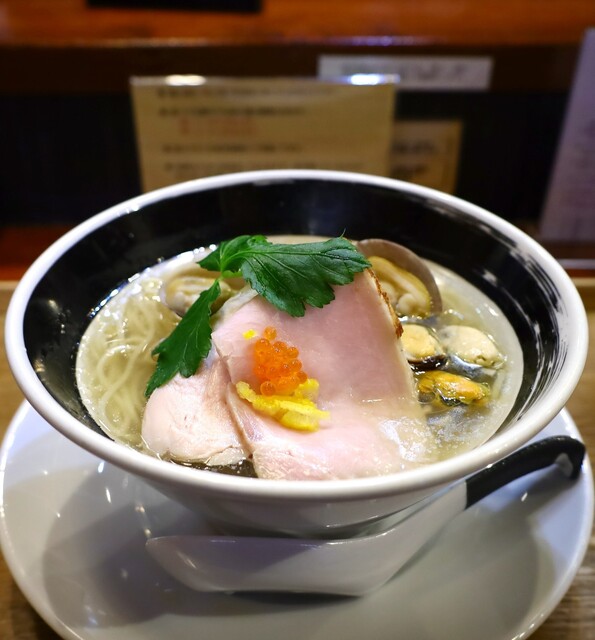
Hachimanyama is not Tokyo’s hotel-lobby omakase or Ginza-counter world. Its rhythm is suburban, Keio Line practical, and close-grained: commuters, neighborhood regulars, and a few ramen hunters moving toward a small counter where the room limits the pace. Here, SOBA-Shiro Kuro reflects a more interesting Tokyo ramen evolution: serious bowls no longer depend on the city’s obvious dining corridors.
Tokyo ramen has spent the past decade splitting into sharper categories: high-volume turnover shops, cult counters where queue discipline is ritual, and compact rooms that treat ramen with the focus once associated with soba, tempura, or sushi counters. This address belongs to the last group. Six counter seats create a narrow service frame, changing how diners should read the experience. It is not for lingering or spectacle, but for concentration, sequence, and a short exchange between kitchen and bowl.
A small-counter ramen format in Tokyo's western wards
Western Tokyo has become fertile ground for ramen shops that do not need Shinjuku or Shibuya theatre to draw attention. Suginami, Setagaya, and nearby rail-linked neighborhoods support specialists whose reputations travel by lists, ratings, and word of mouth rather than nightlife footfall. The Hachimanyama location places SOBA-Shiro Kuro in that pattern: reachable from central Tokyo, but far enough from the usual visitor route to feel deliberate rather than convenient.
The recognition is not incidental. Selection for Tabelog Ramen TOKYO “Tabelog 100” in 2020, 2021, 2022, 2023, 2024, and 2025 puts the shop in a sustained peer group, not a single-year spike. A Tabelog score of 3.88 adds another signal in a category where Tokyo diners compare tiny differences in broth style, noodle texture, and pacing with unusual intensity. That does not make the shop a luxury restaurant; it places it among ramen counters where low prices and high scrutiny coexist.
That tension is central to modern Tokyo ramen. A bowl can sit in an everyday price band while expectations resemble specialist dining. Compared with Tokyo peers such as Gyoza Kan, Seijo Seika, and Ramen Koike, the question is not whether the meal feels grand. It is whether the counter format, recognition history, and neighborhood commitment justify leaving the central dining grid. Here, the case is strongest for diners who already understand ramen as a precision category, not a casual fallback.
The evolution is in restraint, not expansion
Many successful ramen shops grow by adding branches, widening menus, or becoming easier to access. The more persuasive Tokyo model often moves the other way: small room, narrow focus, few distractions. SOBA-Shiro Kuro opened in 2019 and has kept its identity tied to counter seating and ramen rather than broadening into a general noodle restaurant. In a city where attention turns quickly, repeated recognition over six selection years suggests consistency within a format that leaves little room for operational slack.
The no-reservations structure also belongs to ramen’s older democratic code. Tokyo has many dining rooms where access is mediated by hotel concierges, booking platforms, or introductions. Ramen remains different: diners trade comfort for immediacy, and the room decides the pace. Six seats sharpen that exchange. A small queue can matter, solo dining fits naturally, and groups need practical expectations. The experience rewards flexibility more than ceremony.
There is a useful contrast with Tokyo’s premium sushi economy. A counter at Sushi Ichigo, for instance, belongs to a different financial and cultural bracket, where the meal is judged through procurement, cadence, and the chef-guest relationship. Ramen counters use another grammar. Attention turns to broth architecture, noodle handling, aroma, and the compressed timing of a single bowl. That compression is why serious ramen can feel exacting without adopting fine-dining signals.
For visitors building a broader Tokyo itinerary, this stop suits neighborhood-led eating more than a hotel-centered dining plan. The same city can hold yakitori at 124. KAGURAZAKA (Yakitori), curry at 3 Chome no Curry Ya San, and casual visual culture at 2D Cafe; the point is not to rank them together, but to see how Tokyo’s dining depth comes from formats that stay specific.
How to read the meal before going
Expect a compact ramen counter, not a flexible restaurant room. Private rooms and private use are not part of the setup, and the non-smoking policy keeps attention on the bowl and counter. Children are welcome, notable in a category that often skews toward solo diners and quick meals, but six seats mean families should consider timing and group size rather than comfort-driven dining.
Payment is part of the culture. Cash-only ramen counters remain common in Tokyo, and this shop follows that pattern: credit cards, electronic money, and QR payments are not accepted. For international travelers, that matters as much as the rail stop. The address is close to Hachimanyama Station on the Keio Line, making the journey simple by Tokyo standards, but the dining window is governed by counter capacity rather than broad restaurant hospitality.
The stronger editorial recommendation is to treat the restaurant as a specialist ramen stop within a west Tokyo day, not a standalone evening built around atmosphere. Pair it with a neighborhood walk, or use it as a counterpoint to central Tokyo reservations. For a wider city plan, start with Our full Tokyo restaurants guide, then fold in category-specific research through Our full Tokyo hotels guide, Our full Tokyo bars guide, Our full Tokyo wineries guide, and Our full Tokyo experiences guide.
Readers comparing Japan-focused casual dining beyond this counter can also look at 鮪と炭火焼き うお炭 秋葉原店, 12/10 Shinjuku ten, -Grilled beef Sukiyaki- KAMAKURA TANUKIAN 鎌倉 たぬき庵 in Kamakura.cafe in Osaka.know in Kumamoto, (Shoku) Vietnam in Kawasaki, [Curry Senmon Ten] Maruyama Kyoju. in Sapporo, [ki:] in Kyoto, Jōdo Saké Bar in Los Angeles, and Onigiri Time in Pasadena.
Comparable Spots, Quickly
Comparable venues at a glance for context.
| Venue | Cuisine | Price | Notes |
|---|---|---|---|
| SOBA-Shiro KuroThis venue — the venue you are viewing | Specialty ramen / soba shop | $ | Not listed |
| Ayu Ramen Plus (鮎ラーメンプラス) | Traditional Ayu Ramen | $ | Toranomon |
| Hishida Ya | Japanese teishoku cafeteria | $ | Meguro |
| E-chan Shokudo | Early-morning Tokyo ramen counter | $ | Meguro |
| Shiroi Kuro | Modern Japanese sweets & roll cake café | $ | Minato |
| Ramen Jiro Mita honten | Japanese Ramen | $ | Minato |
Recognition history
Dated appearances from independent guides and award organizations, with the underlying list record or original source where available.
Tabelog 100 #62 · No. 62
Tabelog · Tabelog 100 - Ramen - TOKYO - 2025












At a Glance
- Cozy
- Intimate
- Solo
- Family
- Casual Hangout
- After Work
- Standalone
small, counter-only neighborhood ramen shop with a simple, functional interior; the atmosphere is relaxed and friendly, suited to solo diners and families grabbing a focused, high-quality bowl rather than lingering.