Our verdict
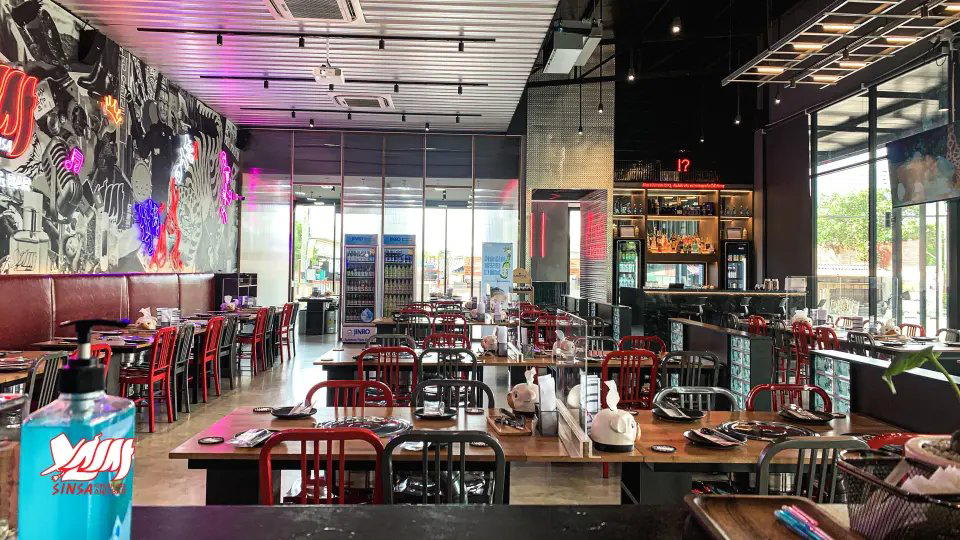
Sinsa Korean BBQ operates in Bangkok's Thawi Watthana district, bringing the charcoal-and-smoke format of Seoul's barbecue tradition to Thailand's capital. Located on Thanon Sala Thammasop, the restaurant sits outside the central dining corridors, making it a deliberate destination rather than a passing choice. For Bangkok's Korean expatriate community and local diners seeking grilled-meat formats, it occupies a distinct position in the city's broader Asian dining conversation.

Pearl is the En Primeur Club membership app, where members save venues, book tables and use the concierge.
Korean Barbecue in Bangkok: Where the Format Travels and What It Costs the Planet
Across Asia's major cities, Korean barbecue has become one of the most replicated dining formats of the past two decades. The appeal is structural: diners control the cook, the meal runs long, and the table fills with banchan before the grill even heats up. In Bangkok, that format competes with the city's own grilled-meat tradition, the Thai moo kata and gai yang circuits, which means Korean barbecue restaurants here must justify their existence on grounds beyond novelty. Sinsa Korean BBQ, addressed at 20/29 Thanon Sala Thammasop in the Thawi Watthana district, occupies the quieter western edge of Bangkok's dining geography, removed from the Sukhumvit corridor where most internationally-oriented restaurants cluster.
The Thawi Watthana Address: Reading a Location
Thawi Watthana is residential Bangkok, the kind of district where restaurants tend to serve a local catchment rather than a destination-seeking visitor base. That positioning shapes the dining experience in ways a Silom or Ekkamai address would not. The Korean community in Bangkok has historically spread across the city rather than concentrating in a single enclave, so Korean restaurants here tend to anchor around residential pockets rather than commercial strips. An address this far west of the centre signals that Sinsa Korean BBQ is drawing regulars, likely including Bangkok's Korean diaspora and families from the surrounding Sala Thammasop neighbourhood, rather than capturing walk-in tourism traffic. For context, the highest-profile dining in Bangkok right now happens at a different register entirely: Sorn (Southern Thai) and Baan Tepa (Thai contemporary) operate at the ฿฿฿฿ tier with substantial critical recognition, while Sühring (German) and Gaa (Modern Indian) extend the city's tasting-menu ambitions. Sinsa sits in a different conversation entirely, one built around format and frequency rather than occasion dining.
The Sustainability Question Inside Korean BBQ
Korean barbecue presents a specific environmental challenge that any serious discussion of the format must address. The charcoal-intensive nature of tableside grilling, the volume of meat that defines the experience, and the logistical weight of banchan production (multiple small dishes, each requiring separate sourcing and preparation) combine to create a heavier footprint per cover than most other restaurant formats at a similar price point. Across Seoul, a slow but documentable shift has emerged among some operators toward lychee or coconut shell charcoal in place of conventional hardwood varieties, reducing particulate emissions in enclosed dining rooms. Ventilation systems have become a technical differentiator in newer Korean barbecue openings globally, as much for environmental management as for diner comfort.
Bangkok's Korean restaurant sector has not, as a whole, moved as visibly on these questions as comparable markets in Seoul or Los Angeles. The Thai dining context does provide one structural advantage: domestic protein supply chains, particularly pork, are shorter here than in imported-product-dependent markets, and locally sourced produce for banchan accompaniments can, when prioritised, carry a lower transport burden than imported Korean vegetable products. Whether any specific Bangkok Korean barbecue operator has formalised these sourcing choices into a stated programme is another question, and one that currently lacks public documentation across the sector. Diners for whom ethical sourcing is a primary criterion would do well to ask directly when booking or on arrival. Elsewhere in Thailand, PRU in Phuket has built its identity explicitly around farm-to-table sourcing, demonstrating that the model is operationally viable in the Thai context. That standard is now a reference point against which other restaurants, across all cuisine types, are quietly measured.
The Format Itself: What Korean Barbecue Actually Requires
Korean barbecue is, at its core, a participatory format. The diner is cook, and the grill at the centre of the table demands attention in a way that a delivered plate does not. This makes it one of the few dining formats where the experience is genuinely shaped by the pace and choices of the table rather than the kitchen. Banchan replenishment rhythms, grill replacement timing, and the sequencing of proteins from leaner to fattier cuts all contribute to an arc that experienced Korean barbecue diners read instinctively. For first-timers, the format benefits from staff guidance, and the quality of that guidance is often the most meaningful differentiator between a competent Korean barbecue restaurant and a memorable one. Seoul's best-regarded barbecue operators, including those that have influenced the diaspora restaurant network across Southeast Asia, are known for their attentive floor teams as much as for their meat quality.
Bangkok's broader dining scene provides useful comparison points. Côte by Mauro Colagreco at the ฿฿฿฿ tier and operations like Hinata show how service discipline operates in precision-format dining. Korean barbecue's service requirements are different in character but no less demanding, and restaurants that treat the floor team as secondary to the kitchen tend to show it in the experience.
Planning a Visit: Practical Considerations
Thawi Watthana is not a district with strong public transport connectivity. BTS and MRT lines do not extend this far west, so reaching Sinsa Korean BBQ requires a taxi, ride-share application, or private car. From central Bangkok, journey times can vary considerably depending on traffic, and the western expressway approaches to this district can slow significantly during evening peak hours, which align directly with dinner service windows. Building in buffer time is advisable. No phone contact or website is currently listed in public-facing directories for Sinsa Korean BBQ, which suggests that walk-in dining or informal booking via messaging platforms may be the operative model. For groups, confirming availability before making the journey from the centre would be a reasonable precaution. The restaurant's location within a residential development on Thanon Sala Thammasop means street-level visibility may be lower than a standalone commercial address; having the specific building number (20/29) to hand is practically useful.
Where Sinsa Sits in Bangkok's Wider Korean Dining Scene
Bangkok supports a Korean restaurant sector that has grown steadily alongside the city's Korean resident and tourist population. The range runs from fast-casual Korean fried chicken formats near BTS stations to more formal barbecue restaurants targeting families and larger group occasions. Sinsa's Thawi Watthana address positions it within the residential-community tier of that sector. For visitors exploring Bangkok's full dining range, our full Bangkok restaurants guide maps the city's options across cuisine types and price points. Elsewhere across Thailand, the dining conversation extends to destinations including AKKEE in Pak Kret, Cherng Doi Roast Chicken in Chiang Mai, Loet Rot in Mueang Chiang Mai, DEVASOM BEACH GRILL in Takua Pa, The Spa in Lamai Beach, Little Edo Suratthani in Mueang Surat Thani, Krua Laew Tae R-Rom in Pattaya, and Hoy Tord Chao Lay in วัฒนา. Globally, the Korean barbecue format has influenced fine dining in measurable ways: Atomix in New York City is among the clearest examples of how Korean culinary tradition operates at a prix-fixe tasting level, while a restaurant like Le Bernardin anchors the opposite end of protein-sourcing rigour in a Western context.
Frequently asked questions
What dish is Sinsa Korean BBQ famous for?
How far ahead should I plan for Sinsa Korean BBQ?
What is Sinsa Korean BBQ leading at?
Can Sinsa Korean BBQ adjust for dietary needs?
Is Sinsa Korean BBQ a suitable choice for a group dinner in Bangkok's Thawi Watthana area?
Price and Recognition
Comparable venues nearby, for context on price, style, and recognition.
| Venue | Cuisine | Price | Notes |
|---|---|---|---|
| Sinsa Korean BBQThis venue (the venue you are viewing) | Korean BBQ Buffet | $10–20 | Not listed |
| Sanguan Sri | Authentic Central Thai Curries | $1–10 | Sukhumwit, Authentic Central Thai Curries |
| Nai Mong Hoi Thod | Thai Crispy Oyster Omelette | $1–10 | Samphanthawong Khwaeng, Thai Crispy Oyster Omelette |
| Je Aoun Chicken Rice | Thai Hainanese Chicken Rice (Khao Man Gai) | $1–10 | Chatuchak, Thai Hainanese Chicken Rice (Khao Man Gai) |
| Kanom Beung Bang Mae Prapa | Traditional Thai Crispy Crepes | $1–10 | Phra Nakhon, Traditional Thai Crispy Crepes |
| Weng | Thai-Chinese Crab Fried Rice | $1–10 | Chinatown, Thai-Chinese Crab Fried Rice |
Continue exploring
More in Bangkok
Restaurants in Bangkok
All restaurants in Bangkok →
Bars in Bangkok
All bars in Bangkok →
Details
- Modern
- Trendy
- Lively
- Group Dining
- Casual Hangout
- Open Kitchen
- Buffet
Current opening hours
- Monday
- Closed
- Tuesday
- 12–10:30 PM
- Wednesday
- 12–10:30 PM
- Thursday
- 12–10:30 PM
- Friday
- 12–10:30 PM
- Saturday
- 12–10:30 PM
- Sunday
- 12–10:30 PM
Hours can change for holidays and private events. Hours as of .
Modern and stylish atmosphere with state-of-the-art grilling at each table.