
Sakurajosui Funakoshi belongs to Tokyo’s serious ramen counter culture rather than its destination-dining theatre: compact, lunch-led, and built around concentration. Its selection for Tabelog Ramen TOKYO “Tabelog 100” in 2023, 2024, and 2025 places it among the city’s closely watched ramen rooms, with an 8-seat counter format that rewards diners who understand Tokyo’s small-shop rhythm.
Pearl is the En Primeur Club membership app — saves, bookings, and concierge access live there. Same editors, same standards.
- Address
- 1 Chome-21-10 Shimotakaido, Suginami City, Tokyo 168-0073, Japan
- Website
- twitter.com
 Saves & bookings on Pearl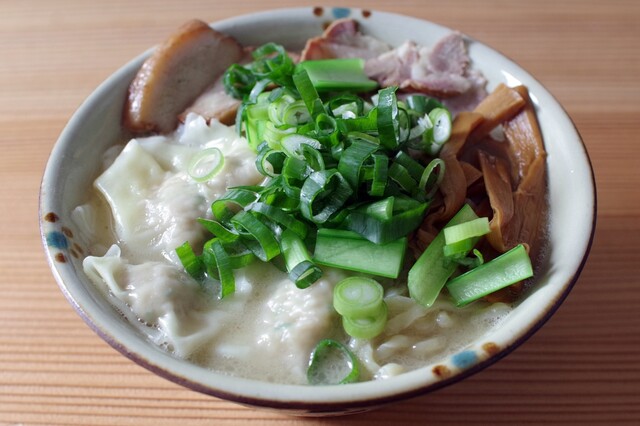
Approaching a Tokyo ramen counter of this size, the first cue is restraint: narrow frontage, street-to-stool immediacy, and a room built for eating, not lingering. In Sakurajosui, that matters. Tokyo ramen culture has long treated smallness as discipline, not inconvenience. An 8-seat, counter-only room compresses the kitchen-diner exchange, keeps the menu cycle tight, and makes excess feel out of place.
Sakurajosui Funakoshi sits where neighbourhood eating still carries weight. Suginami lacks the visitor traffic of Ginza, Shibuya, or Roppongi, so a ramen shop here must satisfy regulars and destination diners, favouring clarity over spectacle: fast turnover, close attention to broth and noodles, and a room where the counter is the whole stage.
A small ramen counter in a city that rewards discipline
Tokyo’s ramen scene is often misread from abroad as a hunt for rarity. The sharper reading is efficiency with consequence. Ramen shops work within narrow margins of time, temperature, portioning, and prep; the make a bowl feel direct without making the operation feel casual. Sakurajosui Funakoshi’s repeated selection for Tabelog Ramen TOKYO “Tabelog 100” in 2023, 2024, and 2025 places it inside a Tokyo-specific ramen conversation, not a generic restaurant ranking.
The format also explains why sustainability here should be read through operations, not slogans. At its disciplined end, ramen is a cuisine of extraction and control: broths built from ingredients that give everything they can, tare used precisely, noodles portioned to match the bowl, and short service windows reducing the looseness of larger dining rooms. In a counter-only shop, waste is visible, pace measurable, and theatrical surplus has little room.
That compactness separates the experience from many mid-market Tokyo restaurants. Noriette, MASSIMOTTAVIO, and La Piccola Tavola occupy different neighbourhood-dining lanes, where meals can stretch across courses and conversation. Ramen Koike and Nishieifuku no Niboshi Bako sit closer in price and category, but the point holds: Tokyo’s serious ramen tier is defined less by luxury cues than by repeatability under pressure. A shop earns attention by making the same narrow promise consistently.
For travellers mapping a wider eating itinerary, Sakurajosui belongs with focused specialist addresses, not the grand-night-out category. It pairs more naturally with casual, single-purpose stops such as 3 Chome no Curry Ya San or 124. KAGURAZAKA (Yakitori) than with a formal tasting-menu evening. Treat it as one sharp meal in a broader Tokyo day, then use Our full Tokyo restaurants guide to build around geography rather than hype.
Why the Tabelog signal matters for ramen
Tabelog carries particular weight in Japan because it reflects a domestic evaluation culture that often rewards consistency, category fluency, and local enthusiasm. For ramen, that matters. Michelin and global lists tend to privilege formats that translate easily to international readers; Tabelog’s ramen selections speak more directly to the everyday intensity of Tokyo’s noodle scene. A Tabelog score of 3.83 and inclusion in the 2025 Tokyo ramen list put Sakurajosui Funakoshi in a watched bracket without making it a luxury proposition.
The price band reinforces the point. Tokyo ramen can be critically serious without behaving like fine dining, and that tension is part of the city’s strength. The meal remains accessible by category standards, while the scrutiny is intense. The better comparison is not expensive sushi counters or hotel dining rooms, but small specialists where a limited format carries the whole argument.
There is also environmental logic to that narrowness. A short menu and compact seating generally create fewer opportunities for overproduction than sprawling, all-day restaurants. In ramen, broth, noodles, and toppings move on different clocks, so preparation still demands care. The more disciplined the shop, the less forgiving it is of waste. Sakurajosui’s scale makes that discipline part of the experience: a system built for focus, not abundance for its own sake.
Tokyo’s better casual meals often sit outside the obvious visitor grid. A serious itinerary should not treat ramen as a quick add-on between luxury bookings. It belongs in the same planning conversation as yakitori, curry, sushi, coffee, and bars, each with its own rhythm. Readers building across categories can cross-reference Our full Tokyo bars guide, Our full Tokyo hotels guide, Our full Tokyo experiences guide, and Our full Tokyo wineries guide rather than forcing every meal into the same level of ceremony.
How to place it in a Tokyo food day
The strongest use case is a diner wanting Tokyo ramen at specialist level without making the meal a full-evening project. The counter format suits solo diners and pairs well with a day west of the central tourist corridor. Families get a clearer signal than at many compact ramen shops: strollers are welcome, though the counter-only room calls for realistic expectations about space and pace.
Its cashless-payment setup also reflects the modernisation of small Tokyo dining. The city’s older ramen image is still tied to ticket machines, coins, and tight lunch queues, but newer small shops increasingly combine traditional counter discipline with contemporary payment habits. That does not change the soul of the format; it removes friction. The result is leaner service mechanics and kitchen attention kept on the bowl.
The restaurant should not be read as a scenic detour or luxury trophy. It is evidence of how Tokyo ramen culture keeps refining itself at neighbourhood scale: small rooms, short menus, limited waste, and public recognition from category authority rather than dining-room theatre. That makes it a precise stop for travellers who care about the mechanics of a city’s food culture as much as the meal itself.
For a broader route through Tokyo and beyond, keep comparisons category-specific. In Tokyo. 鮪と炭火焼き うお炭 秋葉原店, 12/10 Shinjuku ten, and 2D Cafe show different sides of casual dining. Outside the city, the contrast widens through -Grilled beef Sukiyaki- KAMAKURA TANUKIAN 鎌倉 たぬき庵 in Kamakura.cafe in Osaka.know in Kumamoto, (Shoku) Vietnam in Kawasaki, [Curry Senmon Ten] Maruyama Kyoju. in Sapporo, [ki:] in Kyoto, Jōdo Saké Bar in Los Angeles, and Onigiri Time in Pasadena.
How It Stacks Up
Comparable venues by cuisine and category.
| Venue | Cuisine | Price | Notes |
|---|---|---|---|
| Sakurajosui FunakoshiThis venue — the venue you are viewing | Modern shio ramen | $ | Not listed |
| Gyoza no Fukuho (餃子の福包) | Traditional Japanese Gyoza | $ | Shinjuku |
| Echigo Tsuruy | Traditional Japanese mochi & wagashi shop | $ | Suginami |
| Amane | Traditional Japanese Taiyaki & Obanyaki Stand | $ | Kichijoji |
| Katei Saien Sasaki | Japanese home-style fish teishoku cafeteria | $ | Shinjuku |
| Suzumeya | Japanese sweets / Dorayaki | $ | Toshima |
Recognition history
Dated appearances from independent guides and award organizations, with the underlying list record or original source where available.
Tabelog 100 #4 · No. 4
Tabelog · Tabelog 100 - Ramen - TOKYO - 2025












At a Glance
- Lively
- Cozy
- Trendy
- Solo
- Casual Hangout
- After Work
- Chefs Counter
- Standalone
- Street Scene
Current opening hours
- Monday
- 11 AM–3 PM
- Tuesday
- 11 AM–3 PM
- Wednesday
- Closed
- Thursday
- 11 AM–3 PM
- Friday
- 11 AM–3 PM
- Saturday
- 11 AM–3 PM
- Sunday
- Closed
Hours can change for holidays and private events. Last verified .
A compact counter‑only ramen shop with a casual, buzzy atmosphere; guests queue outside along the main road, then eat quickly at the counter in a bright, functional space focused entirely on the ramen rather than decor.