
Ramen Koike belongs to Tokyo’s serious everyday ramen tier: counter-only, low-priced, and validated by repeated Tabelog Ramen TOKYO 100 selections from 2017 through 2025. Its evolution from a 2013 tsukemen shop into the current ramen format explains why Kamikitazawa draws attention well beyond its local station trade.
Pearl is the En Primeur Club membership app — saves, bookings, and concierge access live there. Same editors, same standards.
- Address
- Japan, 〒156-0057 Tokyo, Setagaya City, Kamikitazawa, 4 Chome−19−18 上北沢ハイネスコーポ 1F
- Website
- twitter.com
 Saves & bookings on Pearl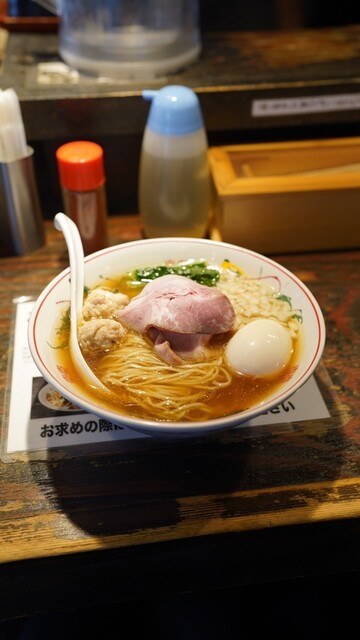
Approaching the counter culture of Tokyo ramen means accepting a different rhythm from the city’s reservation-led dining rooms. The room is small, the exchange is quick, and the meal is judged with little theatre around it. In Kamikitazawa, that format has a particular sharpness: an 11-seat counter, no private rooms, no smoking, and a price band that keeps the experience closer to daily Tokyo eating than ceremony.
That matters because ramen in Tokyo is not a single category so much as a competitive grammar. Central districts often reward speed, late hours, and visibility; residential rail stops reward repeat judgment. Ramen Koike sits in the second camp. Its address in Setagaya, four minutes on foot from Kami Kitazawa Station’s north exit, places it in a neighbourhood pattern where a small shop can become a destination without behaving like a destination restaurant.
A tsukemen origin, then a sharper ramen identity
The useful lens here is change. The shop opened as Tsukemen Koike in November 2013, then reopened under its current name in September 2014. That pivot is not a footnote. Tokyo’s ramen scene has long moved through micro-specialisation: tsukemen houses, niboshi-driven bowls, chuka soba formats, and counter shops that refine one narrow lane until the audience follows. A name change from tsukemen to ramen signals a reorientation of the proposition, not just a cosmetic reset.
Ramen Koike’s credibility comes less from grand dining language than from repeat recognition inside a demanding local category. It has been selected for Tabelog Ramen TOKYO 100 across multiple years, including 2017 through 2025, with a listed Tabelog score of 3.79. In a city where ramen shops are numerous and customer judgment is unusually granular, consecutive appearances on a category-specific Tokyo list carry more weight than generic praise. The signal is consistency under public scrutiny.
The counter format also frames the meal. Eleven seats mean turnover, proximity, and little buffer between kitchen and diner. That is normal for serious ramen, but it separates this kind of address from larger casual restaurants in the same price range. Gyoza Kan, SOBA-Shiro Kuro, Sakurajosui Funakoshi, and Seijo Seika all sit in overlapping low-cost Tokyo territory, yet ramen counters are judged by narrower margins: broth temperature, noodle timing, ticket flow, and whether the bowl holds its shape from first lift to last spoonful. Those specifics are the reason a suburban station stop can compete with better-known dining neighbourhoods.
Kamikitazawa and the Tokyo value equation
Tokyo’s premium dining reputation often focuses on omakase counters, hotel dining rooms, and tasting-menu kitchens, but the city’s value intelligence is just as serious at the JPY 1,000 to JPY 1,999 level. Ramen Koike operates in that bracket for both lunch and dinner, which places it in a category where the diner’s risk is low but the standards are high. The point is not luxury; it is precision per yen.
The practical details reinforce the genre. Reservations are unavailable, payment is cash-only, and the seating is entirely at the counter. For travellers used to booking every Tokyo meal weeks ahead, this is a useful correction: some of the city’s strongest food experiences still run on arrival, patience, and timing rather than concierge access. The shop lists lunch and evening service on most operating days, with Friday as the regular closure; weekends extend lunch to mid-afternoon. Parking is not provided, though a coin parking lot is listed next door, which matters more for local families than visitors using the Keio Line.
There is a family-friendly note here as well, with children welcome. That does not turn an 11-seat ramen counter into a leisurely family restaurant, but it does place the shop inside Tokyo’s everyday eating culture rather than a hushed specialist temple. In this price band, the city’s serious food often remains democratic: quick, small, and exacting.
For readers mapping a broader Tokyo itinerary, the contrast is instructive. Akihabara’s casual grill and fish-bar energy at . 鮪と炭火焼き うお炭 秋葉原店, Shinjuku’s urban density around 12/10 Shinjuku ten, yakitori’s counter discipline at 124. KAGURAZAKA (Yakitori), the visual-café format of 2D Cafe, and curry specialization at 3 Chome no Curry Ya San all show how Tokyo fragments by format rather than by a single dining hierarchy. Ramen belongs in that map because it is one of the city’s clearest tests of repetition, speed, and craft under pressure.
How to read this kind of ramen address
The mistake is to approach a place like this with the expectations of fine dining. There is no need to search for a long chef biography or a tasting-menu narrative. The editorial interest is the accumulated evidence: a 2014 reopening into a defined ramen identity, an 11-seat counter, repeated Tabelog category selections, and a local station location that still draws list-level attention. That combination describes a serious Tokyo ramen shop more accurately than inflated adjectives ever could.
The restaurant is also a reminder that Tokyo’s food geography rewards lateral movement. Setagaya’s rail-line neighbourhoods can be as revealing as Ginza or Shibuya when the category is ramen, soba, curry, or yakitori. Readers building a city plan should treat Kamikitazawa as part of a wider network rather than a detour from it: compare restaurants through Our full Tokyo restaurants guide, then balance the trip with Our full Tokyo hotels guide, Our full Tokyo bars guide, Our full Tokyo wineries guide, and Our full Tokyo experiences guide.
The same value-and-format lens travels well beyond Tokyo. Regional and international comparisons, from -Grilled beef Sukiyaki- KAMAKURA TANUKIAN 鎌倉 たぬき庵 in Kamakura and.cafe in Osaka to.know in Kumamoto, (Shoku) Vietnam in Kawasaki, [Curry Senmon Ten] Maruyama Kyoju. in Sapporo, [ki:] in Kyoto, Jōdo Saké Bar in Los Angeles, and Onigiri Time in Pasadena, show how Japanese casual formats become meaningful when read through price, seating, and specialization rather than décor. The restaurant’s appeal sits exactly there: not in spectacle, but in the disciplined evolution of a small counter that has kept Tokyo’s ramen audience paying attention.
Where It Fits
Comparable venues by cuisine and category.
| Venue | Cuisine | Price | Notes |
|---|---|---|---|
| Ramen KoikeThis venue — the venue you are viewing | Modern ramen noodle bar | $ | Not listed |
| Oniyanma Nakameguro ten | Udon noodle bar | $ | Meguro |
| Chonan Hosono Takashi | Tsukemen & ramen | $ | Nerima |
| Taiyaki Hiiragi | Traditional Japanese Taiyaki Shop | $ | Shibuya |
| Matsushimaya | Traditional Japanese wagashi and daifuku shop | $ | Minato |
| Chuka Soba Nishino | Tokyo ramen (chuka soba) counter | $ | Bunkyō |
Recognition history
Dated appearances from independent guides and award organizations, with the underlying list record or original source where available.
Tabelog 100 #24 · No. 24
Tabelog · Tabelog 100 - Ramen - TOKYO - 2025












At a Glance
- Cozy
- Lively
- Solo
- After Work
- Casual Hangout
- Chefs Counter
- Standalone
Current opening hours
- Monday
- 11 AM–2:30 PM, 6–9 PM
- Tuesday
- 11 AM–2:30 PM, 6–9 PM
- Wednesday
- 11 AM–2:30 PM, 6–9 PM
- Thursday
- 11 AM–2:30 PM, 6–9 PM
- Friday
- Closed
- Saturday
- 11 AM–3 PM, 6–9 PM
- Sunday
- 11 AM–3 PM, 6–9 PM
Hours can change for holidays and private events. Last verified .
Compact counter-only ramen bar with an informal, bustling atmosphere where guests line up outside and eat quickly in a bright, functional space focused on the ramen rather than decor.