

Tabelog Bronze #399
Our verdict
Tokyo’s ramen counters reward discipline over spectacle, and Raa Menya Shima sits in the small-format end of that culture: counter service, narrow capacity, and a reputation supported by The Tabelog Award 2026 Bronze and OAD Casual in Japan 2026 recognition. The draw is not luxury framing, but the precision of a ramen and tsukemen format treated with the seriousness usually reserved for tasting-menu rooms.

Pearl is the En Primeur Club membership app, where members save venues, book tables and use the concierge.
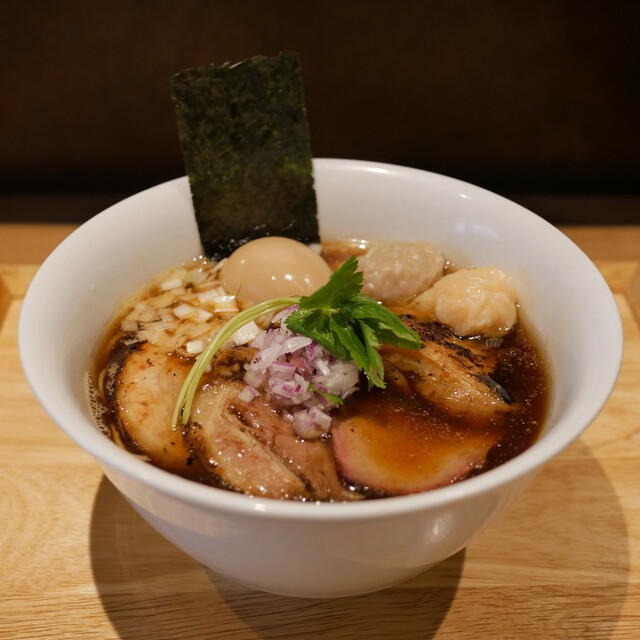
The menu
What to order
- Special Shoyu Ramen
- Shio Ramen
- Tantan Tsukemen
Approach a serious Tokyo counter and the room usually announces its priorities before the order arrives: a compact line of seats, little wasted movement, and a kitchen rhythm measured in seconds rather than courses. Raa Menya Shima belongs to that exact strain of the city’s dining culture, where the performance is not theatrical in the formal sense, but disciplined and counter-side: preparation, timing, assembly, handoff, reset. The guest sees the work because there is nowhere for the work to hide.
That matters in Tokyo, a city where casual food and specialist craft often overlap. The category can look modest from the outside, but its serious rooms often operate with the intensity of formal counters: narrow capacity, fixed flow, and an audience close enough to read the kitchen’s pacing. Raa Menya Shima has the external signal to justify attention beyond local habit, including recognition in the 2026 Opinionated About Dining restaurant data. That credential places it among the Tokyo dining addresses that can attract diners who normally plan the city around specialist counters and tightly focused meals.
A counter performance, not dining-room theatre
The useful way to read this room is through preparation, not décor. Tokyo’s serious counter culture compresses the drama of a longer meal into a short exchange: components prepared with care, sequences calibrated before service, finishing handled with speed, and the dish landing before the sequence loses temperature or texture. The format gives the kitchen less room for delay and the diner less reason to linger.
Raa Menya Shima’s appeal sits in a broader Tokyo tradition that values specialization over breadth. This is not the sprawling casual model, nor the hotel-dining model built around comfort and choice. It is closer to a workshop: compact, focused, and judged by repeatability. For travelers used to reading Japanese dining through luxury signals alone, independent recognition and local demand can be more revealing in casual categories. The important signal is not opulence, but the degree of attention a focused Tokyo counter can command.
The more important point is structural rather than biographical. In this category, authorship shows less through a printed philosophy and more through the controlled mechanics of service. Counter restaurants in Japan often live or fail on consistency across hundreds of small decisions: texture, temperature, seasoning balance, and the choreography between kitchen and seat. The public recognition here indicates a kitchen being judged against that demanding standard, not against a luxury dining template.
Why Tokyo's focused specialists now compete with formal dining for attention
Tokyo has long treated casual food with uncommon seriousness, but the international traveler has only recently caught up. The same visitor who once reserved every dinner around formal or traditional categories now leaves space for compact counters that operate on a different axis: shorter meal, higher friction, stronger local demand. That combination changes the planning logic. A casual Tokyo address can feel simple in format and still require sharper timing than a more comfortable dining room.
Raa Menya Shima is useful because it shows how reputation has moved beyond genre hierarchy. A focused counter with external recognition sits in conversation with other specialist formats across the city, not because the service style is similar, but because the seriousness is. The city’s dining culture has never needed white tablecloths to define ambition. A compact counter can create as much pressure as a formal room because every action is visible and every diner is close to the pass.
The positioning also explains part of the fascination, even if the body of the meal is not the place to reduce the experience to value. Tokyo still allows certain casual specialists to sit at the intersection of everyday format and high reputational weight. That is increasingly rare in global dining capitals, where recognition often pushes experiences toward formality. Here, the interest is sharper: the meal remains anchored in a working counter format while carrying recognition that makes it relevant to travelers mapping the city’s serious food culture.
How to place it in a Tokyo itinerary
This is a focused stop, not a long lunch. It makes the strongest sense for travelers who want to understand Tokyo beyond the familiar premium categories, especially those already comparing counter formats across the city’s specialist dining. The meal’s appeal lies in concentration: a small room, a tight point of view, and a service rhythm built around immediate consumption. It is less suited to groups seeking a leisurely table or a broad à la carte spread.
For broader planning, use Our full Tokyo restaurants guide to connect Raa Menya Shima with the city’s other specialist counters, and pair it with Our full Tokyo hotels guide, Our full Tokyo bars guide, Our full Tokyo wineries guide, and Our full Tokyo experiences guide when building a tighter itinerary. Nearby Tokyo dining notes can also sit beside other unnamed counters, casual rooms, and focused specialists across the city.
Travelers extending the same casual-specialist lens beyond Tokyo can compare the editorial range through other dining cultures in Japan and abroad. The point is not to equate formats, but to read how compact, focused food cultures travel across cities while Raa Menya Shima remains a Tokyo-specific example of that discipline.
Frequently asked questions
Where is Raa Menya Shima in Tokyo?
Tokyo.
What style of cooking does Raa Menya Shima do?
Raa Menya Shima is a focused Tokyo counter experience.
What's the price range at Raa Menya Shima?
Pricing is not specified here.
When is Raa Menya Shima open?
Opening hours are not specified here.
Peers You’d Cross-Shop
| Venue | Cuisine | Price | Awards | Notes |
|---|---|---|---|---|
| Raa Menya ShimaThis venue (the venue you are viewing) | Modern Shoyu Ramen | $20–30 | Tabelog Bronze #399 | Not listed |
| Harutaka | Edo-Style Omakase Sushi | $200–300 | 3 Michelin Stars · World's 50 Best #76 | Sushi |
| RyuGin | Modern Kaiseki | $500+ | 3 Michelin Stars · World's 50 Best #41 | Kaiseki, Japanese |
| L'Effervescence | Modern French with Japanese Influences | $200–300 | 3 Michelin Stars · World's 50 Best #69 | French |
| HOMMAGE | Modern French with Japanese Influences | $150–200 | 2 Michelin Stars · World's 50 Best #78 | Innovtive French, French |
| MAZ | Innovative Peruvian-Japanese Fusion | $150–200 | 2 Michelin Stars · World's 50 Best #28 | Innovative |
Recognition history
Dated appearances from independent guides and award organizations, with the underlying list record or original source where available.
Opinionated About Dining Casual in Japan Ranked #48
Opinionated About Dining
Tabelog Bronze #399
Tabelog
Full recognition history (3 entries)
Tabelog 100 #15 · No. 15
Tabelog · Tabelog 100 - Ramen - TOKYO - 2025
Continue exploring
More in Tokyo
Restaurants in Tokyo
All restaurants in Tokyo →


Bars in Tokyo
All bars in Tokyo →




Details
- Intimate
- Modern
- Solo
- Chefs Counter
- Sake Program
- Counter Dining
Current opening hours
- Monday
- 8:45 AM–2 PM
- Tuesday
- 8:45 AM–2 PM
- Wednesday
- 8:45 AM–2 PM
- Thursday
- 8:45 AM–2 PM
- Friday
- 8:45 AM–2 PM
- Saturday
- Closed
- Sunday
- Closed
Hours can change for holidays and private events. Hours as of .
Focused and intimate counter atmosphere with the chef's meticulous preparation visible, smoky from binchotan grilling, clean and simple setting.