Pizza a taglio in Florence operates in a different register from the city's fine-dining circuit, and Ricciardi on Via Sardegna places itself squarely in the workaday western neighborhoods where Romans and Florentines alike treat sold-by-weight pizza as daily routine rather than destination dining. The format is counter service, the crowd is local, and the value proposition is clear: pay for what you eat, eat well, and leave satisfied without ceremony.
Pearl is the En Primeur Club membership app — saves, bookings, and concierge access live there. Same editors, same standards.
- Address
- via Pistoiese, Via Sardegna, 9/R, 50145 Firenze FI, Italy
- Phone
- +393339605205
- Website
- facebook.com
- Directions
- Get directions
 Saves & bookings on Pearl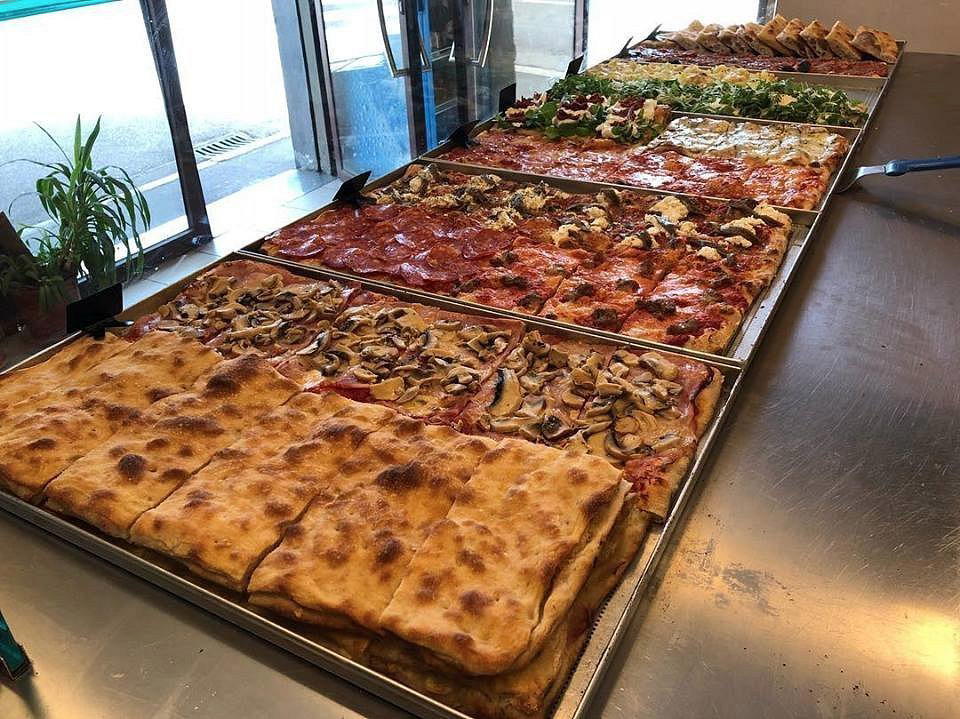
West of the Arno, Away from the Postcard
PIZZA A TAGLIO RICCIARDI is a pizza a taglio restaurant in Florence at via Pistoiese, Via Sardegna, 9/R, 50145 Firenze FI, Italy. Florence's dining conversation tends to collapse around a handful of postcodes: the streets near the Duomo, the Oltrarno ateliers, the riverside tables where kitchens like Borgo San Jacopo plate modern Italian to candlelit rooms. Via Pistoiese, where Ricciardi operates, belongs to a different Florence entirely. This is the western fringe of the city proper, past the Cascine park and into the kind of residential fabric where dry-cleaners and hardware shops share frontage with food counters. The street itself is a working corridor, not a destination thoroughfare, and that context shapes everything about how a pizza a taglio counter functions within it.
Pizza a taglio as a format has its clearest roots in Rome, where it operates as civic infrastructure as much as food service: rectangular trays behind glass, sold by the gram or by rough hand-cut portion, eaten standing or walking. Florence adopted the format at a slower pace than the capital, but in neighborhoods like this one it has settled into the same rhythm. Ricciardi occupies that position in the western residential zone, the kind of counter that serves the lunch crowd from nearby businesses, the school-run parent, and the late-morning regular who already knows what they want before they reach the glass.
The Format as Editorial Point
To understand what a pizza a taglio counter offers in a city like Florence, it helps to place it against the broader spectrum. At the upper end, Florence carries serious fine-dining weight: Enoteca Pinchiorri has held three Michelin stars for decades and remains among the more formally structured dining experiences in Italy. Santa Elisabetta and Atto di Vito Mollica operate in the same upper tier, as does Gucci Osteria da Massimo Bottura, which brings Massimo Bottura's wider creative framework into the city's fashion-house geography. These are reservation-led, multi-hour, multi-course commitments requiring forward planning and commensurate budgets.
Pizza a taglio sits at the opposite structural point. There is no reservation system, no tasting menu arc, no sommelier circuit. The transaction is immediate: you look at what is on the tray, you point, you are served a portion cut to size, you pay. That directness is not a compromise or a lesser version of dining. It is a different format altogether, one that has its own standards and its own criteria for quality, and one that serves a social function that formal restaurants cannot replicate at scale.
The Italian pizza a taglio tradition rewards counters that manage dough hydration well, achieve a bottom crust with structure and lift, and turn trays frequently enough that nothing has been sitting under lights for too long. The leading versions of the format across Italian cities share those qualities regardless of their neighborhood or price point. What a counter like Ricciardi offers in this part of Florence is access to that format in a neighborhood that has relatively few alternatives pitched at the same price tier and with the same day-in-day-out consistency that local regulars require.
Via Sardegna 9/R: Locating It in the City
The Via Pistoiese address places Ricciardi in the 50145 postcode, which covers the area west and northwest of the Cascine, roughly equidistant from the park itself and the outer ring where the city gives way to suburb. Visitors staying in central Florence will need to travel to reach it; this is not a counter you stumble across while leaving the Uffizi. That friction is itself informative. Counters in this part of the city are not built around tourist traffic. The economics of the neighborhood require a different kind of customer base, one that returns on a weekly or daily basis rather than once in a holiday itinerary.
For the traveler who has already covered the central ground and wants to see what the non-postcard city eats on a Tuesday afternoon, this is where that observation happens. The experience of eating pizza a taglio on Via Pistoiese with a mostly local crowd is a different register of Florence than sitting at our full Florence restaurants guide pulls together, and both registers are worth having.
Pizza a Taglio in the Context of Italian Regional Eating
Italy's pizza geography is genuinely regional in a way that sometimes gets flattened for international audiences. Neapolitan pizza, the format most associated with Italy abroad, is a round, wood-fired, eat-it-immediately product where the dough, the San Marzano tomato, and the char timing are the whole conversation. Pizza a taglio operates on different principles: longer fermentation, higher hydration doughs, rectangular pans, and a relationship with toppings that is more layered and more variable. The Roman tradition, which has the deepest roots in the a taglio format, is documented through decades of neighborhood counter culture in districts like Prati and Testaccio.
Florence is not Rome, and its pizza a taglio culture is less embedded and less celebrated in culinary literature. That gap between Roman and Florentine pizza culture is partly historical and partly a function of how Florence's food identity has been narrated: bistecca, lampredotto, ribollita, and wine from the surrounding hills tend to dominate the conversation. The a taglio counter, by contrast, sits in a more anonymous category of daily eating, which is precisely why it rewards attention from anyone trying to read a city beyond its festival dishes. Italy's broader fine-dining circuit, from Osteria Francescana in Modena to Piazza Duomo in Alba and Uliassi in Senigallia, is well documented. The everyday counter culture that feeds Italian cities between those peaks is less so.
Planning Your Visit
Ricciardi operates as a walk-in counter; no reservations are taken and none are needed. The format dictates that you arrive, assess what is on the trays, and order by pointing. Peak service windows at counters of this type are typically the midday lunch hour and, where evening hours apply, the early evening. Arriving slightly before or after peak times means shorter waits and fresher tray rotations. The address at Via Sardegna 9/R, Firenze FI, 50145 is the reliable anchor for navigation. The address at Via Sardegna 9/R, Firenze FI, 50145 is the reliable anchor for navigation.
A Minimal comparable set
Comparable venues nearby, for context on price, style, and recognition.
| Venue | Cuisine | Price | Notes |
|---|---|---|---|
| PIZZA A TAGLIO RICCIARDIThis venue — the venue you are viewing | Nave A Petriolo, Pizza a Taglio | $ | Not listed |
| Trattoria Sabatino | San Frediano, Authentic Tuscan Trattoria | $ | Not listed |
| Gustapizza | Santo Spirito, Neapolitan Pizza | $ | Not listed |
| I’Brindellone | Not listed | $$ | San Frediano, Traditional Tuscan Trattoria |
| Trattoria Sergio Gozzi | Not listed | $$ | Santo Spirito, Traditional Tuscan Trattoria |
| Ristorante Il Guscio | San Frediano, Authentic Tuscan Trattoria | $$$ | Not listed |
Continue exploring
More in Florence
Restaurants in Florence
Browse all →
Bars in Florence
Browse all →
Hotels in Florence
Browse all →
At a Glance
- Cozy
- Casual Hangout
Current opening hours
- Monday
- Closed
- Tuesday
- 11 AM–3 PM, 5–8:30 PM
- Wednesday
- 11 AM–3 PM, 5–8:30 PM
- Thursday
- 11 AM–3 PM, 5–8:30 PM
- Friday
- 11 AM–3 PM, 5–8:30 PM
- Saturday
- 11 AM–2:30 PM, 5–8:30 PM
- Sunday
- 11 AM–2:30 PM, 5–8:30 PM
Hours can change for holidays and private events. Last verified .
Small, no-frills counter-service spot with a casual, local feel.