
Petit Restaurant Naitou belongs to Kyoto’s yoshoku tradition, where Western forms are filtered through Japanese sourcing and dining habits. Its 2025 Tabelog 100 Yoshoku WEST selection, focus on tonkatsu, hamburger steak and fish-led cooking, and compact 25-seat format place it in a local category that rewards technique over spectacle.
Pearl is the En Primeur Club membership app — saves, bookings, and concierge access live there. Same editors, same standards.
- Address
- Japan, 〒604-0934 Kyoto, Nakagyo Ward, Owaricho, 217 サンロータス池治
- Phone
- +81 75-211-3900
- Website
- petitrestaurant-naito.com
 Saves & bookings on Pearl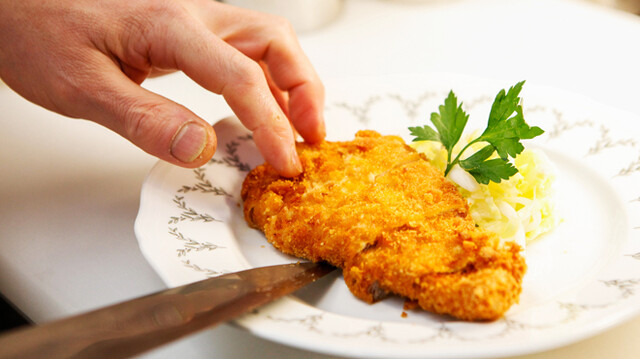
The approach to Petit Restaurant Naitou is more Kyoto side street than grand arrival: low-rise Nakagyo, municipal Kyoto nearby, and a room scaled for a meal, not performance. That matters for yoshoku, a cuisine built on translation: cutlets, croquettes, steaks and sauces brought into Japan, then adapted to rice, cabbage, seasonal produce, frying oils and local service. In a city often reduced to kaiseki and temple-adjacent sweets, yoshoku reads Kyoto differently: postwar, urban, ingredient-conscious and quietly technical.
Petit Restaurant Naitou occupies that lane with unusual clarity. Its selection for Tabelog 100 Yoshoku WEST 2025 places it among restaurants recognized specifically for Japanese-style Western cooking, not as a generic Western room. Its categories, yoshoku, tonkatsu and hamburger steak, are useful signals: a kitchen focused on the Japanese grammar of Western dishes, from frying, sauce work, meat texture and rice compatibility to plates that feel familiar without becoming careless.
Yoshoku in Kyoto, with frying as the technical test
Yoshoku can look simple because the names are plain. Tonkatsu, hamburger steak, cream croquette and fried seafood sound like everyday comfort food. In Japan, that familiarity makes the cooking exposed. A cutlet shows ambition through oil management, breading, thickness, rest time and sauce restraint. A hamburger steak depends on grind, fat, binding and the balance between softness and structure. Fish in a yoshoku setting asks for freshness and restraint, not the heavy masking of poorer Westernized cooking.
The restaurant’s public materials emphasize tonkatsu made with natural oils from a long-established oil shop, and fish is also a stated focus. Those details place the kitchen in yoshoku’s disciplined branch, where Western technique is not decorative but a framework for Japanese ingredients and expectations. Kyoto’s dining culture tends to punish excess; even outside formal washoku, plates are expected to show control. That pressure suits serious yoshoku.
The 2025 Tabelog 100 recognition matters because yoshoku is not usually the first category international travelers chase in Kyoto. Sushi, kaiseki, wagashi and ramen carry louder signals. A yoshoku address with that award sits in a quieter competitive set, where residents and domestic travelers often read value differently from visitors. The point is not novelty, but a tradition Japan has absorbed for more than a century until its Western origins became secondary to local craft.
A la carte format rather than ceremony
Format reinforces that reading. Since 2020, the restaurant has operated without course meals, working instead a la carte. In Kyoto, that changes the meal’s psychology. Course dining can lock a restaurant into a chef’s sequence; a la carte yoshoku lets the table compose across cutlet, fish and hamburger steak, and makes the room more flexible for repeat local use. It also keeps attention on execution rather than narrative.
There are 25 seats, including counter seating and tables, with semi-private seating for small parties. That is small enough for pacing to matter, but not so tiny that the experience becomes a counter-only ritual. The drinks list spans sake, shochu and wine, an important clue in a yoshoku restaurant: the meal can lean Japanese or Western depending on the order. Sommelier availability gives wine more structure, while sake and shochu keep the cooking tethered to local habits rather than brasserie mimicry.
Kyoto has several small-format restaurants that reward a narrow reading of genre. Maeshiro and måne occupy different parts of the city’s small-room dining culture, while Fuyacho 103 shows how one Japanese format, oden, can carry an evening. Petit Restaurant Naitou belongs to the same Kyoto habit of specialization, with yoshoku vocabulary rather than counter kaiseki or oden. The useful comparison is scale, focus and the expectation that the room has a defined reason to exist.
Where it fits in a Kyoto dining week
For travelers, treat yoshoku as a counterweight to Kyoto’s formal meals. After a temple-heavy day or a long kaiseki dinner the night before, Japanese-style Western cooking can reset the palate without leaving local context. This is not a substitute for Kyoto’s seasonal haute cuisine. It explains another side of the city: neighborhood dining with imported technique, Japanese product logic and prices below luxury tasting menus.
The restaurant relocated from Yanagibaba Street to Fuyacho Street in December 2019, a useful marker in Kyoto’s central dining geography. Nakagyo has become one of the city’s stronger areas for compact restaurants that do not need hotel lobbies or riverside views. Around Kyoto Shiyakusho-mae, the rhythm is practical: office workers, residents, destination diners and visitors moving between downtown, the river and older shopping arcades.
Readers building a Kyoto itinerary should place this meal alongside, not beneath, the city’s better-known formats. 3TOKU6MI Shijo karasuma ten, 551蓬莱, [ki:], Abbesses and Aburi Mochi Honke Nemoto Kazariya show how broad Kyoto eating becomes once the lens moves beyond ceremonial dining. For a wider route, use Our full Kyoto restaurants guide, then balance meals with Our full Kyoto hotels guide, Our full Kyoto bars guide, Our full Kyoto wineries guide and Our full Kyoto experiences guide.
The broader Japan list helps frame how genre-specific restaurants travel across cities: -Grilled beef Sukiyaki- KAMAKURA TANUKIAN 鎌倉 たぬき庵 in Kamakura. 鮪と炭火焼き うお炭 秋葉原店 in Tokyo.cafe in Osaka.know in Kumamoto, (Shoku) Vietnam in Kawasaki and [Curry Senmon Ten] Maruyama Kyoju. in Sapporo. Abroad, Jōdo Saké Bar in Los Angeles and Onigiri Time in Pasadena underline the same lesson from another angle: Japanese food culture is often clearest when a narrow format is taken seriously.
Cost and Credentials
Comparable venues for context, by category and price tier.
| Venue | Cuisine | Price | Notes |
|---|---|---|---|
| Petit Restaurant NaitouThis venue — the venue you are viewing | Nakagyō, Seasonal yoshoku and tonkatsu | $$ | Not listed |
| Chao Chao Gyoza (チャオチャオ餃子 三条木屋町店) | Not listed | $$ | Sanjo Kiyamachi, Japanese Gyoza Specialist |
| Zen Kasho In Kyoto muromachi honten | Not listed | $$ | Nakagyō, Traditional Japanese sweets & matcha cafe |
| ほしぞら | Shimogyo-ku, Korean-style Yakiniku | $$ | Not listed |
| Cafe Karirenge | Not listed | $$ | Nakagyō, Kyoto cafe with cakes and light meals |
| Umezono Cafe and Gallery | Not listed | $$ | Nakagyō, Kyoto wagashi café with matcha sweets and pancakes |
Recognition history
Dated appearances from independent guides and award organizations, with the underlying list record or original source where available.
Tabelog 100 #63 · No. 63
Tabelog · Tabelog 100 - Yoshoku - WEST - 2025
Continue exploring
More in Kyoto
Restaurants in Kyoto
Browse all →
Bars in Kyoto
Browse all →
Hotels in Kyoto
Browse all →

Wineries in Kyoto
Browse all →
At a Glance
- Cozy
- Classic
- Intimate
- Solo
- Date Night
- Casual Hangout
- Special Occasion
- Chefs Counter
- Standalone
Current opening hours
- Monday
- Closed
- Tuesday
- 12–1:30 PM, 6–8:30 PM
- Wednesday
- 12–1:30 PM, 6–8:30 PM
- Thursday
- 12–1:30 PM, 6–8:30 PM
- Friday
- 12–1:30 PM, 6–8:30 PM
- Saturday
- 12–1:30 PM, 6–8:30 PM
- Sunday
- 12–1:30 PM, 6–8:30 PM
Hours can change for holidays and private events. Last verified .
Warm, low-key neighborhood restaurant with counter and table seating, a classic yoshoku feel, and a relaxed, unpretentious atmosphere suited to quiet, lingering meals.