On Stargarder Strasse in Prenzlauer Berg, Pasta & Vino occupies a stretch of the neighbourhood where everyday trattorias sit alongside some of Berlin's more considered casual dining. The name signals intent clearly: pasta, wine, and a format built around simplicity. For a city that has increasingly looked to its own larder for high-end credentials, a focused Italian-adjacent counter on this street represents a different but equally deliberate position.
Pearl is the En Primeur Club membership app — saves, bookings, and concierge access live there. Same editors, same standards.
- Address
- Stargarder Str. 72, 10437 Berlin, Germany
- Phone
- +493060947917
- Website
- pasta-vino-berlin.de
- Directions
- Get directions
 Saves & bookings on Pearl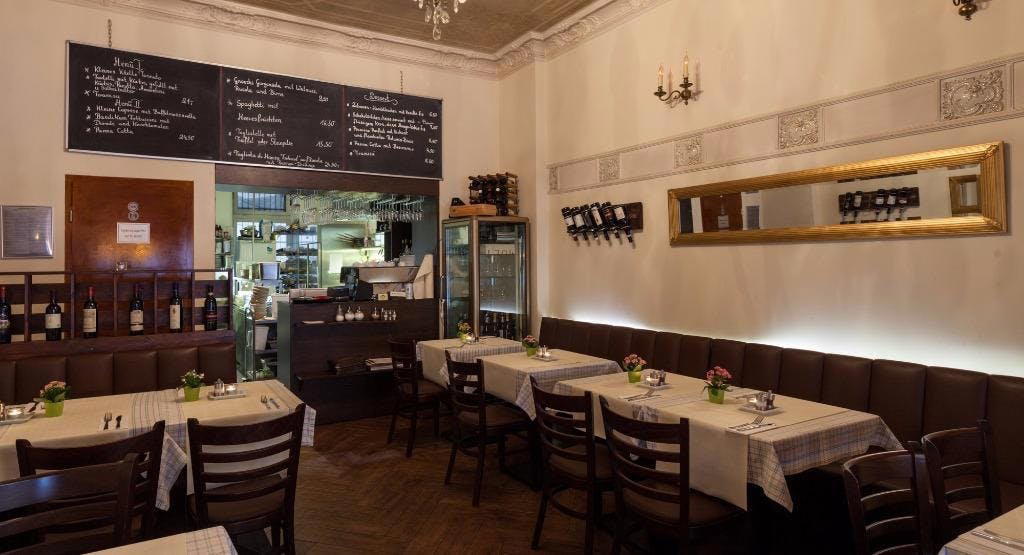
Pasta & Vino is a restaurant in Prenzlauer Berg, Berlin, serving authentic Italian pasta and antipasti at about $25 per person. Prenzlauer Berg has long operated as one of Berlin's more settled residential dining districts, a neighbourhood where the restaurant density is high but the ambition is often domestic rather than destination-driven. Stargarder Strasse, where Pasta & Vino sits at number 72, runs through a section of the area that balances corner bars, family-run kitchens, and the occasional room that punches above its postcode. The street itself has a low-key material quality: tram lines nearby, pre-war apartment facades, the kind of foot traffic that belongs to people who live here rather than people who have come looking.
A Case for Restraint in a City Reaching for Complexity
Berlin's high-end dining conversation has, over the past decade, consolidated around a group of addresses that treat locality and provenance as the primary editorial statement. Nobelhart & Schmutzig made Brutally Local a literal slogan; Rutz built a multi-Michelin reputation on German produce interpreted through a contemporary European lens. Even CODA Dessert Dining and FACIL at the four-star end of the market have leaned into ingredient discipline and reduced-intervention thinking. Against that backdrop, a pasta and wine format reads not as a step back from seriousness but as a different kind of commitment: fewer categories, fewer moving parts, more pressure on the core product to carry the room.
The Italian-influenced trattoria model has a particular resonance in northern European cities precisely because it asks a simple question about sourcing: where does the flour come from, what shapes the pasta, and what is in the glass? When those questions are answered with care, the format holds. When they are not, it collapses faster than a tasting menu can hide behind technique. The name Pasta & Vino makes no attempt at mystification, which is itself a position.
Sustainability as Format, Not Garnish
Across European casual dining, sustainability has split into two distinct registers. The first is performative: a provenance note on the menu, a seasonal addendum, a biodegradable straw. The second is structural: a format designed from the outset around limited SKUs, reduced waste through pasta production, and a wine list that reflects considered sourcing rather than breadth for its own sake. The trattoria model, at its most disciplined, belongs naturally to the second register.
Pasta production inherently favours waste reduction. A kitchen that makes dough daily and uses the whole batch across a small number of shapes generates significantly less spoilage than a kitchen running ten protein-led mains with multiple mise en place components. The flour-water-egg logic of fresh pasta is one of the older forms of nose-to-tail thinking in European cooking, even if it rarely gets framed that way. Wine programmes built around small importers and natural or low-intervention producers add another layer of supply-chain legibility: shorter producer lists, fewer anonymous negociant bottles, more direct relationships between restaurant and vineyard.
Berlin has shown an appetite for this approach at the Michelin end of the market, where Nobelhart & Schmutzig and Rutz have both built their identities around sourcing discipline. Whether that discipline filters down into the neighbourhood trattoria tier is a more open question, and it is the question that addresses like Pasta & Vino on Stargarder Strasse are positioned to answer.
The Berlin Casual Tier: Where Pasta & Vino Sits
Berlin's restaurant market has a pronounced gap between its Michelin-recognised fine dining addresses and its street-level everyday eating. The middle tier, occupied by neighbourhood rooms with serious intentions but accessible pricing, is where much of the city's most interesting work has happened in recent years. This is the category that includes natural wine bars with small plates, regional German kitchens with no tasting menu, and format-led rooms like an all-pasta concept that earns its authority through depth rather than breadth.
At the Michelin end, the reference points for German cooking are geographically distributed: Schwarzwaldstube in Baiersbronn, Vendôme in Bergisch Gladbach, Victor's Fine Dining in Perl, and Waldhotel Sonnora in Dreis represent Germany's top tier outside of the major cities. Berlin's own fine dining, anchored by Restaurant Tim Raue and the rooms above, operates in a different register entirely from a Prenzlauer Berg pasta address. But the broader context matters: a city with a serious fine dining ecosystem tends to have higher ingredient standards cascading through its middle tier, which is the environment in which a place like Pasta & Vino operates.
Comparable format-driven rooms in other German cities include JAN in Munich, Aqua in Wolfsburg, and Restaurant Haerlin in Hamburg, each representing different positions on the formality spectrum. Further afield, Schanz in Piesport, Bagatelle in Trier, and ES:SENZ in Grassau offer data points on how Germany's regional restaurant culture continues to develop outside its metropolitan centres.
What the Name Promises
Format-led naming, the decision to call a restaurant exactly what it does, carries a specific risk: it sets the evaluation criteria in advance. A place called Pasta & Vino is judged on its pasta and its wine. There is no supplementary narrative to absorb a weak dish or an underdeveloped list. The international reference points for this kind of transparent positioning include addresses like Le Bernardin in New York, where the seafood focus is non-negotiable and the room is judged entirely on execution within that constraint, or Atomix, where the Korean tasting format is the premise and the premise must deliver.
On Stargarder Strasse, the stakes are lower and the format more accessible, but the logic is identical: a name that removes ambiguity also removes excuses. The pasta shapes, the dough hydration, the sauce-to-pasta ratio, and the wine selection by the glass all become load-bearing elements in a way they would not be in a broader menu where other dishes can compensate.
Know Before You Go
- Address: Stargarder Str. 72, 10437 Berlin, Germany
- Neighbourhood: Prenzlauer Berg, Pankow district
- Format: Neighbourhood trattoria; pasta and wine focus
- Price range: about $25 per person
- Hours: Mon to Sun, 12 to 11 PM
Reputation First
Comparable venues nearby, for context on price, style, and recognition.
| Venue | Cuisine | Price | Notes |
|---|---|---|---|
| Pasta & VinoThis venue — the venue you are viewing | Authentic Italian Pasta & Antipasti | $$ | Not listed |
| Bäckspace Pizza | Sourdough Pizza | $$ | Weissensee |
| Sotto | Vegetarian Italian Pizzeria | $$ | Gesundbrunnen |
| Prometeo | Authentic Neapolitan Pizza | $$ | Schoneberg |
| Weltwirtschaft | Italian-Inspired Global with Pizza | $$ | Moabit |
| Mangiare Berlin | Authentic Neapolitan Pizza | $$ | Moabit |
Continue exploring
More in Berlin
Restaurants in Berlin
Browse all →
Bars in Berlin
Browse all →
Hotels in Berlin
Browse all →
Wineries in Berlin
Browse all →
At a Glance
- Cozy
- Intimate
- Date Night
- Casual Hangout
- Standalone
- Extensive Wine List
Current opening hours
- Monday
- 12–11 PM
- Tuesday
- 12–11 PM
- Wednesday
- 12–11 PM
- Thursday
- 12–11 PM
- Friday
- 12–11 PM
- Saturday
- 12–11 PM
- Sunday
- 12–11 PM
Hours can change for holidays and private events. Last verified .
Cozy and charming with a sedate evening atmosphere.