
OLD NEW DINER brings Tokyo’s serious hamburger conversation west to Tachikawa, where a 24-seat room with counter seating, sofa seating, take-out service, and family-friendly rules makes the format feel practical rather than precious. Its Tabelog Hamburger 100 selections in 2022, 2024, and 2026 place it in a small national bracket for a category often treated too casually.
Pearl is the En Primeur Club membership app — saves, bookings, and concierge access live there. Same editors, same standards.
- Address
- Japan, 〒190-0022 Tokyo, Tachikawa, Nishikicho, 1 Chome−8−5 イーグル立川 101
- Phone
- +81 50-5303-3563
- Website
- oldnewdiner.jp
 Saves & bookings on Pearl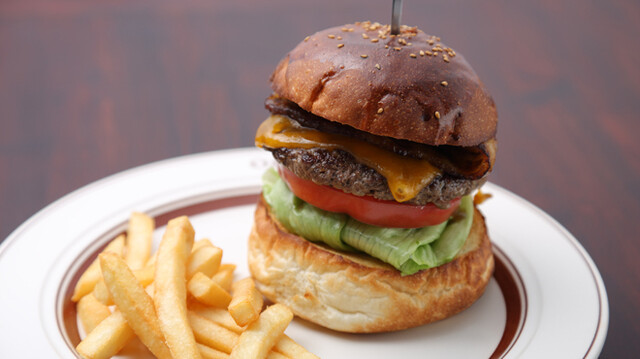
Approaching Tachikawa’s Nishikicho side, the signal is compression, not ceremony: a compact first-floor address, in-room counter, sofa seating, and a no-smoking policy that suits families and solo eaters. Tokyo’s hamburger culture has matured in rooms like this, beyond imported Americana cosplay, toward small-restaurant discipline where seating limits, take-out logistics, and repeat local traffic matter as much as bun and patty.
OLD NEW DINER fits that category. Its Tabelog Hamburger 100 selections in 2022, 2024, and 2026 provide a public benchmark in a crowded Tokyo field. The recognition matters because hamburgers in Japan sit between casual comfort and specialist craft: the category rewards consistency, speed, and heat management, and punishes shortcuts. A relaxed-looking shop can still be judged with ramen-counter or tonkatsu-house intensity.
A Tachikawa burger room built around small-format discipline
Western Tokyo is often read through commuter geography rather than dining ambition, but Tachikawa has the conditions for serious casual restaurants: dense rail access, office traffic, families, and enough distance from central Tokyo to reward operators who build local loyalty instead of chasing tourist flow. Here, the 24-seat format is not a limitation. It keeps the room closer to a counter restaurant than a chain dining room, while take-out extends capacity without turning the experience into a production line.
The sustainability story is not a grand claim about farms or carbon accounting. It is the less glamorous, more credible version: compact restaurant, focused category, no-smoking room, card and QR payment options, and take-out that lets demand move beyond the seats without requiring a larger footprint. In Tokyo, where real estate and staffing pressure shape survival, this restraint has environmental consequences even when the menu is not framed in activist language.
That restraint separates OLD NEW DINER from cheaper curry-and-cafe casualness at RAINBOW SPICE or Ichiroku Coffee Ten, both in lower everyday price bands, and from destination dining such as Soba Kaiseki Muan, where structure and spend occupy another register. The point is not which meal is more ambitious; it is how Tokyo supports specialist dining at multiple scales. A hamburger counter can be evaluated as seriously as soba, yakitori, curry, or coffee when the format is tight.
For broader Tokyo planning, the point is category literacy. The city’s casual hierarchy is deep: yakitori has counters such as 124. KAGURAZAKA (Yakitori), curry has small rooms like 3 Chome no Curry Ya San, and seafood-led izakaya cooking appears at . 鮪と炭火焼き うお炭 秋葉原店. OLD NEW DINER sits in the hamburger lane: narrow focus, modest scale, and enough recognition to justify crossing the city if the category matters to the trip.
Why Tokyo treats the hamburger as a specialist dish
Japan’s strongest casual food forms reward repeatability. Ramen, curry, tonkatsu, yakitori, and hamburgers all make a visible promise: the diner understands the format before entering, then judges execution with little patience for drift. Hamburger restaurants are unusually exposed. There is nowhere to hide behind a long tasting menu, cellar, or service choreography. The meal succeeds on temperature, timing, structure, and whether the room handles busy periods without losing pace.
The one-hour limit that may apply for in-store dining on weekends and public holidays during busy periods tells experienced travelers how to read the room. This is not a lingering hotel-lobby meal. It is a compact urban restaurant where turnover is part of the model. Reservations are available, with weekend and public-holiday reservations accepted from late afternoon, and the one-drink, one-food-per-person condition keeps tables aligned with small-room economics. These mechanics keep independent casual restaurants viable in Tokyo.
Families are explicitly accommodated, including babies, preschoolers, school-age children, and strollers, though limited space can make strollers difficult during busy times. That says more than a generic “family friendly” label. It places the restaurant in a practical Tokyo tradition where compact rooms serve multiple constituencies across the day: lunch budgets, dinner groups, solo counter diners, and parents who need rules stated clearly before arrival.
Travelers planning beyond Tachikawa can use the wider EP Club city pages for contrast rather than sameness: Our full Tokyo restaurants guide, Our full Tokyo hotels guide, Our full Tokyo bars guide, Our full Tokyo wineries guide, and Our full Tokyo experiences guide are more useful when read by neighborhood and format. Tachikawa gives a different Tokyo from Ginza or Aoyama: less polished, more residential, and often better suited to casual specialists.
How to place it in a wider Japan-and-beyond food itinerary
The smarter itinerary does not treat every meal as a trophy. It alternates intensity. A Tachikawa hamburger stop can sit between a stricter counter meal and a looser bar night, just as a traveler might pair Tokyo with regional dining at -Grilled beef Sukiyaki- KAMAKURA TANUKIAN 鎌倉 たぬき庵 in Kamakura, a cafe break at.cafe in Osaka, or contemporary casual cooking at [ki:] in Kyoto. In that company, a hamburger specialist’s value is clarity: it resets the palate and schedule without lowering the editorial bar.
There is also a cross-Pacific echo. Japanese casual formats have shaped dining rooms from Los Angeles to Pasadena, where Jōdo Saké Bar in Los Angeles and Onigiri Time in Pasadena show how focused Japanese categories travel when the format is legible. Within Japan, that clarity appears in different registers, from.know in Kumamoto to (Shoku) Vietnam in Kawasaki and [Curry Senmon Ten] Maruyama Kyoju. in Sapporo. The lesson is not that every category needs luxury treatment. It needs discipline, repeat customers, and enough identity to survive comparison.
The restaurant is strongest as a category-specific stop for travelers who care how Tokyo handles casual food with seriousness. Its repeated Tabelog Hamburger 100 selections, modest price band, compact seating, take-out service, and family rules make the case without overstatement. Pair it with a nearby afternoon in western Tokyo, or use it as a counterweight to a more formal evening. Either way, read it as part of Tokyo’s talent for turning everyday formats into sharply judged specialties.
Cuisine and Awards Snapshot
Comparable venues to calibrate price, style, and recognition.
| Venue | Cuisine | Price | Notes |
|---|---|---|---|
| OLD NEW DINERThis venue — the venue you are viewing | Gourmet American-style Burger Diner | $$ | Not listed |
| BUTCHER'S TABLE Ooizumi gakuen ten | American-style burger & sandwich bar | $$ | Nerima |
| AS CLASSICS DINER KOMAZAWA | Classic American diner & burgers | $$ | Meguro |
| TEDDY BROWN | Wagyu Burger & Cafe | $$ | Shibuya |
| ババ・ガンプ・シュリンプ 東京店 | American Seafood - Shrimp Specialists | $$ | Bunkyō |
| CRUZ BURGERS & CRAFT BEERS | Gourmet burgers & craft beer | $$ | Shinjuku |
Recognition history
Dated appearances from independent guides and award organizations, with the underlying list record or original source where available.
Tabelog 100 #29 · No. 29
Tabelog · Tabelog 100 - Hamburger - 2026
Continue exploring
More in Tokyo
Restaurants in Tokyo
Browse all →



Bars in Tokyo
Browse all →



Hotels in Tokyo
Browse all →




Wineries in Tokyo
Browse all →
At a Glance
- Cozy
- Lively
- Classic
- Casual Hangout
- Family
- Solo
- Group Dining
- After Work
- Private Event
- Standalone
- Private Dining
- Beer Program
- Local Sourcing
Current opening hours
- Monday
- Closed
- Tuesday
- 11 AM–9 PM
- Wednesday
- 11 AM–9 PM
- Thursday
- 11 AM–9 PM
- Friday
- 11 AM–9 PM
- Saturday
- 11 AM–9 PM
- Sunday
- 11 AM–9 PM
Hours can change for holidays and private events. Last verified .
A compact neighborhood burger joint with a classic American-diner feel, casual and energetic, focusing on hearty handmade burgers in a bright, smoke-free, family-friendly setting.