
A take-out taiyaki and obanyaki shop in Bunkyo’s Edogawabashi area, Naniwaya Edogawabashi belongs to Tokyo’s old-school wagashi circuit rather than the city’s tasting-menu economy. Its Tabelog 100 selection for Tokyo Japanese traditional sweets in 2023, sub-JPY 999 pricing, and no eat-in format make it a planning-sensitive stop: quick on paper, but better treated as a timed detour.
Pearl is the En Primeur Club membership app — saves, bookings, and concierge access live there. Same editors, same standards.
- Address
- 1 Chome-5-8 Sekiguchi, Bunkyo City, Tokyo 112-0014, Japan
- Phone
- +81 3-3268-6261
- Website
- tabelog.com
 Saves & bookings on Pearl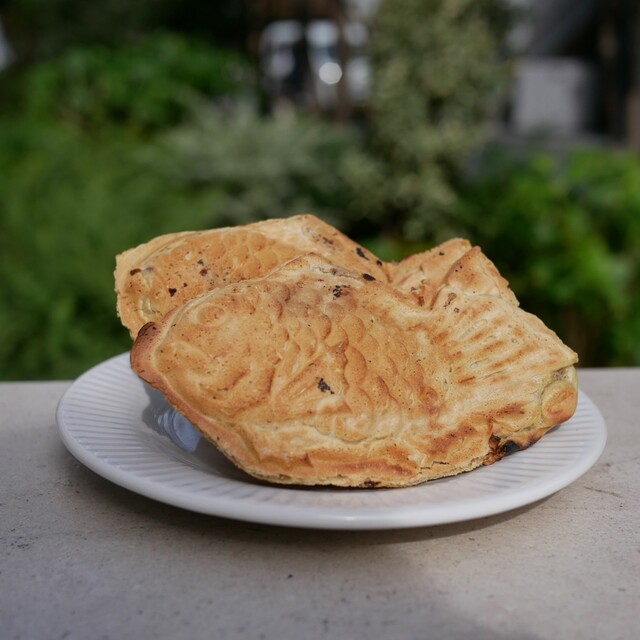
Jizo-dori shopping street brings Tokyo’s sweet traditions to pavement level: shutters, counter windows, small queues, and purchases carried away rather than staged in a dining room. In a city where dessert can mean hotel pâtisserie, department-store gift boxes, or precision wagashi counters, the taiyaki and obanyaki shop is immediate, inexpensive, and tied to neighbourhood rhythm. Naniwaya Edogawabashi sits in that lane, closer to daily Tokyo than ceremony, with the key credibility signal: selection for Tabelog’s Tokyo Japanese traditional sweets and sweets-cafe 100 in 2023.
The booking experience is about understanding the format, not securing a seat. There is no eat-in area, so arrive with a plan, buy at the counter, and fold the stop into a Bunkyo walk rather than treating it like a restaurant reservation. For travellers building Tokyo days around fixed meals, that matters. A taiyaki run can fit between Kagurazaka, Waseda, and central Tokyo itineraries, but rewards precision because the value is timing and simplicity, not lingering.
Taiyaki culture at counter scale, not dessert-course theatre
Tokyo’s premium dining conversation often tilts toward sushi counters, kappo rooms, yakitori omakase, and French-Japanese tasting menus. Wagashi uses a quieter, older grammar: seasonality, bean paste, griddle work, gift culture, and local repeat custom. Taiyaki and obanyaki are direct expressions of it, built for hand-held eating, priced for repeat purchase, and judged by texture, filling balance, and turnover rather than tableware or service choreography.
That makes the sub-JPY 999 spend bracket central. It places the shop where small execution differences carry the visit. At a higher-priced counter, the room, pacing, and beverage program broaden the experience; at a take-out sweets shop, the product has fewer places to hide. The Tabelog 100 recognition in 2023 gives Naniwaya Edogawabashi a useful external marker in a crowded Tokyo field, especially for travellers without the local memory bank to separate a routine shopping-street stop from a serious one.
The comparison set shows how Tokyo’s lower-price food culture branches. Kamaage Udon Hatsutomi and SAN TORA sit in a JPY 1,000–1,999 band, while Naniwaya Edogawabashi occupies a lighter spend category and snack-driven role. Tori Takuchu belongs to a far higher JPY 10,000–14,999 bracket, where booking and meal structure govern the evening. These venues do not compete directly; they show that Tokyo rewards visitors who match format to purpose: sweets counter for a focused stop, udon or curry for a quick meal, yakitori for a planned night.
Edogawabashi makes the stop feel local rather than spectacle-driven
Bunkyo is not Tokyo selling itself through neon density. Edogawabashi and the nearby Kagurazaka orbit are better read through slopes, residential streets, small merchants, schools, shrines, and old shopping streets not flattened into one visitor script. That setting suits taiyaki. The pleasure is the scale of the transaction: a counter, a small order, a short walk, and a neighbourhood that gives the purchase somewhere to belong.
For a broader eating day, this part of Tokyo pairs well with nearby casual and specialist addresses rather than another high-commitment meal. The Kagurazaka axis can move from skewers at 124. KAGURAZAKA (Yakitori) to sweets here, while central Tokyo plans might connect to 3 Chome no Curry Ya San, . 鮪と炭火焼き うお炭 秋葉原店, or 12/10 Shinjuku ten depending on the day’s direction. For travellers mapping by category rather than neighbourhood, 2D Cafe is a useful contrast: Tokyo’s sweets culture can be graphic, social-media-driven, traditional, or purely functional, sometimes within a few train stops.
The absence of a dining room is part of the experience, not a limitation to solve. Tokyo has a strong culture of compact formats: ramen counters with fast turnover, department-basement counters built around gifting, standing bars, and take-out specialists whose reputation travels through repetition. Naniwaya Edogawabashi belongs to that practical city. Visitors expecting a seated dessert course will misread it; visitors treating it as a precise sweets errand will understand the appeal faster.
How to place it inside a Tokyo eating itinerary
The strongest use case is a daytime stop around Edogawabashi, Kagurazaka, or Bunkyo, not a cross-city evening detour. Take-out service and modest spend make it easy to add if the itinerary leaves room for a short, targeted pause. Groups require more planning than solo visitors or pairs, since the format is compact and reservations are relevant for parties of six or more. Payment follows an older cash-first Tokyo pattern, so do not assume cards, electronic money, or QR payment will smooth the transaction.
Tokyo’s serious travellers often over-index on reservations and under-index on small formats. That is a mistake. The city’s food intelligence lives as much in shopping streets and specialist counters as in award-heavy dining rooms. A stop like this adds texture to a day built around lunch and dinner bookings: lower spend, shorter duration, and a different reading of craft. It will not replace a formal meal, but it can make the day feel less engineered.
For wider planning, use Our full Tokyo restaurants guide to build around neighbourhood clusters rather than isolated pins. Stays matter too: Our full Tokyo hotels guide helps decide whether Bunkyo is a short hop or a dedicated outing. Drinking routes can be layered through Our full Tokyo bars guide, while category completists can scan Our full Tokyo wineries guide and Our full Tokyo experiences guide for non-restaurant anchors.
Japan’s regional food map also calibrates expectations. A Tokyo taiyaki counter has little in common with beef sukiyaki in Kamakura at -Grilled beef Sukiyaki- KAMAKURA TANUKIAN 鎌倉 たぬき庵 in Kamakura, café culture at.cafe in Osaka, contemporary dining at.know in Kumamoto, or curry specialization at [Curry Senmon Ten] Maruyama Kyoju. in Sapporo. Even within Japanese casual formats abroad, the comparison shifts: Jōdo Saké Bar in Los Angeles and Onigiri Time in Pasadena translate different parts of the everyday-food vocabulary. For travellers moving through Japan, [ki:] in Kyoto and (Shoku) Vietnam in Kawasaki show how local context changes the meaning of a small-format meal.
The verdict is simple: this is a Tokyo sweets stop for people who value format discipline. The draw is not luxury, length, or ceremony. It is a compact expression of wagashi-adjacent street tradition, backed by a 2023 Tabelog 100 selection, priced for an easy detour, and best approached with the seriousness travellers usually reserve for harder-to-secure tables.
Accolades, Compared
Comparable venues by cuisine and price in the same metro.
| Venue | Cuisine | Price | Notes |
|---|---|---|---|
| Naniwaya EdogawabashiThis venue — the venue you are viewing | Traditional Japanese taiyaki & obanyaki shop | $ | Not listed |
| Pneuma Curry | Japanese Curry | $ | Shinjuku |
| CHANTOYA COCONUT CURRY | Coconut-focused Japanese curry | $ | Chiyoda |
| Hendrix curry | Japanese Spice Curry Bar | $ | Shibuya |
| Karinto Yushima Kagetsu | Japanese Confectionery | $ | Bunkyō |
| China Soba Osada | Ramen & Tantanmen | $ | Itabashi |
Recognition history
Dated appearances from independent guides and award organizations, with the underlying list record or original source where available.
Tabelog 100 #40 · No. 40
Tabelog · Tabelog 100 - Japanese traditional sweets / Japanese sweets cafe - TOKYO - 2023









At a Glance
- Classic
- Cozy
- Casual Hangout
- Solo
- Family
- After Work
- Standalone
Current opening hours
- Monday
- 10 AM–6 PM
- Tuesday
- Closed
- Wednesday
- 10 AM–6 PM
- Thursday
- 10 AM–6 PM
- Friday
- 10 AM–6 PM
- Saturday
- 10 AM–6 PM
- Sunday
- 10 AM–6 PM
Hours can change for holidays and private events. Last verified .
A small, traditional Japanese sweets shop on Jizo-dori Shopping Street with no eat-in area, focused on takeaway; reviews highlight the craftsmanship of its taiyaki and a nostalgic, low-key neighborhood atmosphere rather than sit-down ambiance.