Nagano Meijitei (明治亭) occupies the third floor of the MIDORI Nagano building in the Minami-Chiyoda district, positioning itself within the city's station-adjacent dining corridor. The restaurant draws visitors and locals alike to a setting that bridges Nagano's mountain-prefecture identity with accessible urban dining. Practical and centrally located, it represents a readable entry point into the city's mid-tier restaurant scene.
Pearl is the En Primeur Club membership app — saves, bookings, and concierge access live there. Same editors, same standards.
- Address
- 南千歳1-22-6 (MIDORI長野 3F), 長野市, 長野県, 380-8543
 Saves & bookings on Pearl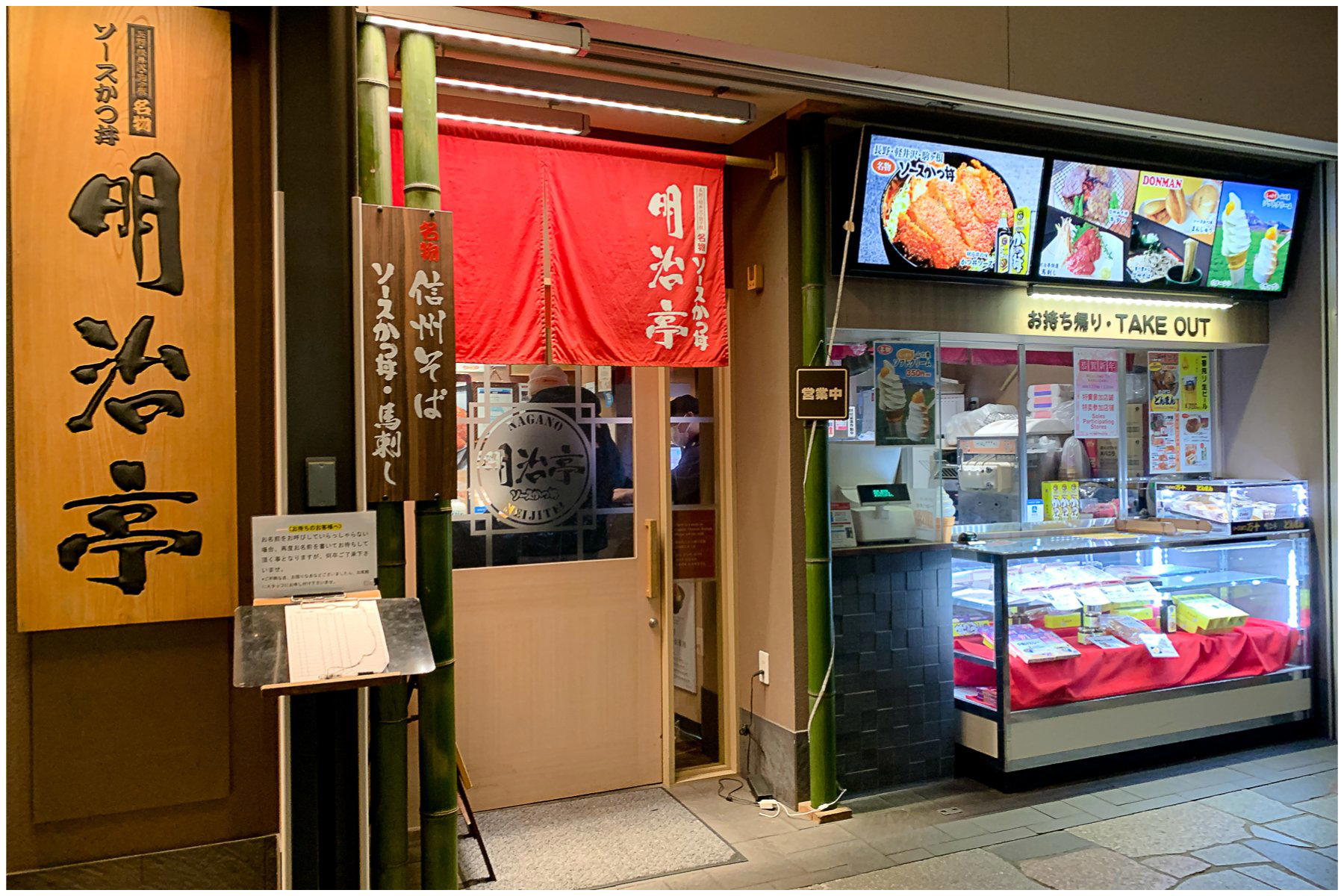
Station-Level Dining in a Mountain City
Nagano Meijitei (明治亭) is a casual restaurant in Nagano, serving Nagano Sauce Katsu-don for about $15 per person, at 南千歳1-22-6 (MIDORI長野 3F), 長野市, 長野県, 380-8543. Nagano's restaurant geography divides along a familiar Japanese pattern: the dense cluster of options within walking distance of the Shinkansen terminal, and the more deliberate destinations scattered through residential and resort districts further out. Nagano Meijitei (明治亭) sits firmly in the first category, occupying the third floor of the MIDORI Nagano shopping complex at 南千歳1-22-6, a building directly integrated with Nagano Station. That positioning is not incidental. In Japanese cities of this scale, the station-building restaurant tier fills a specific function: it absorbs the traveller who has just arrived from Tokyo or Matsumoto, the office worker who wants a reliable lunch, and the family that needs a no-logistics dinner after a day in the mountains. For a city that sees significant through-traffic on its way to ski resorts and alpine hiking trails, that tier carries more weight than it might in a city with a denser standalone restaurant culture.
Nagano Prefecture's dining identity sits at an interesting intersection. The region produces some of Japan's most respected cold-climate ingredients, miso with considerable regional variation, buckwheat cultivated at altitude, freshwater fish from mountain streams, and a wine-grape sector that has grown steadily over the past two decades. How individual restaurants in the city translate that ingredient geography into menu logic varies considerably. The more ambitious operations, like Aoitou or Bleston Court Yukawatan, build explicit connections between the prefecture's ingredients and what appears on the plate. Station-level venues tend to prioritise format legibility and throughput over that kind of specificity.
Reading the Menu Structure
In Japan, the way a restaurant structures its menu communicates its positioning more reliably than price alone. A multi-page picture menu with broad category coverage, grilled items, set meals, noodles, small plates, signals a venue built for volume and diverse appetite. A short, seasonally rotated list with minimal redundancy signals kitchen confidence and a narrower but deeper brief. The architecture of the menu at a station-floor restaurant in a building like MIDORI Nagano typically reflects the former logic: it must serve the ski group arriving for lunch as effectively as the solo business traveller and the local family celebrating a birthday. That breadth is a design choice, not a limitation, and it shapes every other decision the kitchen makes.
Nagano Meijitei's menu reads as a structured set of approachable Japanese categories rather than a tightly curated single-direction experience. This is the norm for the station-adjacent tier across Japanese cities of comparable size, venues like Chinese Sai Muen, which covers Sichuan and dim sum in the JPY 3,000 to 4,999 range, or the Italian-leaning Fogliolina della Porta Fortuna, occupy adjacent market positions but with more defined single-cuisine identities. Meijitei sits in a different register: accessible, geographically convenient, and formatted for repeat use rather than occasion dining.
For readers calibrating expectations against Nagano's higher tier, the contrast is instructive. At the other end of Japan's restaurant spectrum, three-star operations like HAJIME in Osaka or the precision counter format of Harutaka in Tokyo represent a fundamentally different relationship between menu architecture and guest time. Nagano Meijitei operates in neither of those registers, which is the point: it serves the part of the market that those venues don't address.
The MIDORI Building Context
Shopping-complex restaurants in Japan have shed much of the stigma they carried two decades ago. The integration of serious kitchens into department stores and station buildings has become common enough that the format itself no longer signals compromise. Venues inside LUMINE, PARCO, and similar chains across the country range from fast-casual to genuinely committed mid-tier restaurants. The MIDORI Nagano building follows that broader pattern, with its third floor functioning as a dining floor rather than a food court. The distinction matters: a dedicated restaurant floor with table service, a structured menu, and a consistent kitchen team is a different proposition from a shared food-hall environment, even if the enclosing building is a retail complex.
For the traveller using Nagano as a base for Hakuba or Shiga Kogen, the station-floor location removes one logistical variable entirely. No taxi, no map-reading, no reservation for a restaurant you're not sure you'll reach on time after a delayed train. That convenience has real value, and it's what this tier of the market trades on. Comparable convenience-anchored venues in other Nagano prefectural cities handle the same function, see 北の山乃 in Sapporo or 湖畔荘 in Takashima for how different regional cities handle the accessible mid-tier.
Placing Meijitei in Nagano's Wider Scene
Anyone mapping Nagano's restaurant options for a multi-day stay will find the city's serious dining concentrated away from the station. Gion Sasaki in Kyoto and akordu in Nara illustrate how provincial Japanese cities can sustain genuinely destination-level restaurants when the culinary ambition matches the local ingredient base. Nagano has the ingredient base to support that ambition; it's developing the restaurant infrastructure to match. The more considered options, including those listed in our full Nagano restaurants guide, tend to require advance planning and deliberate navigation. Meijitei occupies the other end of that accessibility spectrum.
For the reader who has already scheduled dinners at more focused venues like Goh in Fukuoka or Atomix in New York City during other trips, the utility of a station-floor restaurant on arrival or departure day is direct: low friction, predictable format, no reservation lead time. That's the functional case for Nagano Meijitei within a broader itinerary.
Planning Your Visit
Nagano Meijitei is located on the third floor of MIDORI Nagano, directly connected to Nagano Station, the Shinkansen hub serving the city from Tokyo in roughly 90 minutes. The station-building location means no separate transport is needed, which makes it particularly practical for arrivals and departures on mountain-resort itineraries. Current hours, booking procedures, and pricing should be confirmed directly with the venue or the MIDORI Nagano building information desk. Given the station-adjacent format, walk-in availability during off-peak hours is a reasonable expectation, though weekend and ski-season periods may see higher demand.
Accolades, Compared
Comparable venues nearby, for context on price, style, and recognition.
| Venue | Cuisine | Price | Awards | Notes |
|---|---|---|---|---|
| Nagano Meijitei (明治亭)This venue — the venue you are viewing | Nagano Sauce Katsu-don Specialist | $$ | , | |
| Grill The Butcher Nagano (グリル ザ ブッチャー 長野) | Shinshu Beef Steakhouse | $$ | , | Nagano Station |
| すし築地日本海 長野駅前店 | Authentic Edomae Sushi & Izakaya | $$ | , | Nagano Station (Zenkokuji-guchi) |
| Uzura Ya | Traditional Togakushi soba restaurant | $$ | , | Togakushi |
| Aoitou | Japanese Sauce Katsudon | $$ | , | 西箕輪 |
| Obusedo | Traditional Japanese Chestnut Cuisine | $$ | , | Obuse-machi |
Continue exploring
More in Nagano
Restaurants in Nagano
Browse all →
Hotels in Nagano
Browse all →
Wineries in Nagano
Browse all →
At a Glance
- Classic
- Casual Hangout
- Standalone
- Sake Program
Casual station restaurant atmosphere focused on hearty local comfort food.