

Michelin Plate · Tabelog 100 #47
Our verdict
A Michelin Plate-recognised Shanghai-rooted counter in Minami-Aoyama, MIMOSA serves a multi-course set menu where dishes arrive the moment they leave the wok. The white counter format puts the cooking on full display, and the seasonal focus runs through a Chinese lens rather than a Japanese one. At ¥¥¥, it sits below the city's top-tier Chinese rooms while holding its own against Tokyo's mid-range counter dining scene.

Pearl is the En Primeur Club membership app, where members save venues, book tables and use the concierge.
The menu
What to order
- Shrimp egg fried rice
- Mustard greens
- Shanghai crab
Shanghai Cooking in a City That Takes Chinese Food Seriously
Tokyo's Chinese restaurant tier is more stratified than most visitors expect. At the leading sit long-running institutions like Chugoku Hanten Fureika and Chugoku Hanten Kohakukyu (Amber Palace), both carrying Michelin recognition for Cantonese-influenced work refined over decades. Below them sits a second tier of smaller, counter-format rooms where the emphasis shifts from ceremony to immediacy, where the gap between wok and plate is measured in seconds, not minutes. MIMOSA, on the second floor of a Minami-Aoyama building, operates in that second tier, with a white counter that doubles as both the dining surface and the front row for watching high-heat Chinese cookery executed at close range.
The address matters contextually. Minami-Aoyama is not a neighbourhood built around Chinese food. It is a district that attracts design-conscious, food-literate diners who make deliberate choices, and the presence of a Shanghai-based counter format here signals something about the intended audience. These are not guests looking for a familiar Cantonese banquet hall experience. They are guests who understand that Shanghai cuisine, lighter than Cantonese in some registers, more vinegar-forward, more attuned to seasonal produce, has its own distinct grammar.
The Wok as the Centre of the Room
Counter Chinese at this level is an exercise in sensory sequencing. The sounds arrive first: the hard percussive crack of ingredients hitting a screaming-hot wok, the sustained roar of a gas flame turned fully open. The aromas follow within seconds, the characteristic breath of wok hei, that slightly smoky, caramelised quality that develops when protein and vegetables make brief, violent contact with carbon-seasoned steel at temperatures a domestic hob cannot approach. By the time a dish reaches the counter in front of you, both the visual and olfactory cues have been building for thirty seconds or more.
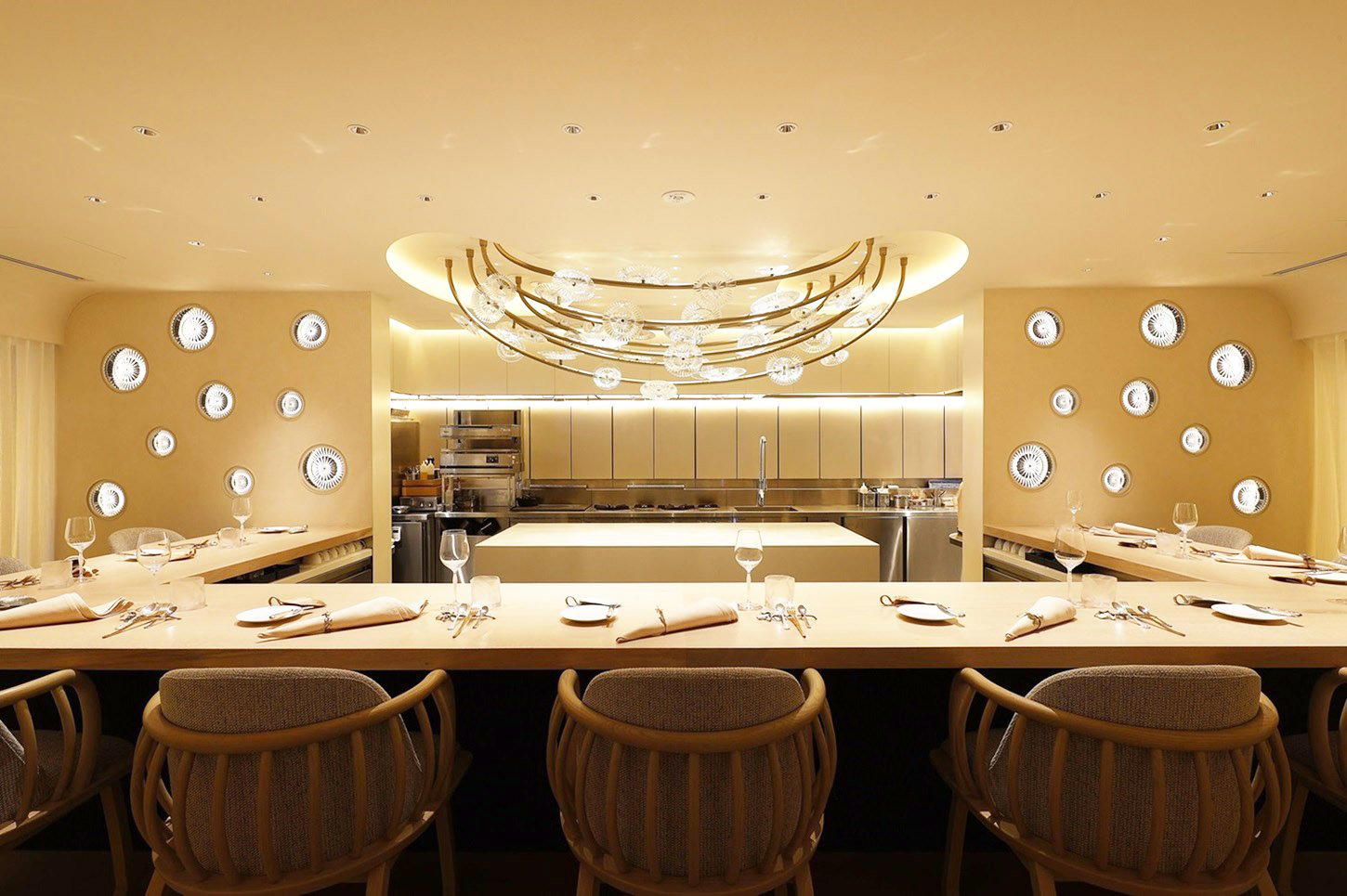
MIMOSA's counter format makes this sequence the primary dining experience. The uniform white counter creates a visual frame that keeps attention on the cooking rather than the room. It is a format that requires the kitchen to perform with precision rather than hiding behind distance or timed runners. Every plate arrives as it comes off the heat, which means the kitchen controls the tempo entirely, and the guest surrenders their own.
This is the structural logic of a set menu in this context: it is not primarily about variety or storytelling. It is about ensuring that the kitchen can sequence its wok work so that nothing sits, nothing cools, and the wok hei in each dish is intact by the time it lands. That constraint shapes what goes on the menu and in what order.
Shanghai Roots, Seasonal Logic
Shanghai cuisine has a seasonal sensitivity that aligns well with the broader Tokyo dining ethic. The city's restaurant culture, across Japanese, French, and now Chinese formats, treats the calendar as an organising principle, and MIMOSA's set menu is framed around fresh ingredients expressing the seasons through a Chinese lens. This is not a marketing abstraction. It means that the sourcing rhythm changes as the year moves through hairy crab season, through the arrival of winter vegetables, through the particular produce windows that Shanghai cooks have tracked for generations.
In a Shanghai context, that simplicity is a technique. The cuisine is not known for elaborate garnish or architectural plating. It is known for controlling flavour through timing, heat, and the quality of a small number of ingredients, a philosophy that translates directly to the counter format at MIMOSA. Courses are not designed to impress visually before they impress on the palate. They are designed to be eaten immediately, while the heat from the wok is still present in the food itself.
MIMOSA has held a Michelin Plate in both 2024 and 2025, a designation that signals quality cooking without the full ceremony of a star. In the context of Tokyo's Chinese restaurant category, where starred Chinese rooms tend to be larger operations with longer histories, a Plate designation at a small Minami-Aoyama counter represents a coherent market position: serious technique, accessible format, mid-range price bracket. Comparable counter dining in Tokyo at the ¥¥¥ tier includes Ippei Hanten, while those after a different counter register might consider itsuka or Koshikiryori Koki for adjacent formalities.
MIMOSA in the Wider Tokyo Dining Picture
Tokyo's serious dining options extend well beyond Chinese cuisine, and the city rewards planning across multiple categories. Our full Tokyo restaurants guide covers the range, from kaiseki to contemporary European. For those building an itinerary across Japan, comparable levels of counter-format precision apply at operations like HAJIME in Osaka, Gion Sasaki in Kyoto, and akordu in Nara. Further afield in Japan, Goh in Fukuoka, 1000 in Yokohama, and 6 in Okinawa each represent counter dining in different regional registers.
For those interested in how Chinese cuisine is being reinterpreted in other major cities, Restaurant Tim Raue in Berlin and Mister Jiu's in San Francisco offer useful comparative reference points, each operating at the intersection of Chinese technique and a distinct local food culture.
For accommodation, bars, and experiences in Tokyo, see our Tokyo hotels guide, Tokyo bars guide, Tokyo wineries guide, and Tokyo experiences guide.
Know Before You Go
- Location: 2F, Fiora Minami-Aoyama Building, 3-10-40 Minami-Aoyama, Minato City, Tokyo
- Price range: ¥¥¥ (mid-to-upper range; set menu format)
- Cuisine: Chinese (Shanghai-based)
- Format: Counter seating; set multi-course menu; courses arrive direct from the wok
- Recognition: Michelin Plate 2024 and 2025
- Booking: Advance reservation recommended given the counter format and limited seating
- Note: Hours, phone, and website are via reservation platforms before visiting
Frequently asked questions
What kind of setting is MIMOSA?
MIMOSA operates as a counter-format restaurant on the second floor of a Minami-Aoyama building. The counter is white throughout, which keeps the visual focus on the cooking. The kitchen works in full view, and the format is intimate rather than large-scale. For a ¥¥¥ venue in Tokyo with Michelin Plate recognition in both 2024 and 2025, the positioning sits between the casual and the formally ceremonial, a counter room where technique is on display but the atmosphere is not stiff.
Does MIMOSA work for a family meal?
The counter format and multi-course set menu structure are better suited to pairs or small adult groups who can pace themselves through numerous courses arriving sequentially from the wok. At ¥¥¥ pricing in Tokyo, it is a considered spend rather than a casual family outing. Those travelling with children or larger groups should note that the counter configuration typically imposes a natural seat limit, and the structured pacing of a set menu does not easily accommodate the variable rhythms of a family table. It works well for two to four adults with an interest in watching the cooking up close.
at MIMOSA?
MIMOSA operates on a set menu, so individual dish selection is not part of the format. The kitchen sequences courses as they come off the wok, and the menu rotates with the season based on Shanghai culinary logic. The Michelin Plate recognition in 2024 and 2025 points to consistency across the menu as a whole rather than a single standout dish. The value of the format is in experiencing Shanghai technique, wok heat, timing, restrained arrangements, as a complete sequence rather than selecting individual items.
How It Stacks Up
| Venue | Cuisine | Price | Awards | Notes |
|---|---|---|---|---|
| MIMOSAThis venue (the venue you are viewing) | Modern Shanghai Cuisine | $150–200 | Michelin Plate · Tabelog 100 #47 | Not listed |
| Harutaka | Edo-Style Omakase Sushi | $200–300 | 3 Michelin Stars · World's 50 Best #76 | Sushi |
| RyuGin | Modern Kaiseki | $500+ | 3 Michelin Stars · World's 50 Best #41 | Kaiseki, Japanese |
| L'Effervescence | Modern French with Japanese Influences | $200–300 | 3 Michelin Stars · World's 50 Best #69 | French |
| HOMMAGE | Modern French with Japanese Influences | $150–200 | 2 Michelin Stars · World's 50 Best #78 | Innovtive French, French |
| MAZ | Innovative Peruvian-Japanese Fusion | $150–200 | 2 Michelin Stars · World's 50 Best #28 | Innovative |
Recognition history
Dated appearances from independent guides and award organizations, with the underlying list record or original source where available.
Michelin Plate
Michelin
Tabelog 100 #47 · No. 47
Tabelog · Tabelog 100 - Chinese cuisine - TOKYO - 2026
Full recognition history (4 entries)
Michelin Plate
Michelin
Michelin Plate
Michelin
Continue exploring
More in Tokyo
Restaurants in Tokyo
All restaurants in Tokyo →



Bars in Tokyo
All bars in Tokyo →





Details
- Elegant
- Modern
- Intimate
- Date Night
- Special Occasion
- Open Kitchen
- Extensive Wine List
- Set Menu
Current opening hours
- Monday
- Closed
- Tuesday
- 5–10 PM
- Wednesday
- 5–10 PM
- Thursday
- 5–10 PM
- Friday
- 5–10 PM
- Saturday
- 5–10 PM
- Sunday
- Closed
Hours can change for holidays and private events. Hours as of .
Stylish open kitchen with uniform white L-shaped counter seats, reassuring sight of wok cooking, amid sounds and aromas of stir-frying.