Our verdict
On Keupstraße, Cologne's most culturally layered high street, Mevlana occupies a position that most formal dining rooms cannot replicate: a seat inside a neighbourhood that has sustained Turkish community life in Germany for generations. The address places it among the small traders, tea houses, and family-run kitchens that define this stretch of Mülheim, offering a counterpoint to the modern cuisine formats that dominate Cologne's fine-dining tier.

Pearl is the En Primeur Club membership app, where members save venues, book tables and use the concierge.
The menu
What to order
- Yaprak Döner Pilavli Salatli
- Adana kebab
- Lamb ribs
Keupstraße and the Dining Culture It Sustains
There is a particular kind of street in every European city where migration history and culinary practice have fused so completely that the food becomes inseparable from the place. Keupstraße in Cologne's Mülheim district is that street for the city's Turkish community. It has been a hub of Turkish commercial and social life since the 1960s, and the restaurants, bakeries, and tea houses that line it today carry that continuity in their menus as much as their shopfronts. Mevlana, at number 47-49, sits inside this tradition rather than adjacent to it.
Cologne's broader restaurant scene has moved decisively toward the modern cuisine format over the past decade. Tables at Ox & Klee, La Société, and maiBeck are booked weeks in advance by diners oriented toward tasting menus and seasonal German produce. Mevlana operates in a different register entirely, one where the reference points are Istanbul and Anatolia rather than the Rhine valley, and where the rhythm of a meal is set by communal sharing rather than progressive courses. That distinction is not a hierarchy; it reflects two entirely different dining traditions coexisting within the same city.
Approaching the Street, Reading the Room
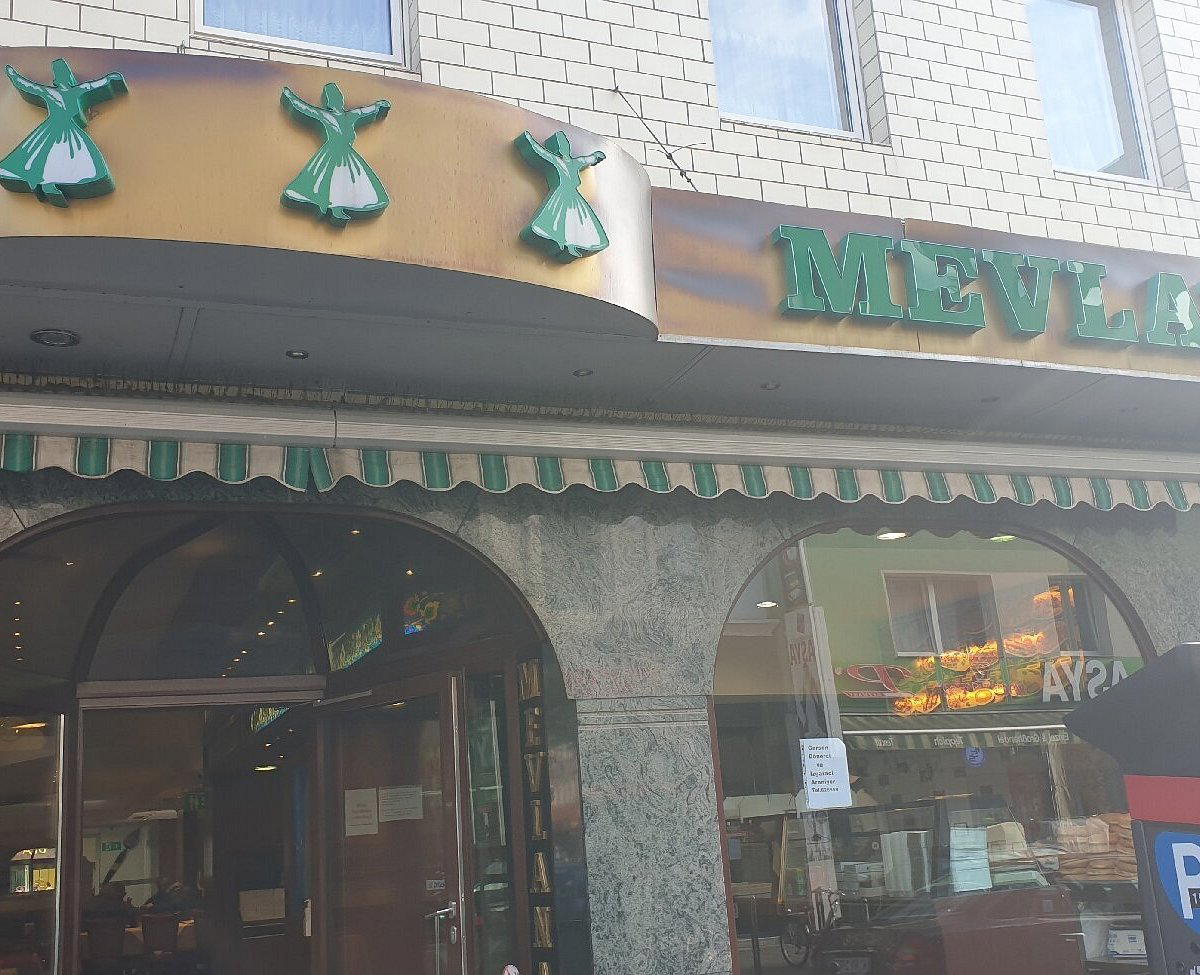
Arriving on Keupstraße by foot from Köln-Mülheim S-Bahn station, the shift in atmosphere is immediate and deliberate. The street operates at a different pace to the city centre: produce shops display goods onto the pavement, the smell of grilling meat drifts from multiple directions, and tea houses project a sociability that no formal dining room can manufacture. Mevlana's frontage on this stretch positions it as a neighbourhood anchor rather than a destination that has been dropped into an unfamiliar context.
Inside, the experience follows a logic that Turkish restaurant culture developed long before modern dining rooms codified it into tasting menus. Mezes arrive first, multiple small dishes designed to be read as an opening movement rather than a prelude to be rushed through. Bread is present throughout, not as an amuse or an afterthought, but as a functional element of how the meal is eaten. The structure of the meal is participatory: dishes arrive to be shared, and the pace is set by the table, not a kitchen timeline imposed from outside.
The Progression of a Meal in This Tradition
Understanding how a meal at a serious Anatolian or Turkish-German restaurant unfolds requires accepting that the tasting progression works differently to the European fine-dining arc. There is no single protein course toward which everything builds. Instead, the meal operates through accumulation: cold mezes give way to warm mezes, grilled meats and kebabs arrive as the structural centrepiece, and the experience concludes with tea and something sweet rather than a plated dessert sequence.
This format has deep parallels with other meze traditions across the eastern Mediterranean and Middle East, and it rewards a slower pace and a larger group. A table of two eating sequentially will have a different experience to a table of four or six eating communally. The format is built for the latter. Dishes like lentil soup, stuffed peppers, and char-grilled köfte function differently when they arrive simultaneously and in quantity than when served one at a time.
For context on how progressive tasting formats operate at the highest level of the German dining scene, Aqua in Wolfsburg, Vendôme in Bergisch Gladbach, and Schwarzwaldstube in Baiersbronn represent the formal end of that spectrum. What Keupstraße offers is the opposite pole: informality with equal depth of tradition.
Where Mevlana Sits in Cologne's Dining Picture
Cologne's high-end dining tier is well documented. La Cuisine Rademacher and Le Moissonnier Bistro anchor the French-inflected end of the market, while modern German and contemporary European formats fill much of the middle ground. Its comparators are not the modern cuisine rooms on the west bank of the Rhine; they are the long-established Turkish restaurants that have served Cologne's largest immigrant community across multiple generations.
That community concentration on Keupstraße gives the street, and the restaurants on it, a credibility that newly opened concept restaurants rarely achieve. The kitchen is accountable to regulars who know the reference points intimately, not to a dining public encountering the cuisine for the first time. That accountability tends to produce more consistent and less compromised food than kitchens cooking for novelty-seekers.
For comparison across Germany's broader dining spectrum, JAN in Munich, CODA Dessert Dining in Berlin, and Restaurant Haerlin in Hamburg represent the formal fine-dining end of the national scene. Internationally, Le Bernardin in New York City and Atomix in New York City illustrate how deeply embedded cultural identity can anchor a restaurant's authority over decades. The principle applies equally to Keupstraße: longevity in a specific neighbourhood, serving a specific community, is its own form of credential. Further afield in Germany, ES:SENZ in Grassau, Victor's Fine Dining by christian bau in Perl, Waldhotel Sonnora in Dreis, and Schanz in Piesport all demonstrate how regional rootedness becomes an asset rather than a limitation when a kitchen commits to it fully.
Planning Your Visit
Keupstraße is accessible directly from Köln-Mülheim S-Bahn station, a short walk east of the city centre. The street is most active from mid-morning through the evening, and the restaurant trade on this stretch tends to be busiest on weekends, when the area draws visitors from across Cologne as well as its immediate neighbourhood. Because specific booking details for Mevlana are not centrally listed, arriving early in the evening or at off-peak hours on weekdays is the practical approach for those without a confirmed reservation. The address at 47-49 Keupstraße places it mid-street, among the densest concentration of food businesses on the strip.
For a fuller picture of where Mevlana fits within Cologne's dining scene across all price points and formats, the EP Club Cologne restaurants guide maps the city's current options with the same critical framework applied here.
Frequently asked questions
What's the address for Mevlana?
Mevlana is located at Keupstraße 47-49, 51063 Köln, Germany, Cologne.
How does Mevlana compare to other Turkish restaurants in Cologne, and is it worth travelling across the city for?
Keupstraße in Köln-Mülheim is the geographic and cultural centre of Cologne's Turkish-German dining scene, and Mevlana at number 47-49 sits within that concentration rather than operating as an isolated outpost. Reaching it from central Cologne takes around 15 minutes via the Köln-Mülheim S-Bahn, which stops a short walk from the street. For anyone whose frame of reference is the scattered Turkish restaurants elsewhere in the city, the density and community context of Keupstraße makes the journey substantively different from a like-for-like comparison.
What's the must-try dish at Mevlana?
What is consistent with serious Anatolian restaurants on Keupstraße is a meal structure built around shared cold starters, grilled proteins, and bread-centred service rather than a Western tasting sequence. Arriving with time to work through multiple courses is the approach that suits this dining tradition.
Do I need a reservation for Mevlana?
Keupstraße is most active from mid-morning through the evening, and restaurants at this end of the street tend to draw a consistent local crowd. Visiting outside peak evening hours or contacting the venue directly before arrival is a practical approach.
What is Mevlana known for?
Mevlana is a fixture of Keupstraße, the Cologne street where decades of Turkish and Anatolian migration have produced one of Germany's most concentrated corridors of that culinary tradition. The address at 47-49 Keupstraße places it at the heart of this community dining culture, where the format follows Anatolian conventions rather than adapted European ones. In Cologne's broader dining picture, it represents the neighbourhood-rooted end of the spectrum rather than the French-inflected fine dining anchored elsewhere in the city.
Can Mevlana adjust for dietary needs?
No formal dietary accommodation policy is documented for Mevlana. Anatolian dining traditions do include a substantial range of vegetable-forward dishes and mezze that naturally suit non-meat eaters, though halal preparation is standard practice across most Turkish-German establishments on Keupstraße. Confirming specifics directly with the restaurant before visiting is advisable.
Just the Basics
Comparable venues nearby, for context on price, style, and recognition.
| Venue | Cuisine | Price | Notes |
|---|---|---|---|
| MevlanaThis venue (the venue you are viewing) | Authentic Turkish Grill | $10–20 | Not listed |
| Artistanbul Meze | Authentic Turkish Meze | $20–30 | Altstadt/Nord, Authentic Turkish Meze |
| Adieu Paris | Vegan Turkish Döner | $1–10 | Neustadt/Nord, Vegan Turkish Döner |
| Kudret Kebap House | Authentic Turkish Kebab | $10–20 | Ehrenfeld, Authentic Turkish Kebab |
| EAT KUMPIR | Turkish Kumpir (Stuffed Baked Potatoes) | $10–20 | Ehrenfeld, Turkish Kumpir (Stuffed Baked Potatoes) |
| little green kitchen | Vegan Plant-Based Cafe | $10–20 | Altstadt/Nord, Vegan Plant-Based Cafe |