LUPO sits in Madrid's Barajas district, positioning itself within a city where the top tier of creative Spanish dining has become one of Europe's most competitive fields. With Spain's fine dining tradition evolving beyond its Basque and Catalan strongholds, Madrid restaurants in this bracket compete on tasting-menu architecture, seasonal sourcing, and a clear point of view. LUPO represents that broader shift toward destination dining within the capital itself.
Pearl is the En Primeur Club membership app — saves, bookings, and concierge access live there. Same editors, same standards.
- Address
- C. Bahía de Gando, 1, Barajas, 28042 Madrid, Spain
- Phone
- +34911908576
- Website
- restaurantelupo.com
- Directions
- Get directions
 Saves & bookings on Pearl
Barajas and the Edges of Madrid's Fine Dining Map
Madrid's restaurant geography has never been strictly central. The city's most discussed tables are spread across districts that don't always appear on the obvious tourist circuit, from the Salamanca kitchens pushing modern Castilian cooking to the outer ring where airport proximity and lower rents have allowed a different kind of ambition to take root. LUPO, on Calle Bahía de Gando in Barajas, occupies that outer-ring position, a location that tells you something about where Madrid's dining expansion is heading: outward, and with intent.
The Barajas district is better known for its proximity to Adolfo Suárez Madrid-Barajas Airport than for its restaurant scene, which makes venues that do serious work there more conspicuous by contrast. In cities like Madrid, where the centre competes on density and noise, the periphery can offer something rarer: a meal that doesn't feel rushed by the pressure of neighbouring tables or the logistics of a busy city block. Whether LUPO takes full advantage of that quieter register is something each diner will assess on arrival.
Where Madrid's Creative Dining Sits Right Now
To understand any serious Madrid restaurant, it helps to map the broader field. Spain's fine dining has spent the last two decades building one of the most discussed culinary reputations in Europe, anchored by destinations well beyond the capital: El Celler de Can Roca in Girona, Arzak in San Sebastián, Mugaritz in Errenteria, Martin Berasategui in Lasarte-Oria, and Azurmendi in Larrabetzu. The Basque Country and Catalonia long defined the poles of that identity. Madrid entered the conversation more forcefully in the last decade, with venues like DiverXO, which operates at the most experimental tier of the city's offer, and Coque, which applies deep cellar thinking and theatrical sequencing to a tasting format that rewards patience. DSTAgE and Deessa occupy overlapping positions in the modern Spanish creative bracket, while Paco Roncero has long pushed technical ambition as a marker of the city's ambitions.
The Architecture of the Meal
Spain's most discussed tasting menus share a structural logic: they build. The opening sequences are typically lighter, more acidic, designed to calibrate the palate rather than satisfy it. Snacks and small bites arrive in rapid succession, establishing a rhythm and a point of view before the kitchen commits to its main statement. It's a format that borrows from the classical French progression while departing from it in texture and temperature contrast, a Spanish signature that shows up from the pintxo bars of San Sebastián to the elaborate counter services of Barcelona's Cocina Hermanos Torres.
The middle section of these menus is where kitchens typically reveal their actual position: whether they're working from produce-first simplicity, from technical transformation, or from a concept that subordinates both in favour of a narrative arc. The final savoury course is often the most declarative, a single protein or a complex assembly that consolidates what came before. Dessert sequences in this tier have grown more ambitious over time, moving away from sugar-led sweetness toward dairy, fermentation, and temperature play that extends the meal's logic rather than interrupting it.
The structure matters because it's how serious tasting menus are evaluated. Diners who arrive expecting to assess individual dishes in isolation will miss the point. The question is whether the progression feels authored, whether each course modifies what preceded it. That standard applies across Spain's fine dining field, from Aponiente in El Puerto de Santa María and Quique Dacosta in Dénia to Ricard Camarena in València and Atrio in Cáceres. A meal at this level is evaluated as a whole, not as a collection of plates.
Internationally, the tasting progression format has been refined at venues like Atomix in New York City, where the sequencing of Korean-influenced courses carries a deliberate educational layer alongside the sensory one, and Le Bernardin in New York City, where classical French discipline provides the backbone for a menu that has remained coherent across decades. The common thread is intentionality: every transition between courses answers a question the previous course posed.
Reading the Location as a Signal
A restaurant's address in Barajas, adjacent to Spain's busiest airport hub, invites a specific type of visitor: the traveller with a layover long enough to allow a proper meal, the local who has stopped treating proximity to the airport as a deterrent. Both profiles reward a kitchen that can deliver something worth making the trip for. The venues that succeed in peripheral locations typically do so by offering an experience that doesn't require the energy of a central city restaurant, a slower pace, more space between tables, and a service rhythm that doesn't feel compressed by turnover pressure.
Madrid's centre already offers that energy in concentrated form. For the reader choosing between a table in Chueca or Salamanca and one in Barajas, the calculus is practical as much as culinary. If you're arriving or departing, LUPO's location resolves a scheduling problem. If you're making a dedicated trip from the city, the question of what the kitchen offers in exchange for that additional travel time is the one worth asking before booking. Our full Madrid restaurants guide maps the city's dining by district and tier, which is a useful reference for building an itinerary around multiple meals.
Know Before You Go
Address: C. Bahía de Gando, 1, Barajas, 28042 Madrid, Spain
District: Barajas, adjacent to Adolfo Suárez Madrid-Barajas Airport
Dress code: Not specified in available data
Continue exploring
More in Madrid
Restaurants in Madrid
Browse all →
Bars in Madrid
Browse all →
Hotels in Madrid
Browse all →


At a Glance
- Cozy
- Modern
- Elegant
- Casual Hangout
- Group Dining
- After Work
- Terrace
- Open Kitchen
Current opening hours
- Monday
- 9 AM–4:30 PM, 8–11 PM
- Tuesday
- 9 AM–4:30 PM, 8–11 PM
- Wednesday
- 9 AM–4:30 PM, 8–11 PM
- Thursday
- 9 AM–4:30 PM, 8–11 PM
- Friday
- 9 AM–4:30 PM, 8–11 PM
- Saturday
- 12:30–4:30 PM, 8–11 PM
- Sunday
- 12:30–4:30 PM, 8–11 PM
Hours can change for holidays and private events. Last verified .
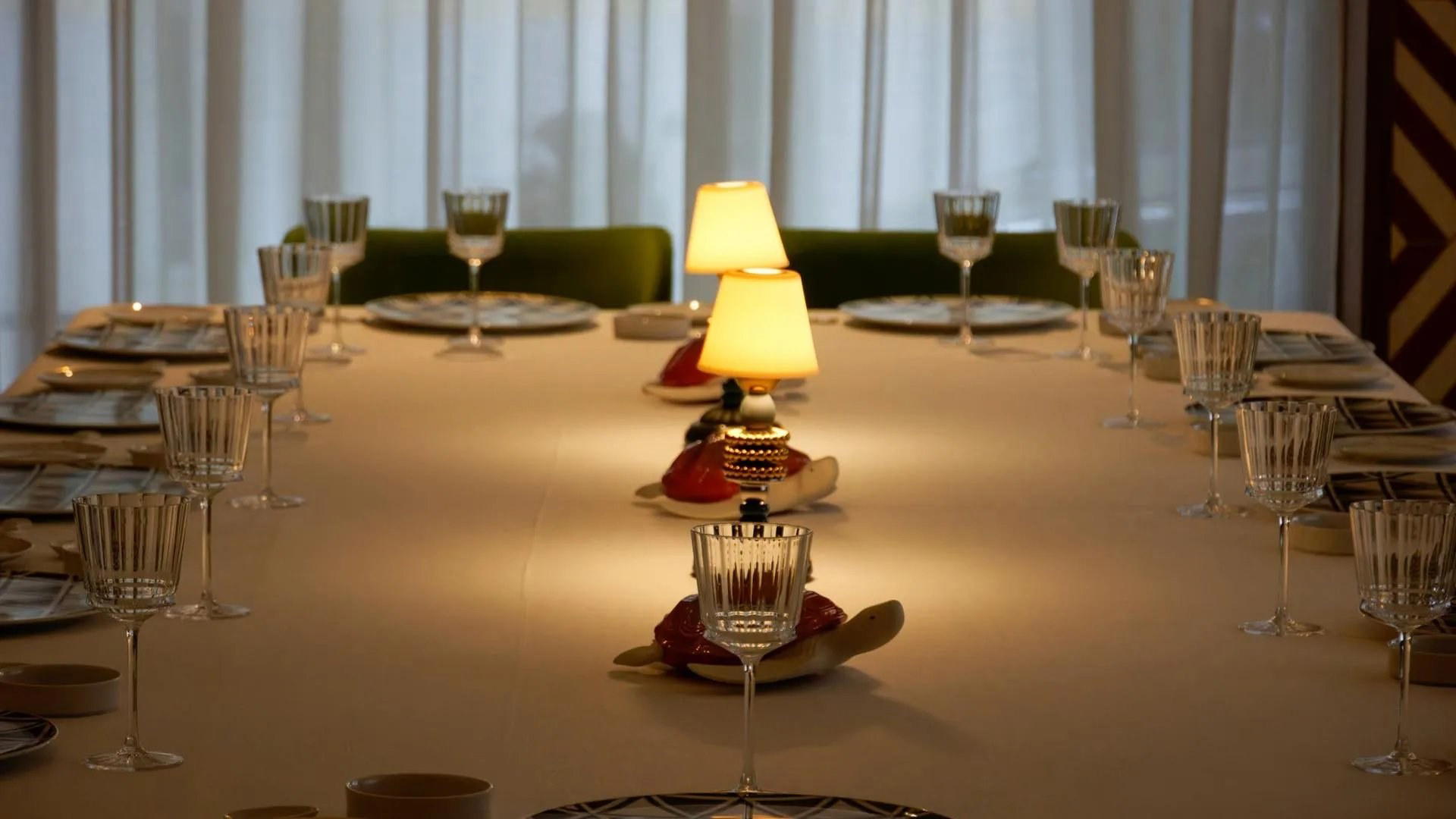
Elegant and welcoming interior with a modern Italian aesthetic, designed to evoke contemporary Italian sophistication.
Know Before You Go
- Getting there
- C. Bahía de Gando, 1, Barajas, 28042 Madrid, Spain