Little Collins De Pijp
Little Collins De Pijp sits on Eerste Sweelinckstraat in Amsterdam's De Pijp, a neighbourhood where the daily Albert Cuyp market and a dense concentration of neighbourhood restaurants have made local loyalty the real currency. The address places it squarely in a dining culture built on return visits rather than one-off occasions, where what regulars order without looking at the menu matters more than any single headline dish.
Pearl is the En Primeur Club membership app — saves, bookings, and concierge access live there. Same editors, same standards.
- Address
- Eerste Sweelinckstraat 19F, 1073 CL Amsterdam, Netherlands
- Phone
- +31 20 753 9636
- Website
- littlecollins.nl
- Directions
- Get directions
 Saves & bookings on Pearl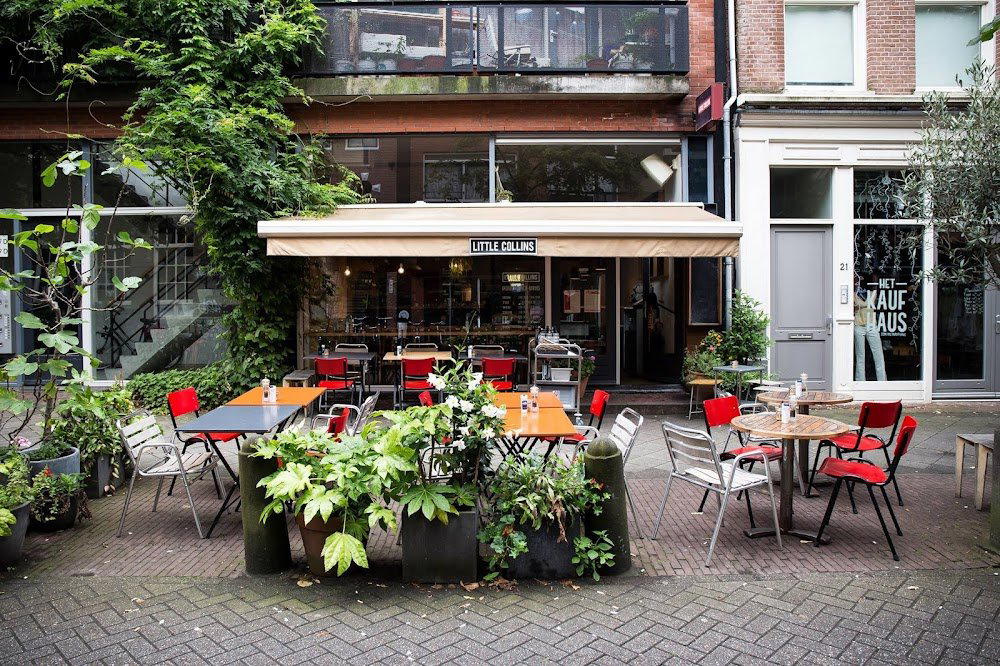
De Pijp and the Grammar of the Regular
In Amsterdam's De Pijp, the restaurants that last are rarely the ones chasing recognition from the city's formal fine-dining circuit. That tier, anchored by addresses like Ciel Bleu, Flore, Spectrum, and Vinkeles, operates on a different logic entirely: destination dining, occasion spending, the theatre of a tasting menu. De Pijp runs on something more stubborn. The neighbourhood's character comes from the Albert Cuyp market, the compressed row-house streets, and a resident population that eats out the way other people cook at home, frequently and without ceremony. The restaurants that root here tend to earn their status through accumulated evenings rather than a single memorable meal.
Little Collins De Pijp, on Eerste Sweelinckstraat, sits inside that logic. The address itself signals something: a residential side street off the market corridor, the kind of spot you find because someone who lives two blocks away told you to go. That geography shapes everything about how the place functions and who fills it.
What Regulars Know That First-Timers Don't
The regulars' perspective is one reliable guide to any neighbourhood restaurant, and in De Pijp that perspective tends to be specific. Locals here are not easily impressed by novelty. The neighbourhood has seen enough trend-driven openings cycle through to develop a healthy scepticism toward anything that performs harder than it delivers. What keeps people returning to a place on a Tuesday when the Albert Cuyp stalls have packed up and the tourist foot traffic has thinned is consistency, a room that feels like it belongs to them, and a kitchen that doesn't need to reinvent itself every season to hold attention.
The unwritten menu at places like this is often more telling than the printed one. It's the order placed without a glance at the card, the off-menu request granted because the person asking has been coming for two years, the table that gets held because the staff know it's someone's standing Wednesday night. That kind of institutional knowledge between a restaurant and its regulars is harder to build than a Michelin citation and, in De Pijp, considerably more prized.
Amsterdam's neighbourhood dining scene has developed along similar lines to what you find in the denser arrondissements of Paris or the inner boroughs of London: a class of restaurant that is emphatically not trying to compete with the destination tier but which, on its own terms, is doing something more socially complex. Compare the €€€€ formality of Bistro de la Mer with the rhythm of a De Pijp local, and the difference isn't simply price. It's intent, audience, and the specific kind of pleasure being offered.
The Neighbourhood as Context
De Pijp earned its density of good eating the same way most European neighbourhood dining districts do: through a resident population with genuine appetite and limited patience for mediocrity, combined with rents that, until recently, allowed independent operators to experiment without catastrophic downside. That equation has tightened in Amsterdam as it has in comparable cities, which makes the restaurants that have established genuine local followings more valuable, not less.
Eerste Sweelinckstraat sits in the quieter, more residential pocket of De Pijp, away from the Ferdinand Bolstraat commercial spine and the louder tourist-facing blocks closer to the Heineken Experience. Restaurants on streets like this tend to run on word of mouth and repeat business. They don't need the walk-in trade that sustains a market-facing terrace. That independence from footfall is, counterintuitively, a mark of a certain kind of confidence: the room fills because people come back, not because they stumble in.
The broader Dutch dining scene has its own distinct character worth placing this in. The Netherlands has produced a generation of serious kitchens operating well outside Amsterdam. De Librije in Zwolle, Inter Scaldes in Kruiningen, and De Nieuwe Winkel in Nijmegen anchor a national fine-dining conversation that is genuinely sophisticated. Further afield, addresses like De Lindenhof in Giethoorn, Tribeca in Heeze, De Groene Lantaarn in Staphorst, Brut172 in Reijmerstok, De Lindehof in Nuenen, De Bokkedoorns in Overveen, and De Treeswijkhoeve in Waalre represent the depth of Dutch culinary ambition outside the capital. Amsterdam's neighbourhood restaurants operate in a different register entirely, but the city benefits from existing inside a country that takes the table seriously.
Internationally, the model of the neighbourhood restaurant with a devoted local following has produced particularly interesting dining of the past two decades. Lazy Bear in San Francisco built its reputation through community intimacy before formal recognition arrived. The distance between that and the formal precision of Le Bernardin in New York City is not simply one of cuisine or price but of what relationship the restaurant is trying to have with the people who eat there. In De Pijp, the answer is clear: a relationship built over time, not across a single occasion.
Planning a Visit
Little Collins De Pijp is at Eerste Sweelinckstraat 19F, 1073 CL Amsterdam. The address places it in the southern stretch of De Pijp, walkable from the Ceintuurbaan tram stops and a short ride from the city centre.
Cuisine-First Comparison
Comparable venues nearby, for context on price, style, and recognition.
| Venue | Cuisine | Price | Notes |
|---|---|---|---|
| Little Collins De PijpThis venue — the venue you are viewing | Australisch geïnspireerde brunch en gedeeld dineren | $$ | Not listed |
| The Lobby Nesplein | Modern Western Bistro | $$ | Nes e.o. |
| Noorderlicht Café | Sustainable Dutch Cafe with Vegetarian Focus | $$ | NDSM terrein |
| De Blauwe Hollander | Traditional Dutch | $$ | Leidsebuurt Noordoost |
| La Brasa | Argentine Steakhouse | $$ | Westelijke Eilanden |
| Pacific Amsterdam | Dutch Grill & International | $$ | Westergasfabriek |
Continue exploring
More in Amsterdam
Restaurants in Amsterdam
Browse all →
Bars in Amsterdam
Browse all →
Hotels in Amsterdam
Browse all →
Wineries in Amsterdam
Browse all →
At a Glance
- Cozy
- Trendy
- Lively
- Brunch
- Casual Hangout
- Group Dining
- Open Kitchen
- Craft Cocktails
Current opening hours
- Monday
- 9 AM–4 PM
- Tuesday
- 9 AM–4 PM
- Wednesday
- 9 AM–4 PM
- Thursday
- 9 AM–4 PM
- Friday
- 9 AM–4 PM
- Saturday
- 9 AM–4 PM
- Sunday
- 9 AM–4 PM
Hours can change for holidays and private events. Last verified .
Gezellig met vriendelijke sfeer, populair voor brunch en gedeeld dineren.