Lezizel Manti brings one of Turkey's most labour-intensive pasta traditions to Venloer Strasse in Cologne's Ehrenfeld district, where the city's Turkish community has sustained a distinct culinary identity for decades. In a Cologne dining scene dominated by French-influenced fine dining and modern German tasting menus, manti occupies a different register entirely: hand-formed, broth-based, and rooted in Anatolian domestic craft rather than restaurant convention.
Pearl is the En Primeur Club membership app — saves, bookings, and concierge access live there. Same editors, same standards.
- Address
- Venloer Str. 246, 50823 Köln, Germany
- Phone
- +4922175960376
- Website
- lezizel.de
- Directions
- Get directions
 Saves & bookings on Pearl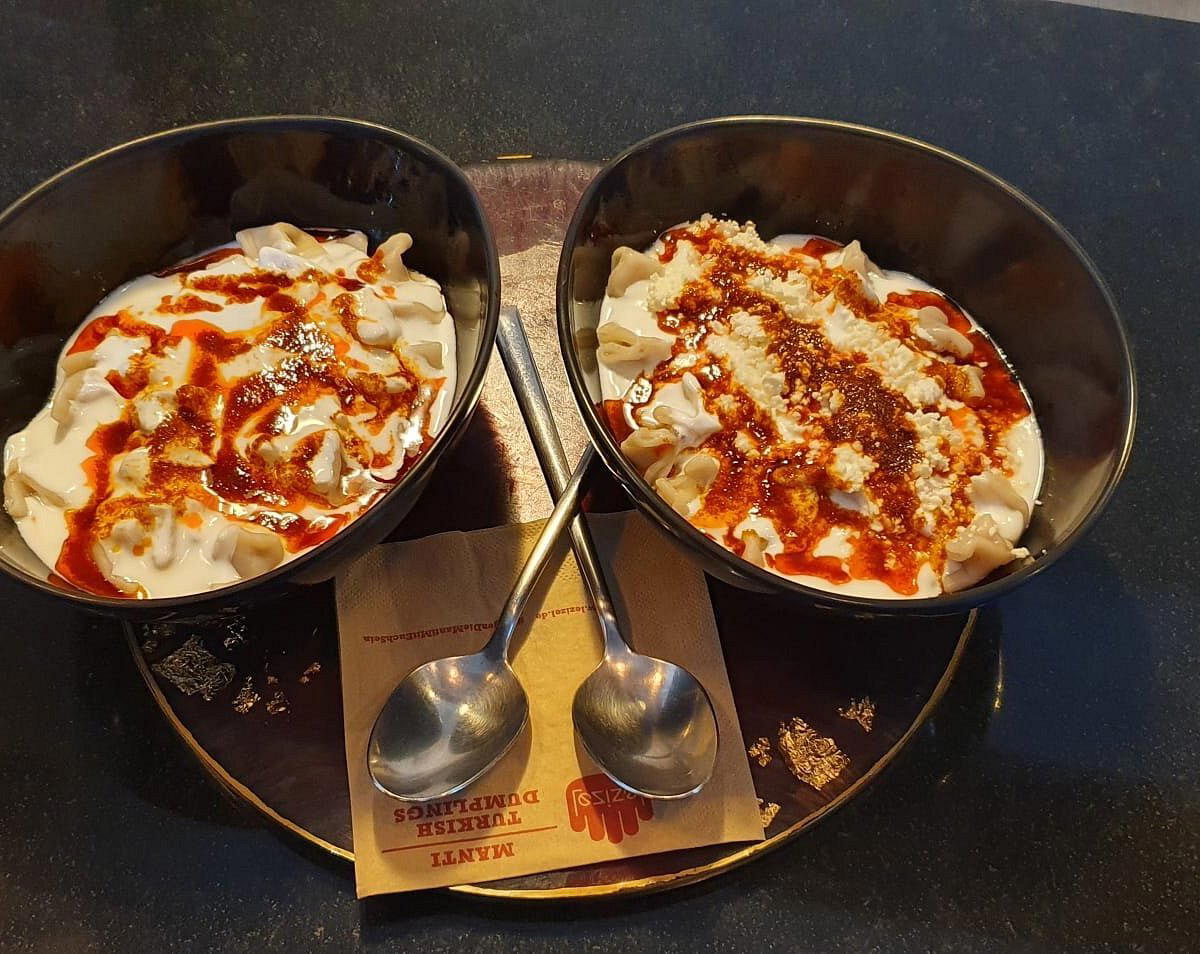
Lezizel Manti is a Turkish manti restaurant in Cologne's Ehrenfeld district, at Venloer Str. Venloer Strasse runs through Ehrenfeld like a long argument about what Cologne actually is. It is the Cologne of Turkish bakeries opening before the city is awake, of grocers whose shelves read in two languages, and of restaurants whose cooking answers to Anatolian domestic tradition rather than to the expectations of a European fine-dining circuit that includes addresses like Ox & Klee and La Société. Walking this stretch, the sensory register shifts: lamb fat on the air, the dense sweetness of çay, the sound of a kitchen running at the tempo of something made by hand.
Manti is the dish that defines the house. Understanding what that means requires a moment on the food itself, because manti is not pasta in any sense that Italian tradition would recognise, even though the form, a small parcel of filled dough, superficially suggests it. Turkish manti, particularly in its central Anatolian form, involves dough rolled extremely thin and cut into pieces that are filled, pinched closed, and boiled or baked. The filling is typically minced lamb or beef seasoned with onion and black pepper. What distinguishes the tradition in quality terms is scale: the smaller the dumpling, the greater the skill implied, with particularly celebrated regional versions producing pieces barely larger than a thumbnail. A single portion requires dozens of them. This is food whose identity is inseparable from the labour that produces it, and that labour is why manti rarely appears in restaurant kitchens outside Turkish communities.
The Ingredient Logic Behind Manti
Manti's flavour architecture depends on sourcing at two ends of the dish: the meat inside and the dairy on leading. The filling in traditional preparation uses lamb or beef ground coarsely enough to retain texture through cooking, seasoned simply so the meat's own character reads through the dough. The finishing layer, applied at the table or just before service, involves two components that must carry quality: yoghurt, ladled cold over the hot dumplings, and a butter sauce infused with dried chilli and sometimes dried mint, poured hot over the yoghurt so it pools and sizzles at the edges of the bowl. The interplay between cold dairy, hot fat, and chilli heat is the point of the dish. Cheap yoghurt or flat butter collapses this dynamic into something merely starchy.
In Germany, the Turkish community's long-established supply networks mean that ingredients specific to Anatolian cooking, particular chilli varieties, specific yoghurt cultures, lamb from halal butchers with direct supplier relationships, are more reliably available in Turkish-run kitchens than they would be in most European cities attempting the same food. Ehrenfeld's position as one of Cologne's most densely Turkish neighbourhoods supports exactly this kind of ingredient specificity. The food at addresses like Lezizel Manti benefits from proximity to suppliers whose primary market is a community rather than a restaurant trade, which changes both availability and price point.
That conversation is almost entirely conducted in French or modern-European terms. Manti sits entirely outside it, operating in a different register of value and craft where the measure of quality is not innovation but fidelity to a time-intensive traditional form.
Where Manti Sits in Cologne's Wider Dining Picture
Cologne's restaurant tier above casual dining is concentrated in French-influenced formats. La Cuisine Rademacher, Le Moissonnier Bistro, and maiBeck each sit within a critical and commercial world that prizes tasting menus, wine lists, and chef pedigree. That world is worth knowing, but it describes only one band of what the city actually eats. A separate and substantially older dining tradition runs through Ehrenfeld and the districts with large Turkish, Lebanese, and Kurdish populations, cooking that preceded Cologne's fine-dining moment by decades and that has never sought its validation.
Manti specifically represents a distinct niche within this tradition. Unlike döner or lahmacun, which have been absorbed into the city's street-food mainstream, manti remains a specialist item eaten primarily within Turkish households and at a handful of dedicated restaurants. Its labour intensity is partly why: a portion of hand-formed manti takes time that the economics of a busy takeaway counter cannot support. Finding it served at a dedicated address on Venloer Strasse rather than as an afterthought on a large menu is itself a signal about the kitchen's orientation.
For context on what serious specialist cooking looks like in Germany, CODA Dessert Dining in Berlin and JAN in Munich each built reputations on format discipline within a specific niche. The logic is similar here, though the tradition and the audience are different. Internationally, the model of a restaurant built around one deeply specific dish, perfected rather than expanded, has produced addresses like Le Bernardin in New York City and Atomix in New York City, where focus is itself the editorial statement. Manti houses operate at a different price point, but the underlying logic of specialisation is recognisable.
Readers building a broader picture of German dining at the leading end can follow threads through Restaurant Haerlin in Hamburg, Schanz in Piesport, and ES:SENZ in Grassau. Cologne's range spans price tiers and formats, and readers willing to travel beyond the city can also find Waldhotel Sonnora in Dreis.
Who This Works For
Manti houses in Ehrenfeld generally operate in a casual, walk-in-friendly format without the formality signals that accompany Cologne's fine-dining addresses. The format suits people who want to eat something specific and well-made rather than something theatrical. Families eat here, working lunches happen here, and neighbourhood regulars return without ceremony. The dish itself scales well across a table: a bowl of manti, some ayran or çay, and a simple soup or salad alongside is a complete meal rather than a tasting exercise.
The setting on Venloer Strasse means the surrounding block rewards time before or after eating. The street has cafés, bakeries, and specialist food shops that give a clearer picture of what a Turkish-German neighbourhood kitchen actually sources than any restaurant menu could.
Know Before You Go
Address: Venloer Str. 246, 50823 Köln, Germany
Neighbourhood: Ehrenfeld, Cologne
Hours: Mon: 12-10 PM; Tue: 12-10 PM; Wed: 12-10 PM; Thu: 12-10 PM; Fri: 12-11 PM; Sat: 12-11 PM; Sun: 1-10 PM
Bookings: Walk-in format typical for this category; confirmation advised for larger groups
Price: About USD 15 per person
A Minimal comparable set
Comparable venues nearby, for context on price, style, and recognition.
| Venue | Cuisine | Price | Notes |
|---|---|---|---|
| Lezizel MantiThis venue — the venue you are viewing | Ehrenfeld, Turkish Manti Dumplings | $$ | Not listed |
| Artistanbul Meze | Not listed | $$ | Altstadt/Nord, Authentic Turkish Meze |
| EAT KUMPIR | Not listed | $ | Ehrenfeld, Turkish Kumpir (Stuffed Baked Potatoes) |
| Deli Sülz | Sülz, Mediterranean Deli | $$ | Not listed |
| Kudret Kebap House | Ehrenfeld, Authentic Turkish Kebab | $ | Not listed |
| Tibet Momo | Not listed | $$ | Neustadt/Nord, Tibetan Momo Bistro |
Continue exploring
More in Cologne
Restaurants in Cologne
Browse all →
Bars in Cologne
Browse all →
Hotels in Cologne
Browse all →

At a Glance
- Cozy
- Casual
- Casual Hangout
Current opening hours
- Monday
- 12–10 PM
- Tuesday
- 12–10 PM
- Wednesday
- 12–10 PM
- Thursday
- 12–10 PM
- Friday
- 12–11 PM
- Saturday
- 12–11 PM
- Sunday
- 1–10 PM
Hours can change for holidays and private events. Last verified .
Casual and charming eatery atmosphere focused on fresh, traditional Turkish street food.