Our verdict
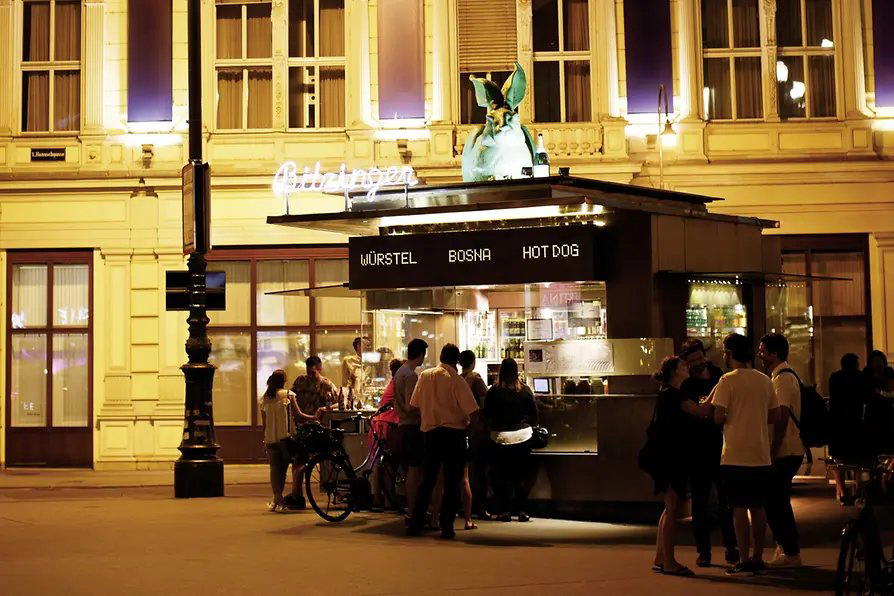
On the Burgring, directly opposite the Kunsthistorisches Museum, Würstlstand Burgring occupies a position that tells you something about how Vienna treats its street food: seriously, and in plain sight. This is a Viennese sausage stand doing what the format has done for generations, serving the working city and the curious visitor from a counter that makes no apologies for what it is. The Ringstraße address makes it one of the most architecturally framed Würstelstände in the city.

Pearl is the En Primeur Club membership app, where members save venues, book tables and use the concierge.
The menu
What to order
- Käsekrainer
The Würstelstand and Vienna's Street-Eating Tradition
Few cities have institutionalised a single piece of street food infrastructure the way Vienna has the Würstelstand. These sausage counters, scattered across the city from outer district corners to the Ringstraße itself, are not a nostalgic holdover. They function as a genuine alternative eating tier, occupying a social space that sits below the Beisl, below the Gasthaus, and entirely outside the formal dining circuit where restaurants like Steirereck im Stadtpark and Amador operate. The Würstelstand answers a different question: not where to eat well in the restaurant sense, but where to eat efficiently, honestly, and without ceremony, at almost any hour.
Würstlstand Burgring sits on the Burgring, the southern stretch of the Ringstraße boulevard, facing the Kunsthistorisches Museum. The address alone carries architectural weight. The Ringstraße was conceived in the 1860s as a statement of imperial ambition, lined with museums, opera houses, and parliament buildings that were designed to be seen from each other. To position a sausage stand within that frame is, whether by accident or instinct, to participate in a very Viennese kind of democratic pragmatism: the grand and the quotidian sharing the same pavement.
Daytime at the Counter: The Lunch Reality
Midday at a Burgring-facing Würstelstand is determined by the rhythm of the surrounding institutions. Museum workers, students from the nearby university district, and tourists who have already spent two hours with the Habsburgs' art collection all converge on roughly the same window. The appeal at lunch is speed and directness. A sausage, a roll, a mustard selection, possibly a can or a small bottle: this is the transaction, and it completes in under three minutes. That efficiency is not incidental to the format's survival in a city with a well-developed café and Beisl culture. It fills a gap that neither a sit-down lunch nor a coffee-and-cake stop addresses.
The value logic at lunchtime is also specific. Vienna's formal dining tier, which includes multi-course tasting menus at places like Konstantin Filippou and Mraz & Sohn, operates at a price point that makes a midweek lunch a considered occasion. The Würstelstand operates in an entirely different register. Its prices reflect the stripped infrastructure: no kitchen, no service staff, no linen. What you are paying for is the product itself and the location, and on the Burgring, the location is considerable.
After Dark: How the Evening Shift Changes Things
The more culturally specific version of the Würstelstand experience is the late-night one. Vienna's sausage stands have historically served as the city's post-theatre, post-opera, and post-bar infrastructure. The Burgring position, within walking distance of the Staatsoper and the Musikverein, puts Würstlstand Burgring directly in the path of concert-goers emerging after nine or ten in the evening. This is the hour at which the Würstelstand stops being a lunch convenience and becomes something closer to a social institution.
Evening crowd at a well-placed Ringstraße stand is genuinely mixed in a way that few other eating formats in the city achieve. The format's low price point and standing-only format strip out most of the signalling that stratifies Vienna's other eating options. A sausage at midnight on the Burgring costs the same whether you have just come from the stalls or the gallery. That particular levelling is part of what gives the Würstelstand its cultural staying power, and why food writers discussing Vienna's dining identity regularly return to it as a reference point alongside destinations such as Doubek.
The Sausage Canon and What It Means Here
Austrian sausage culture runs considerably deeper than the tourist shorthand of bratwurst-and-mustard. The canonical Würstelstand menu covers a range of preparations: the Käsekrainer, a pork sausage loaded with cheese that pools and chars at the casing during grilling; the Burenwurst, a coarser, more intensely seasoned boiled sausage; the Frankfurter, the thin, mild variety served in pairs; and the Debreziner, Hungarian-influenced and paprika-forward. Each has its moment and its constituency. The Käsekrainer has become something of a Viennese identity marker in its own right, the thing locals recommend to visitors who want to understand what the format is actually about.
This sausage vocabulary connects Vienna's street food culture to a Central European culinary tradition that extends into the Austrian regions. The kind of ingredient seriousness that shows up in different registers at restaurants such as Döllerer in Golling an der Salzach or Obauer in Werfen has its popular-culture expression in the sourcing standards that serious Würstelstand operators maintain. The leading stands in Vienna are not casual about their suppliers, even if the presentation is entirely casual.
Where Würstlstand Burgring Sits in Vienna's Eating Map
Vienna's dining options now cover a wider range than they did a generation ago. The creative fine-dining tier represented by Steirereck im Stadtpark at the upper end, and modernist Austrian projects in the regions like Ikarus in Salzburg or Griggeler Stuba in Lech, has expanded alongside a renewed interest in traditional formats. The Würstelstand occupies the opposite end of that spectrum, not as a lesser option but as a structurally different one. It does not compete with tasting menus any more than a New York counter like those orbiting the world that Le Bernardin or Atomix inhabit competes with street carts. The comparison clarifies rather than ranks.
For visitors building a Vienna eating itinerary from our full Vienna restaurants guide, the Würstelstand functions as punctuation between longer meals rather than a destination in its own right. It is the breakfast before a museum, the late-night stop after the opera, the standing lunch between two serious dinners. The Burgring position makes it one of the more conveniently placed stands for anyone working through the first district's cultural institutions.
Planning a Visit
Würstlstand Burgring is a pavement counter on the Burgring, accessible on foot from the Kunsthistorisches Museum U-Bahn stop and the Oper tram and metro interchange. No reservation exists or is needed; the format is walk-up by definition. Payment is typically cash at Viennese Würstelstände, though practices vary. The evening hours on weekends, when the opera and concert schedule is densest, produce the longest queues and the most animated atmosphere. For a quieter visit with a clearer view of the museum facade across the road, a weekday midmorning, outside the lunch window, gives the most direct experience. There is no indoor seating; the experience is entirely pavement-based regardless of season, which is worth factoring in during Vienna's colder months from November through February.
Frequently asked questions
Where is Würstlstand Burgring in Vienna?
Würstlstand Burgring is located at Burgring, 1010 Wien, Austria, Vienna.
What makes Würstlstand Burgring different from other Würstelstände across Vienna?
Its address on the Burgring, directly on Vienna's grand Ringstrasse boulevard in the 1st district, gives it a catchment area that few other sausage stands share: daytime foot traffic from the Kunsthistorisches Museum, commuters from the Oper interchange, and a late-night crowd after performances at the Staatsoper and Volkstheater. The location situates a format associated with working-class immediacy inside one of the most architecturally loaded stretches of the city.
What do regulars order at Würstlstand Burgring?
The Würstelstand canon in Vienna runs from Käsekrainer (the cheese-filled pork sausage that splits and blisters on the grill) to Burenwurst and Debreziner, typically served with a roll and mustard. At a Burgring-facing counter, regulars tend to know their sausage type and mustard preference before they reach the front. There is no printed menu to agonise over, the format assumes a working knowledge of Austrian sausage culture.
Can I walk in to Würstlstand Burgring?
Yes. Würstlstand Burgring is a pavement counter on the Burgring in Vienna's 1st district, there are no reservations, no bookings, and no door policy. You walk up, order, and eat standing. Access is straightforward from the Kunsthistorisches Museum U-Bahn stop and the Oper tram and metro interchange.
What has Würstlstand Burgring built its reputation on?
Its position on the Burgring places it in one of Vienna's most trafficked institutional corridors, between the Kunsthistorisches Museum and the Ringstrasse. The Würstelstand as a format has been central to Viennese street life for well over a century, functioning as a democratic equaliser where office workers, students, and late-night theatre-goers use the same counter. Würstlstand Burgring inherits that cultural role by location and format.
Can Würstlstand Burgring handle vegetarian requests?
The Würstelstand format is built around pork and beef sausages, and vegetarian options are not a standard feature of the traditional Austrian sausage counter.
Is Würstlstand Burgring good value for money?
The Würstelstand format is Vienna's most affordable hot meal, typically placing a grilled sausage with a roll well below the cost of any sit-down option in the 1st district. On the Burgring, that value is amplified by the setting, you are eating within sight of the Kunsthistorisches Museum for the price of a fast-food counter anywhere else in Europe. Pricing specifics are not formally listed, so expect to pay with cash and in the range standard for Viennese street stands.
A Credentials Check
| Venue | Cuisine | Price | Awards | Notes |
|---|---|---|---|---|
| Würstlstand BurgringThis venue (the venue you are viewing) | Traditional Viennese Sausage Stand | $1–10 | Not listed | Not listed |
| Steirereck im Stadtpark | Modern Austrian Fine Dining | $200–300 | 3 Michelin Stars · World's 50 Best #33 | Creative |
| Konstantin Filippou | Modern Fish-Led Fine Dining | $200–300 | 2 Michelin Stars · La Liste Top Restaurants | Modern European, Modern Cuisine |
| Mraz & Sohn | Contemporary Austrian Fusion | $150–200 | 2 Michelin Stars · La Liste Top Restaurants | Modern Austrian, Creative |
| Silvio Nickol Gourmet Restaurant | Modern Austrian Fine Dining | $300–500 | 2 Michelin Stars · La Liste Top Restaurants | Modern Cuisine |
| APRON | Modern Austrian Fine Dining | $150–200 | 1 Michelin Star · Falstaff Restaurant - 95 Falstaff Points | Austrian, Creative |