Under the refined U-Bahn tracks at Schönhauser Allee, Konnopke's Imbiß has been serving Currywurst to Prenzlauer Berg since 1930, surviving division, reunification, and gentrification without abandoning its post. Few street food institutions in Germany carry a comparable documentary record of continuity across political and urban upheaval. It is a reference point for understanding how Berlin's working-class food culture persists alongside the city's fine-dining ascent.
Pearl is the En Primeur Club membership app — saves, bookings, and concierge access live there. Same editors, same standards.
- Address
- Schönhauser Allee 44b, 10435 Berlin, Germany
- Phone
- +4949304427765
- Website
- konnopke-imbiss.de
- Directions
- Get directions
 Saves & bookings on Pearl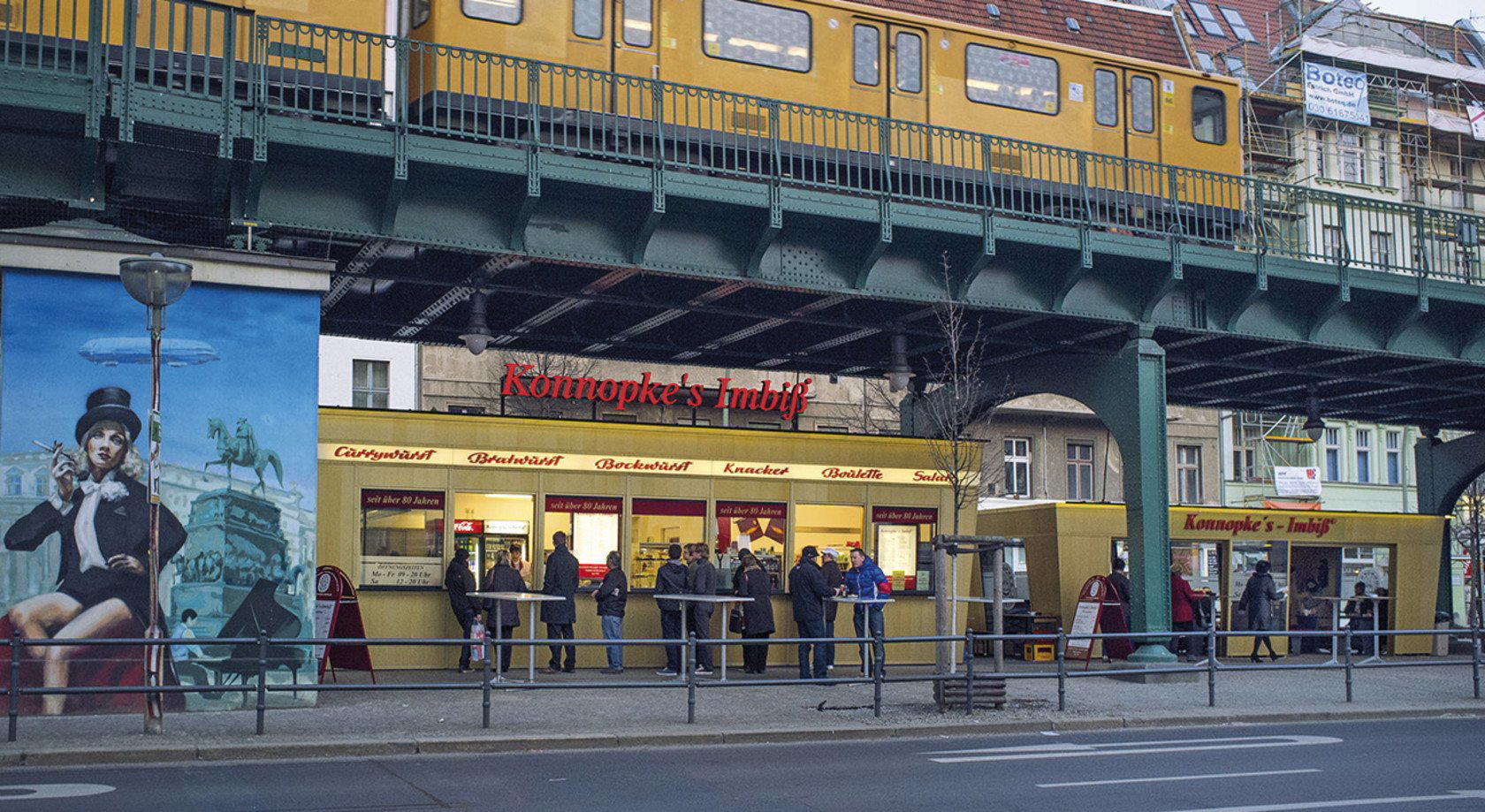
Under the Tracks, Through Every Era
The S-Bahn and U-Bahn lines that cross above Schönhauser Allee cast the same iron shadows they have for nearly a century. Below them, Konnopke's Imbiß occupies a position that is less about sausage and more about the specific texture of Berlin's relationship with its own past. The stand operates from the same stretch of pavement it has claimed since 1930, which makes it one of the city's longest-running food operations regardless of category. In a neighbourhood that has cycled through working-class density, GDR routines, post-reunification neglect, and eventual gentrification into one of the pricier residential districts inside the Ring, the Imbiß has functioned as an anchor rather than a relic.
That distinction matters in a city where food culture now splits sharply between two registers: the Michelin-tracked tier, where Berlin's growing cluster of two- and three-star restaurants, including Rutz, Nobelhart & Schmutzig, and FACIL, compete against comparable rooms across Germany and Europe; and the street-level tradition that shaped how Berliners actually ate through the twentieth century. Konnopke's belongs to neither a nostalgic revival nor a concept restaurant performing authenticity. It is the continuous original.
What Currywurst Means in This Context
Currywurst as a category needs some context before the specifics of this stand make sense. The dish, grilled or steamed pork sausage, sliced, dressed with a ketchup-based curry sauce, and served with a dusting of curry powder, emerged in West Berlin in the late 1940s, attributed to Herta Heuwer's 1949 synthesis of ingredients available through postwar British occupation rations. Konnopke's, operating in the Soviet sector, developed its own variant independently, and the East Berlin version acquired its own character over the following decades: the sauce formula, the sausage specification, and the accompaniments all evolved in relative isolation from the western branch of the same tradition.
That divergence is part of what gives the stand documentary interest. When Berlin reunified and the neighbourhood began its long transformation, Konnopke's continued to produce a Currywurst that carries the East Berlin lineage rather than converging on a standardised pan-city version. The result is a dish with a traceable address inside the broader category, not merely a regional variant of a national fast food.
Ninety Years of Reinvention at the Same Address
The editorial angle that applies here is evolution rather than preservation. Konnopke's has not simply maintained its original form across nine decades. The stand was restructured during the GDR period, navigated the economic disruptions of the 1990s, survived a controversial renovation in the early 2010s that temporarily displaced it during construction work on the Schönhauser Allee infrastructure, and re-emerged with an updated physical setup while retaining its core product and location identity.
The 2010 renovation episode is particularly instructive. When Berlin's transport authority began restoration work on the viaduct above, Konnopke's faced temporary closure. The response from Prenzlauer Berg residents and food writers was substantial enough to generate media coverage. That episode documents something about Berlin's relationship with specific food institutions: the city is capable of treating a Currywurst stand with the same protective instinct it applies to cultural landmarks, which is itself a statement about how the city values its ground-level history.
Physical stand today reflects this layered history: functional, unadorned, and positioned precisely where the urban logic of the neighbourhood has always placed it, at the intersection of transit infrastructure and pedestrian movement, where working people change trains and stop to eat.
Where Konnopke's Sits in the Berlin Dining Picture
Berlin's fine-dining tier has expanded substantially over the past fifteen years. CODA Dessert Dining operates at the extreme creative edge; Restaurant Tim Raue draws international attention for its Asia-inflected cooking; and across Germany, rooms like Aqua in Wolfsburg, JAN in Munich, and Schwarzwaldstube in Baiersbronn define the country's upper tier alongside Vendôme in Bergisch Gladbach, ES:SENZ in Grassau, and Victor's Fine Dining by Christian Bau in Perl. None of these compete with Konnopke's, and Konnopke's competes with none of them.
The comparison is not between price points or ambitions. It is between the types of knowledge a city's food culture can preserve. A three-Michelin-star kitchen at a property like Waldhotel Sonnora in Dreis or a two-star room like Restaurant Haerlin in Hamburg documents culinary technique, seasonal sourcing, and chef lineage. Konnopke's documents something else: how a specific population ate, how a dish mutated under political conditions, and how a neighbourhood negotiated continuity across successive ruptures. Both are legitimate forms of culinary record. They occupy different shelves.
For readers building a broader picture of German dining, the Schanz in Piesport, Bagatelle in Trier, and international reference points like Le Bernardin in New York City or Atomix in New York City offer contrasting models of how culinary tradition gets formalised and transmitted. Konnopke's informal model, no reservations, no menu, no stated philosophy, transmits the same way it always has: through repetition at a fixed address.
Planning a Visit
Schönhauser Allee 44b is served by the U2 line at Eberswalder Strasse, among the more used interchange points in Prenzlauer Berg. The stand operates as a walk-up counter; there are no bookings, no dress code considerations, and no seat scarcity in the fine-dining sense. Midday on weekdays draws the heaviest queues, particularly from local workers and visitors combining the stand with a walk through the neighbourhood. The surrounding streets, Kastanienallee, Oderberger Strasse, form one of Berlin's denser concentrations of independent cafés and specialist food shops, which makes the area worth allocating a longer afternoon rather than a single stop.
- Currywurst
- Bockwurst
- Knacker
- Wiener
- Krakauer
- Kartoffelpuffer
Reputation Context
Comparable venues nearby, for context on price, style, and recognition.
| Venue | Cuisine | Price | Notes |
|---|---|---|---|
| Konnopke's ImbißThis venue — the venue you are viewing | Traditional German Currywurst | $ | Not listed |
| Ebert | Traditional German | $ | Wilmersdorf |
| Restaurant Hackescher Hof | Modern German Regional | $$ | Mitte |
| Schnitzelei Mitte | Modern German Schnitzel | $$ | Mitte |
| Flemming´s | German Steakhouse with Mediterranean Influences | $$ | Kreuzberg |
| Brisgavi | Modern German Bistro | $$ | Schlachtensee |
Continue exploring
More in Berlin
Restaurants in Berlin
Browse all →
Bars in Berlin
Browse all →
Hotels in Berlin
Browse all →


Wineries in Berlin
Browse all →
At a Glance
- Well Known
- Classic
- Lively
- Casual Hangout
- Solo
- After Work
- Standalone
- Beer Program
- Street Scene
Current opening hours
- Monday
- Closed
- Tuesday
- 11 AM–6 PM
- Wednesday
- 11 AM–6 PM
- Thursday
- 11 AM–6 PM
- Friday
- 11 AM–6 PM
- Saturday
- 12–7 PM
- Sunday
- Closed
Hours can change for holidays and private events. Last verified .
A stripped-down, fast-moving sausage stand under the U-Bahn viaduct, known more for its cult Berlin street-food energy than for sit-down atmosphere.