Our verdict
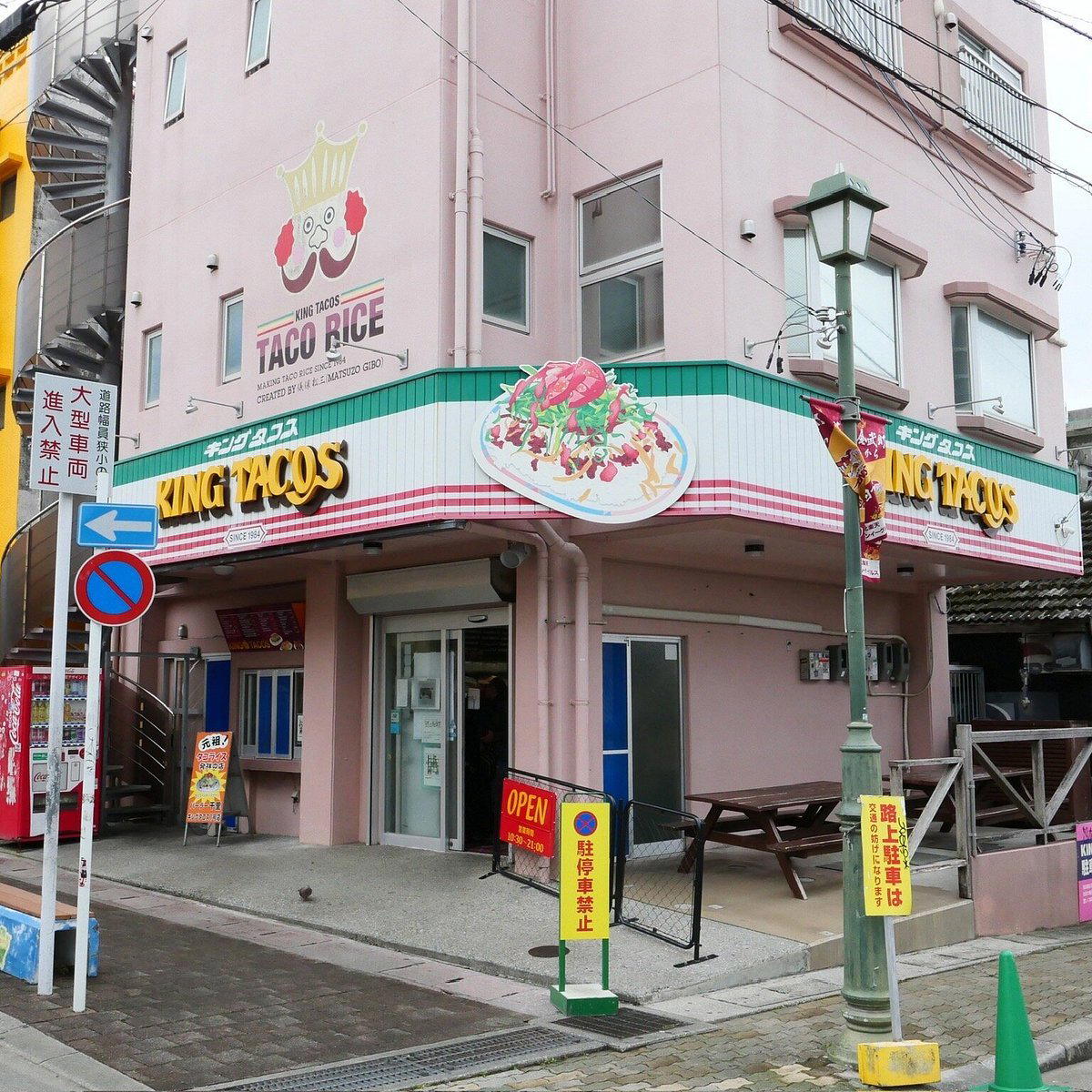
King Tacos sits in Kin, Okinawa, a town whose decades-long proximity to US military bases created one of Japan's most distinctive taco traditions. This is where the American fast-food format absorbed Okinawan ingredients and became something genuinely local. The result belongs to a food culture found nowhere else on the Japanese mainland.

Pearl is the En Primeur Club membership app — saves, bookings, and concierge access live there. Same editors, same standards.
The menu
What to order
- Taco rice
- Taco rice with cheese and vegetables
Where American Bases Shaped Okinawan Food
Kin is a small town in the Kunigami District of northern Okinawa, and it occupies an unusual place in Japan's food geography. Decades of US military presence around Camp Hansen transformed the town's eating habits in ways that the rest of Japan never experienced. The taco as street food, adapted through local palates and local ingredients, took root here in a form distinct from both its Mexican origin and its American fast-food version. King Tacos is part of that tradition, operating in a community where the taco is not an import but a local staple. For context on how Okinawa's dining culture differs from the broader Japanese dining spectrum, the range runs from the kaiseki refinement of Gion Sasaki in Kyoto to the innovative French precision of HAJIME in Osaka. Kin sits at a different point on that map entirely.
The Taco Rice Tradition and What It Means for Sourcing
The dish most associated with Kin's taco culture is taco rice, a format developed in Okinawa in the 1980s that places seasoned ground meat, cheese, lettuce, and tomato over a bed of white rice rather than inside a tortilla shell. The logic was practical: rice was abundant, familiar, and cheaper than the flour tortillas that American servicemembers were used to. What emerged was a hybrid that has since become a genuinely Okinawan category, taught in local schools and served across the island. The ingredient sourcing for this format reflects that origin story. The base is Japanese short-grain rice. The produce, lettuce and tomato in particular, tends to come from Okinawa's own agricultural zones, which operate under a subtropical climate that differs markedly from Honshu's growing conditions. Okinawa's year-round warmth allows for produce cycles that mainland Japan cannot replicate, and local tomatoes and greens often carry a freshness suited to the raw, uncooked format that taco rice requires. Compare this sourcing logic to the hyper-local precision applied at places like akordu in Nara or the ingredient-led approach at Goh in Fukuoka, and you see how sourcing intent can exist across every price tier, not just at the ¥¥¥¥ level.
The Setting in Kin
Kin town itself is not a major tourism node. It lacks the resort infrastructure of Naha or the beaches of Okinawa's southern coast. That absence shapes the experience at places like King Tacos considerably. This is a working town, and the taco shops within it function as neighbourhood restaurants for residents rather than as curated experiences for visitors. The address at 4244-4 Kin places the venue within a town that is leading reached by car or motorbike from Naha, given that public transport in northern Okinawa is sparse. Visitors coming from the south will pass through agricultural land and small coastal settlements, and the drive itself provides useful context for understanding how removed Kin is from Okinawa's tourist economy. For those building a longer Japan itinerary that mixes metropolitan dining with regional food culture, the contrast with something like Harutaka in Tokyo or Le Bernardin in New York City could not be more deliberate.
Kin's Taco Scene in the Context of Regional Japanese Food Culture
Okinawa holds a specific position in Japan's regional food geography. Its cuisine draws on Chinese, Japanese, and American influences in proportions unlike any other prefecture. Champuru dishes, goya (bitter melon), rafute (braised pork belly), and awamori (the local spirit distilled from indica rice) sit alongside taco rice and American-style burgers in a food culture shaped by geography, history, and military proximity. Kin amplifies that American influence to a degree unusual even within Okinawa, because Camp Hansen has been a constant presence there for the better part of a century. This is the context that explains why a town of a few thousand people supports taco shops with genuine local loyalties. Japan's broader dining scene, as represented by the precision of aki nagao in Sapporo or the dedication to regional produce at Aji Arai in Oita, reflects a country where local identity shapes food deeply. Kin's taco culture is part of that same regional logic, just expressed through a very different set of historical circumstances. Those curious about similar regional specificity in other parts of Japan might look at Amegen in Saga, Abon in Ashiya, or Akakichi in Imabari for how deeply embedded local food identity runs across Japan's prefectures.
Planning a Visit
Kin is approximately 30 kilometres north of Naha by road, making it a reasonable half-day or full-day trip if combined with other northern Okinawa stops. A rental car is the practical choice given limited bus frequency in the district. The broader our full Kin restaurants guide covers additional eating options in the area. For those building out a Japan food itinerary beyond Okinawa, the guides to affetto akita in Akita, Ajidocoro in Yubari District, Amaki in Aichi, anchoa in Kanagawa, Arakawa in Hyogo, and Lazy Bear in San Francisco provide useful reference points across different cuisine categories and price tiers.
Frequently asked questions
Would King Tacos be comfortable with kids?
Kin's taco culture grew out of everyday community eating rather than destination dining, which points toward a relaxed, informal setting without dress codes or formal service. Taco rice, the dish most associated with the town's taco shops, is a straightforward format that tends to work well across ages. Kin itself sits outside Okinawa's resort economy, so restaurants there generally reflect a local, unpretentious character.
What's the vibe at King Tacos?
King Tacos sits in Kin, a working town in the Kunigami District that operates well outside Okinawa's resort circuits. Expect a functional, neighbourhood atmosphere shaped by decades of feeding locals and servicemembers from nearby Camp Hansen rather than any effort to perform for visiting tourists. The address on the northern stretch of Okinawa signals a place that earns its trade from repeat customers, not passing resort traffic.
Why is Kin specifically associated with taco rice rather than other parts of Okinawa?
Camp Hansen, the US Marine Corps base that has operated in and around Kin since the post-war period, created sustained local demand for American-style food in a town small enough that a handful of taco shops could define its entire culinary identity. Kin is located in the Kunigami District approximately 30 kilometres north of Naha, positioning it in the heart of Okinawa's military base geography rather than its tourist corridors. That concentration of American servicemembers over decades is the direct reason taco rice took root here at a density found nowhere else in Japan.
What do regulars order at King Tacos?
Taco rice is the format most closely associated with Kin's taco shops: seasoned ground meat, cheese, lettuce, and tomato served over Japanese rice rather than in a tortilla shell. The dish emerged in Okinawa in the 1980s and Kin remains one of its most concentrated sources, shaped directly by proximity to Camp Hansen. It is the dish the town built its food identity around.
How do I find King Tacos?
King Tacos is located at 4244-4 Kin, Kunigami District, Okinawa 904-1201, Japan, Kin.
Fast Comparison
Comparable venues nearby, for context on price, style, and recognition.
| Venue | Cuisine | Price | Notes |
|---|---|---|---|
| King TacosThis venue — the venue you are viewing | Okinawan Taco Rice | $10–20 | Not listed |
| Charlie Takos | Okinawa-style taco shop | Not listed | .null |
| タコス専門店 メキシコ | Okinawan-style Tacos | Not listed | 伊佐 |
| Tortilla | Okinawan Tacos & Taco Rice | Not listed | Urasoe |
| Arry 8Bites | Japanese Small Bites | Not listed | Tokyo |
| Rishiri Ramen Miraku (利尻らーめん 味楽) | Rishiri-Style Yaki Shoyu Ramen | $10–20 | Kohoku-Ku |
Continue exploring
More in Kin
Restaurants in Kin
All restaurants in Kin →
Bars in Kin
Browse all →

Details
- Lively
- Casual
- Casual Hangout
- Standalone
- A La Carte
Current opening hours
- Monday
- 10:30 AM–9 PM
- Tuesday
- 10:30 AM–9 PM
- Wednesday
- 10:30 AM–9 PM
- Thursday
- 10:30 AM–9 PM
- Friday
- 10:30 AM–9 PM
- Saturday
- 10:30 AM–9 PM
- Sunday
- 10:30 AM–9 PM
Hours can change for holidays and private events. Last verified .
Casual fast-food atmosphere with indoor upstairs seating and a few outdoor tables, popular for its hearty portions and soul food vibe.