
King Seimen puts Tokyo ramen in its disciplined, counter-service register: compact room, low spend, no reservations, and recognition on Tabelog’s Ramen TOKYO 100 list from 2020 through 2025. In Ojihoncho, near Oji, it belongs to the city’s serious everyday-ration category rather than the destination tasting-menu economy.
Pearl is the En Primeur Club membership app — saves, bookings, and concierge access live there. Same editors, same standards.
- Address
- Japan, 〒114-0022 Tokyo, Kita City, Ojihoncho, 1 Chome−14−1 高崎ビル 1階
- Website
- ramenkoike.com
 Saves & bookings on Pearl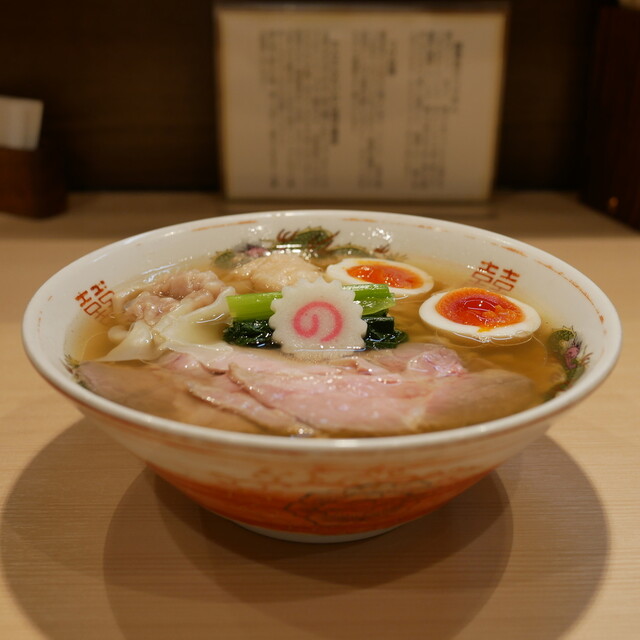
Oji is not the Tokyo ramen district that visitors usually plan a day around, and that is part of its usefulness. The rhythm here is local, commuter-led, and compact: a short walk from the station, a ground-floor counter, and a service model built for bowls rather than lingering. King Seimen fits that register with uncommon discipline. The room runs on ten counter seats, reservations are not taken, and the spend sits in the JPY 1,000 to JPY 1,999 band at both lunch and dinner, placing it in the part of Tokyo dining where technical cooking and everyday pricing still overlap.
Tokyo ramen has become a citywide classification system as much as a meal: shoyu specialists, niboshi houses, tsukemen shops, tantanmen counters, and hybrid menus all compete within a price tier that remains relatively democratic. King Seimen’s listed categories, ramen, tsukemen, and brothless tantan-men, put it in the broader camp of noodle shops where the kitchen has to manage different textures and ratios without the insulation of a long menu or wine-program theatrics. A counter of this size exposes timing. Noodles, broth, tare, toppings, and table turnover all have to move in a tight sequence.
A counter format where the team matters more than theatre
The assigned drama at a serious ramen counter is not the chef’s biography; it is coordination. In a ten-seat room, front-of-house is not a separate performance layer. It is the queue, the seat changeover, the ticket or order flow, the pacing of bowls, and the quiet work of keeping a short service from clogging. That dynamic is why small Tokyo ramen rooms can feel more exacting than restaurants charging many times the price. The kitchen and counter operate as one mechanism, and any weakness shows quickly.
King Seimen has the credentials to be judged inside that stricter category. It was selected for Tabelog’s Ramen TOKYO 100 in 2025, with selection history also listed for 2020, 2021, 2022, 2023, and 2024. That continuity matters more than a single-year notice. In Tokyo ramen, where new openings can spike quickly on novelty, repeated inclusion signals that the shop has held attention across multiple cycles of local scrutiny. Its Tabelog score is listed at 3.79, another useful marker in a category where small differences in score can reflect a large volume of opinionated local comparison.
The lineage note is also relevant, but only as context. The restaurant is described as the third restaurant after Ramen Koike and Chukasoba Nishino, with sister shops including Ramen Koike, Chinese Soba Nishino, Hongoen, Tsukemen Kinryu, Koikenoiekei, Aida-ya, and Inose. That places it in a multi-shop network rather than an isolated neighbourhood counter. For diners, the point is not mythology; it is operating depth. A group with several noodle formats has more room to refine procurement, noodle handling, service choreography, and category positioning.
Oji gives the meal a different Tokyo tempo
Central Tokyo ramen often asks diners to choose between high-visibility shops with tourist queues and specialist counters buried in residential or commuter districts. Oji sits closer to the second pattern. The area does not need the neon density of Shinjuku or the late-night gravity of Ikebukuro to justify a serious bowl; its value is in showing how deeply ramen quality is distributed across the city. The restaurant’s address in Ojihoncho, Kita City, makes it a practical northern Tokyo stop rather than a detour built around spectacle.
Compared with the supplied Tokyo peers, the positioning is clear. Ittoan belongs to the soba lane at a modest yen-mark price tier, while Niboshi Soba Ru. and Sansanto sit even lower on listed spend. Stand Totonoi occupies a higher JPY 2,000 to JPY 2,999 band. The restaurant lands in the middle, not bargain-basement and not premium by Tokyo standards, with award recognition that raises expectations beyond a casual station-adjacent bowl. That is the useful reading: pay everyday ramen money, but expect the level of focus associated with a shop repeatedly selected in a citywide ramen list.
For broader Tokyo planning, this is the kind of address that pairs better with neighbourhood exploration than with a packed dining itinerary. A lunch here can sit before a rail hop across the north side of the city; dinner works if the evening does not depend on a reservation chain. Readers mapping a wider restaurant day can cross-reference Our full Tokyo restaurants guide, with adjacent Tokyo entries such as . 鮪と炭火焼き うお炭 秋葉原店, 12/10 Shinjuku ten, 124. KAGURAZAKA (Yakitori), 2D Cafe, and 3 Chome no Curry Ya San offering different parts of the city’s casual-dining spectrum.
Know Before You Go
- Format: Ramen, tsukemen, and brothless tantan-men in a ten-seat, counter-only room.
- Recognition: Selected for Tabelog Ramen TOKYO 100 in 2025, with listed selection history from 2020 through 2024.
- Price band: JPY 1,000 to JPY 1,999 at lunch and dinner.
- Booking: Reservations are unavailable, so timing matters more than planning far ahead.
- Service windows: Daily lunch and dinner services are listed, with a mid-afternoon closure between them.
- Access: The shop is listed near Oji Ekimae, with JR Oji Station and the Tokyo Metro Namboku Line as practical rail approaches.
- Payment: Credit cards, electronic money, and QR code payments are listed as unavailable; carry cash.
- Other logistics: Non-smoking, no private rooms, no private use, and no parking listed.
Seen against Tokyo’s larger hospitality map, the restaurant is not trying to solve every occasion. It is wrong for a long, wine-led evening and right for a focused noodle stop where the value is in execution, pace, and repeat recognition. For travellers building a fuller Tokyo file beyond restaurants, EP Club’s city guides cover Tokyo hotels, Tokyo bars, Tokyo wineries, and Tokyo experiences. Japan and wider dining references include -Grilled beef Sukiyaki- KAMAKURA TANUKIAN 鎌倉 たぬき庵 in Kamakura.cafe in Osaka.know in Kumamoto, (Shoku) Vietnam in Kawasaki, [Curry Senmon Ten] Maruyama Kyoju. in Sapporo, [ki:] in Kyoto, Jōdo Saké Bar in Los Angeles, and Onigiri Time in Pasadena.
Comparable Spots, Quickly
Comparable venues for orientation by cuisine and category.
| Venue | Cuisine | Price | Notes |
|---|---|---|---|
| King SeimenThis venue — the venue you are viewing | Modern Tokyo ramen & dumpling shop | $ | Not listed |
| Kaeru Shokudo | Japanese Curry Counter | $ | Toshima |
| Imojin | Traditional Japanese sweets & ice cream café | $ | Bunkyō |
| Pneuma Curry | Japanese Curry | $ | Shinjuku |
| Mendokoro Honda Akihabara honten | Modern Tokyo Ramen & Tsukemen | $ | Chiyoda |
| Ichigenya | Traditional Japanese Sweets (Wagashi) | $ | Chiyoda |
Recognition history
Dated appearances from independent guides and award organizations, with the underlying list record or original source where available.
Tabelog 100 #67 · No. 67
Tabelog · Tabelog 100 - Ramen - TOKYO - 2025











At a Glance
- Cozy
- Lively
- Solo
- Casual Hangout
- Late Night
- Chefs Counter
- Standalone
Current opening hours
- Monday
- 11 AM–3 PM, 5:30–8:30 PM
- Tuesday
- 11 AM–3 PM, 5:30–8:30 PM
- Wednesday
- 11 AM–3 PM, 5:30–8:30 PM
- Thursday
- 11 AM–3 PM, 5:30–8:30 PM
- Friday
- 11 AM–3 PM, 5:30–8:30 PM
- Saturday
- 11 AM–3 PM, 5:30–8:30 PM
- Sunday
- 11 AM–3 PM, 5:30–8:30 PM
Hours can change for holidays and private events. Last verified .
A compact counter-only ramen shop with a clean, comfortable interior and friendly, efficient service; the atmosphere is casual but focused, with the buzz of a constantly busy local favorite rather than a loud bar-like space.