
Michelin Bib Gourmand
Our verdict
A Michelin Bib Gourmand recipient in both 2024 and 2025, Jian Lai Fa began as a street stall in 1984 and now operates across two storeys in Quanzhou's Licheng District. Three generations of the same family have kept the Minnan repertoire grounded in home-style technique, with braised duck in rice wine and ginger among the dishes that define the kitchen's identity. Priced at ¥¥, it sits at the accessible end of serious Fujian cooking in the city.

Pearl is the En Primeur Club membership app, where members save venues, book tables and use the concierge.
The menu
What to order
- Braised duck in rice wine with ginger and salt
- Marine fish braised in soy and scallion
- Razor clam in peppered salt
Forty Years of Minnan Cooking in One Address
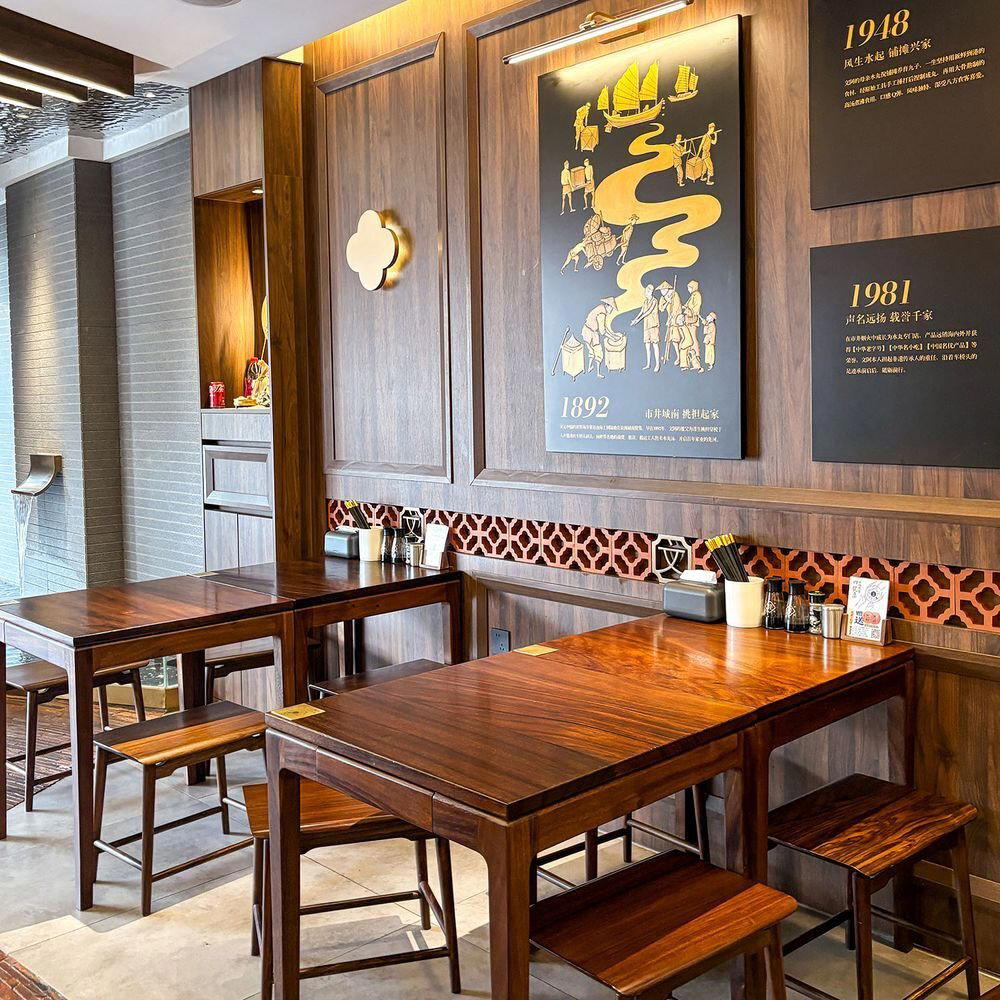
Walk along Nanjun North Road in Licheng District on any given afternoon and the smell of braising liquid, ginger, rice wine, and dark soy reducing together, signals the kitchen at Jian Lai Fa before the sign comes into view. This is not a restaurant that announces itself through design or spectacle. The two-storey building holds the unhurried energy of a place that has been feeding the same neighbourhood for decades, where the crowd tends to include extended families, working regulars, and a steady stream of visitors who have tracked down the Michelin Bib Gourmand listing and followed it here.
Quanzhou's dining identity is shaped by Minnan food culture, the cooking of the southern Fujian region that also migrated outward through the Hokkien diaspora to Southeast Asia and beyond. That tradition prizes clean, restrained seasoning over heavy spice, leans on the sea for protein, and relies on slow-braising and gentle steaming to coax depth from simple ingredients. Within that frame, home-style cooking occupies a specific register: not the refined institutional version you find in larger coastal cities, but the kind of food that carries memory through repetition and familiarity. Jian Lai Fa operates firmly in this register.
From Snack Stall to Two-Storey Dining Room
The restaurant's origin story is straightforwardly documented: a snack stall founded in 1984, now in its third generation of family operation. That trajectory matters less as biography than as context for understanding what the kitchen is trying to do. Forty-plus years of continuous operation in one city is a long feedback loop. Dishes survive because local diners return for them, not because a tasting menu format requires rotation. The kitchen team's stated aim is to re-create authentic home-style Minnan cooking with what they describe as a nostalgic quality, a word that, in this context, implies fidelity to older technique rather than nostalgia as a marketing posture.
In Quanzhou's restaurant scene, that kind of continuity is not unusual at the neighbourhood level, but Bib Gourmand recognition in consecutive years (2024 and 2025) places Jian Lai Fa in a smaller subset of accessible-price venues that have passed Michelin's consistency threshold. The Bib Gourmand designation is awarded for good cooking at moderate cost, which at a ¥¥ price point puts this kitchen in direct conversation with places like Chun Sheng, another Fujian-focused option at the same tier. The two venues serve overlapping cuisine but draw on different parts of the Minnan repertoire, and eating across both gives a more complete picture of what home-style cooking means across different Quanzhou households.
The Braised Duck and What It Signals
Where northern Chinese duck preparations, Peking duck most prominently, rest on lacquer-skin crispness achieved through air-drying and high-heat roasting, the Minnan braising tradition moves in a different direction entirely. The goal here is yielding, bone-detaching tenderness, with rice wine and ginger providing the aromatic base rather than the caramelised maltose and hoisin register of Beijing-style duck. These are not competing philosophies so much as distinct regional answers to the same protein, shaped by different pantry traditions and different ideas about texture as the measure of a skilled kitchen.
The comparison is worth holding alongside broader Chinese roasting culture. The char siu tradition of Cantonese barbecue, another technique built on patience, sugar, and fat rendering, has produced one of the most globally recognised Chinese cooking methods. Minnan braising is less exported, partly because it depends on specific aromatics and on rice wine varieties that don't travel as easily as the visual drama of lacquered pork. That relative unfamiliarity makes dishes like the braised duck at Jian Lai Fa instructive for diners who have encountered Fujian cooking primarily through its diaspora forms in Southeast Asia, where the tradition bifurcated and adapted to local ingredients. For comparison, Hokklo in Xiamen and Hokkien Cuisine in Chengdu offer two further reference points for how the Fujian canon is interpreted across different city contexts.
The Wider Menu
Beyond the duck, the kitchen's documented repertoire leans on the sea. Marine fish braised in soy and scallion represents the coastal pantry at its most direct: a short ingredient list where quality of fish and precision of timing carry most of the weight. Razor clam in peppered salt operates in a different register, higher heat, textural contrast, the bivalve's natural sweetness balanced against pepper's mild bite. These are dishes that reward diners familiar with Minnan technique and serve as clear introductions for those arriving without that context.
For visitors building a broader picture of Quanzhou's dining range, the city offers considerable breadth. A Qiu Niu Pai on Huxin Street and Antstory represent different points on the contemporary dining spectrum. Lao A Bo covers further ground in the traditional register, while Hall Thing in Licheng adds another option within the same district as Jian Lai Fa. Our full Quanzhou restaurants guide maps the city's dining character more completely.
Fujian cooking has received increasing Michelin attention across mainland Chinese cities. Xin Rong Ji in Beijing and Xin Rong Ji in Chengdu both carry the same brand into higher price tiers, demonstrating how the cuisine scales. At the fine dining end, Chef Tam's Seasons in Macau and Imperial Treasure Fine Chinese Cuisine in Guangzhou show how Cantonese and broader southern Chinese traditions have been positioned at the formal restaurant tier across the region. Ru Yuan in Hangzhou and 102 House in Shanghai provide further comparative reference for the range of Chinese regional cooking now receiving consistent critical recognition.
Planning Your Visit
Jian Lai Fa sits at 104 Nanjun North Road in Licheng District, Quanzhou, the same district as several other reviewed venues in the city, making it practical to combine with other meals during a longer stay. At the ¥¥ price point, a full meal for two with multiple dishes should remain accessible relative to other Bib Gourmand-level dining in Fujian. For broader trip planning, our guides to Quanzhou hotels, bars, wineries, and experiences cover the full picture of what the city offers.
Frequently asked questions
Is Jian Lai Fa chef-led?
The chef associated with Jian Lai Fa is Henry Chang.
Has Jian Lai Fa won any awards?
Jian Lai Fa has received recognition including: Jian Lai Fa started out as a snack stall back in 1984. Now in its third generation, it has grown into a restaurant that is spread over two storeys. The kitchen team strives to re-create authentic home-style Minnan cooking with a nostalgic t….
What's the signature dish at Jian Lai Fa?
The kitchen's defining preparation is braised duck in rice wine with ginger and salt, a dish rooted in Minnan home-cooking tradition and central to the restaurant's Michelin Bib Gourmand recognition in both 2024 and 2025. The method prioritises slow braising over high heat, producing meat that separates cleanly from the bone. Two other dishes round out the documented repertoire: marine fish braised in soy and scallion, and razor clam in peppered salt, both drawing on Quanzhou's coastal pantry.
Booking and Cost Snapshot
| Venue | Cuisine | Price | Awards | Notes |
|---|---|---|---|---|
| Jian Lai FaThis venue (the venue you are viewing) | Traditional Minnan Fujian | $10–20 | Michelin Bib Gourmand | Not listed |
| Chun Sheng | Home-style Fujian | $20–30 | Michelin Bib Gourmand | Fujian |
| Jiang Nan Yuan | Vegetarian | Not listed | Not listed | Not listed |
| Luo Ji Mian Xian Hu | Minnan Noodle Shop | $10–20 | Michelin Bib Gourmand | Noodles |
| Qing You Yu | Live Seafood Selection with Refined Fujian Technique | $50–100 | 1 Michelin Star · Black Pearl 1 Diamond | Seafood |
| Che Qiao Tou Wen A Shui Wan (Daxi Street) | Traditional Quanzhou Small Eats | Not listed | Michelin Bib Gourmand | Not listed |
Recognition history
Dated appearances from independent guides and award organizations, with the underlying list record or original source where available.
Michelin Bib Gourmand
Michelin
Full recognition history (3 entries)
Michelin Bib Gourmand
Michelin
Michelin Bib Gourmand
Michelin
Continue exploring
More in Quanzhou
Restaurants in Quanzhou
All restaurants in Quanzhou →
Bars in Quanzhou
Browse all →



Details
- Cozy
- Classic
- Family
- Casual Hangout
- Standalone
- Local Sourcing
- A La Carte