
Michelin Bib Gourmand
Our verdict
A Quanzhou institution of four decades, Luo Ji Mian Xian Hu has earned consecutive Michelin Bib Gourmand recognition in 2024 and 2025 for its mee sua gou, a wheat vermicelli soup of porridge-like consistency served from a counter worn smooth by years of use. Toppings run from vinegar pork and oyster to sautéed pork liver finished with sweet potato starch. Prices sit firmly in the single-digit range.

Pearl is the En Primeur Club membership app, where members save venues, book tables and use the concierge.
The menu
What to order
- Mee sua gou
- Sautéed pork liver
A Counter That Has Outlasted Most Trends
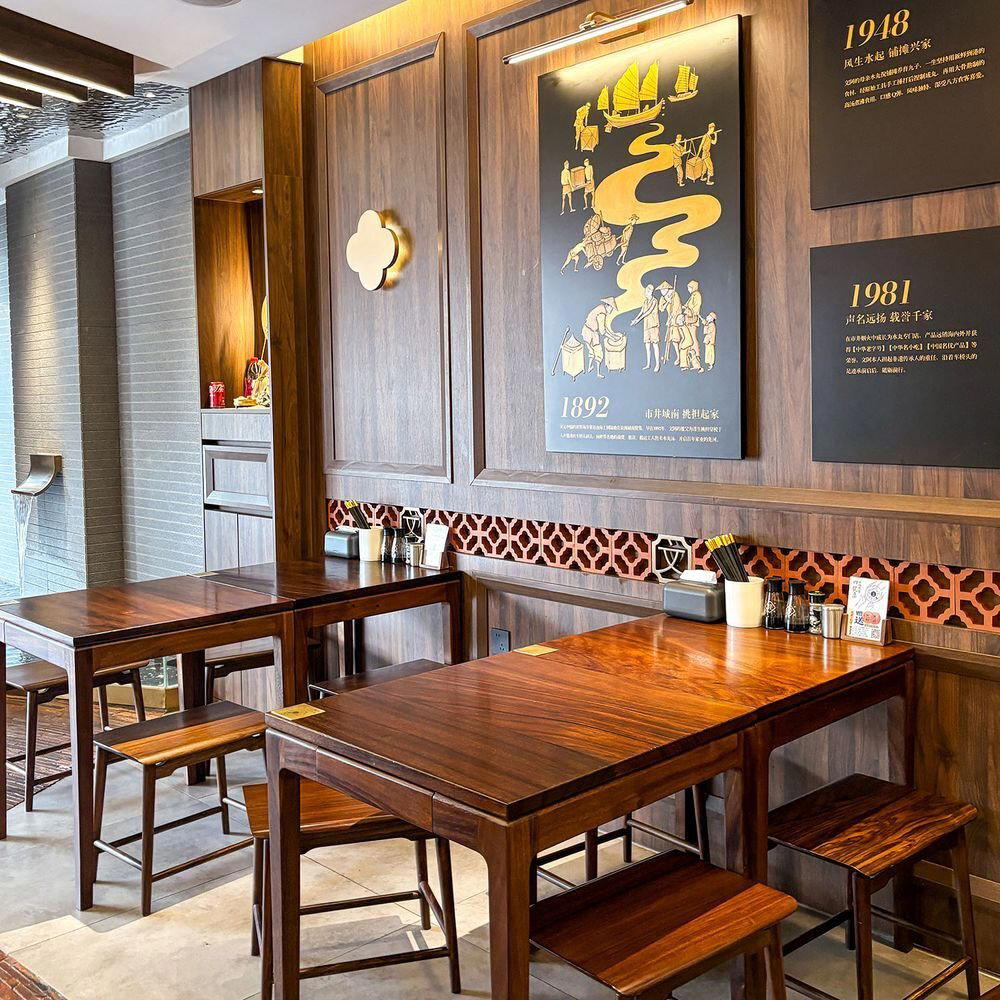
The fading sign above the entrance and the vintage enamelware stacked inside place Luo Ji Mian Xian Hu squarely in the category of Quanzhou eating that predates food media, delivery apps, and the entire concept of the Bib Gourmand. The shop opened roughly 40 years ago on Xianhou Road in Licheng District, and its physical environment has barely kept pace with time, which is precisely what signals to a returning visitor that nothing essential has changed. This is the kind of counter where the room itself is a credential.
Quanzhou's street-food scene operates on a different logic than China's more heavily curated dining cities. The city sits on Fujian's southern coast, historically a gateway for trade and emigration that sent Hokkien-speaking communities across Southeast Asia. Many of those communities carried mee sua with them, and the dish survives in forms recognisable across Fujian, Taiwan, and the overseas Hokkien diaspora. At Luo Ji, the version is mee sua gou, wheat vermicelli cooked to a porridge-like consistency, thickened rather than brothy, closer to congee in texture than to the clear-soup noodles common in northern China. It is a local register of the dish, and it is not widely replicated at this level of execution.
What Alan Lam and Grace Li Are Running Together
The editorial angle assigned to this kind of counter is team dynamic, and here the dynamic is compact by necessity. Alan Lam and Grace Li operate a format where the kitchen and the counter are the same space. There is no sommelier, no front-of-house manager in any conventional sense, and no tasting menu pacing to manage. What takes the place of that institutional structure is the accumulated shared knowledge of a two-person operation that has been producing the same dish, with disciplined variation through toppings, for decades. The Michelin inspectors who awarded consecutive Bib Gourmands in 2024 and 2025 are recognising precisely this: consistency maintained without the scaffolding of a formal kitchen brigade.
That consistency shows most clearly in the toppings programme, which functions as the primary axis of variation. Vinegar pork, pork intestine, and oyster are the standard choices to layer over the base bowl. The sautéed pork liver is the one preparation that receives specific technique attention: lightly coated in sweet potato starch, it develops a crust on the outside while retaining a juicy centre, a result that requires heat control and timing, not just ingredient quality. Ordering a fried dough stick alongside the soup to soak up the thickened broth is the established way to finish what the bowl leaves. These are not written recommendations from the kitchen; they are the accumulated habits of forty years of regular customers, and Alan Lam and Grace Li know the difference between a first-time visitor and someone who has been coming since the 1990s.
Where Mee Sua Gou Sits in Quanzhou's Noodle Tradition
Quanzhou has a documented culture of single-dish noodle specialists. De Wen Xia Zai Mian and Zhuang Ji Quan Fu Lu Mian Guan operate within the same low-price, high-frequency format that defines the city's working lunch circuit. What separates the mee sua gou tradition from most of these is the porridge-register texture: the soup thickens as it cooks, producing a bowl that demands slower eating than a standard noodle soup. It is morning food for many regulars, though the shop draws visitors at hours beyond the breakfast window.
For comparison points further afield, Fujian-influenced noodle traditions appear across Chinese culinary culture in different registers. A Bing Bao Shan Mian in Hangzhou and A Kun Mian in Taichung operate within similar single-format noodle specialisation, though with distinct regional identities. The shared characteristic across all three is the refusal to diversify the menu beyond the central preparation, a discipline that Michelin's Bib Gourmand category consistently rewards across Asia.
At the higher price tier in the same region, venues like Xin Rong Ji on Xinyuan South Road in Beijing and Imperial Treasure Fine Chinese Cuisine in Guangzhou represent what Fujian and Cantonese cuisine looks like when formalised into a dining-room context. Luo Ji Mian Xian Hu operates at the opposite end of that spectrum without any loss of seriousness about the food itself. The same Michelin guide that awards stars to white-tablecloth restaurants in these cities gives its Bib Gourmand to a 40-year-old counter shop in Licheng District, which is the clearest available external signal of where this fits.
Planning a Visit
The shop is on Xianhou Road in Licheng District, a central part of Quanzhou that puts it within range of the city's older commercial and residential quarters. Our full Quanzhou restaurants guide covers the broader eating picture, and the city rewards visitors who use meal planning to cover multiple price tiers: a morning bowl at Luo Ji sits logically before a lunch stop at somewhere like A Qiu Niu Pai on Huxin Street or an evening at Antstory. The price range is the lowest available tier, a full bowl with toppings stays inside a range that makes repeat visits within a single trip genuinely practical rather than aspirational.
Quanzhou's popular single-dish spots tend to move quickly during peak hours; arriving outside the main morning and lunch rushes reduces wait time. For visitors building a broader itinerary, our Quanzhou hotels guide, bars guide, and experiences guide cover the city's other layers. If the focus is Fujian cooking specifically, Che Qiao Tou Wen A Shui Wan on Daxi Street represents another local register worth including in the same day. For those extending into the wider region, Ru Yuan in Hangzhou and 102 House in Shanghai are editorially distinct but sit within the same Michelin-recognised circuit. Our full Quanzhou wineries guide and Xin Rong Ji in Chengdu complete the regional picture for visitors tracking recognised cooking across China.
Frequently asked questions
Is Luo Ji Mian Xian Hu a family-friendly restaurant?
At ¥ pricing, a bowl each for a family of four costs very little, and the counter format places no dress or booking expectations on diners. The menu is tight, mee sua gou with optional toppings like vinegar pork, oyster, or pork intestine, so children with straightforward tastes will find something to eat without difficulty.
Is Luo Ji Mian Xian Hu formal or casual?
Fully casual. The shop operates with vintage enamelware, a fading exterior sign, and counter seating, a format that has earned two consecutive Michelin Bib Gourmand awards (2024 and 2025) without any concession to formal dining conventions. Arrive and order; there is no dress code and, based on available data, no reservation system.
Is Luo Ji Mian Xian Hu Michelin-listed?
Luo Ji Mian Xian Hu has received recognition including: By the fading sign and vintage enamelware, it’s not hard to believe this noodle shop opened its doors 40 years ago. It focuses on mee sua gou – a wheat vermicelli soup of porridge consistency. Feel free to jazz it up with toppings like vine….
What's the signature dish at Luo Ji Mian Xian Hu?
The defining preparation is mee sua gou: wheat vermicelli cooked to a thick, porridge-like consistency and served as a soup, with toppings such as vinegar pork, pork intestine, or oyster. The sautéed pork liver, coated in sweet potato starch to produce a charred exterior and moist centre, is the other preparation Michelin specifically noted in its Bib Gourmand recognition.
Credentials Lens
A quick peer list to put this venue’s basics in context.
| Venue | Cuisine | Price | Awards | Notes |
|---|---|---|---|---|
| Luo Ji Mian Xian HuThis venue (the venue you are viewing) | Minnan Noodle Shop | $10–20 | Michelin Bib Gourmand | Not listed |
| Chun Sheng | Home-style Fujian | $20–30 | Michelin Bib Gourmand | Fujian |
| Jiang Nan Yuan | Vegetarian | Not listed | Not listed | Not listed |
| Zhong Ji Yan Shao Fan Ya | Fujianese Claypot Braised Duck | $10–20 | Michelin Bib Gourmand | Fujian |
| Zhuang Ji Quan Fu Lu Mian Guan | Fujianese Lor Mee | $1–10 | Michelin Bib Gourmand | Noodles |
| Qing You Yu | Live Seafood Selection with Refined Fujian Technique | $50–100 | 1 Michelin Star · Black Pearl 1 Diamond | Seafood |
Recognition history
Dated appearances from independent guides and award organizations, with the underlying list record or original source where available.
Michelin Bib Gourmand
Michelin
Full recognition history (3 entries)
Michelin Bib Gourmand
Michelin
Michelin Bib Gourmand
Michelin
Continue exploring
More in Quanzhou
Restaurants in Quanzhou
All restaurants in Quanzhou →
Bars in Quanzhou
Browse all →




Details
- Classic
- Cozy
- Well Known
- Casual Hangout
- Family
- Historic Building
- Local Sourcing
- A La Carte
Humble lived-in elegance with vintage enamelware, patinaed details, warm and efficient energy.