
Inaka Udon Tetsu gives Kawagoe’s udon scene a rural Saitama accent: wheat-germ noodles, regional cooking, and vegetable tempura tied to local sourcing rather than city-center polish. Its Tabelog Udon EAST 100 selections in 2020, 2022, and 2024 place it among serious noodle addresses, while the low lunch budget keeps the experience grounded.
Pearl is the En Primeur Club membership app — saves, bookings, and concierge access live there. Same editors, same standards.
- Address
- 2881 Kugedo, Kawagoe, Saitama 350-0011, Japan
- Phone
- +81 49-235-3631
- Website
- ameblo.jp
 Saves & bookings on Pearl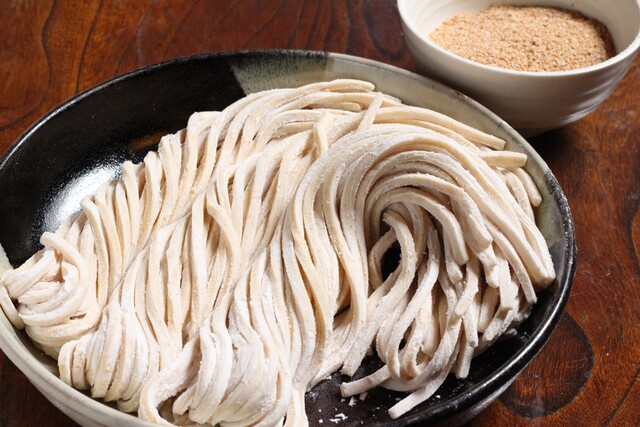
The approach to Kawagoe’s Kugedo area shifts the appetite before the meal begins. Central Kawagoe’s warehouse streets and tourist foot traffic give way to a quieter, more domestic edge of the city, where udon feels less like a snack between sights and more like a local ritual. In that setting, Inaka Udon Tetsu reads as part of a different Japanese noodle grammar: not the urban ramen counter with velocity and volume, but the country-style udon house built around wheat, vegetables, and a short daytime rhythm.
Kawagoe is often sold through Edo-period architecture, sweet-potato shops, and day-trip nostalgia, but its better eating is more varied than that postcard suggests. The city has serious ramen at Ganja Honten, burger culture at Burger Cafe Honohono, and South Asian cooking at amrit. Udon sits in a quieter lane, less performative than ramen and less tied to sightseeing. That is why a restaurant such as this matters: it shows how Kawagoe’s everyday food culture can carry as much specificity as its preserved streets.
Wheat-germ udon puts the grain before the garnish
Japan’s udon map is regional, and its variations often turn on texture before toppings. Sanuki-style noodles tend to prize bounce and chew; Musashino udon, associated with Tokyo’s western suburbs and Saitama, often leans firmer and more rustic. Inaka Udon Tetsu fits that broader country-style conversation by putting wheat-germ noodles at the center of the meal. The point is not luxury. It is grain character, a trait that can disappear when udon is treated only as a vehicle for broth, tempura, or dipping sauce.
The sourcing angle sharpens the identity. The kitchen is known for freshly fried tempura made with locally sourced vegetables and for using vegetables connected to Aizu, the predecessor’s hometown. That detail matters because udon shops at this tier are rarely about rare ingredients or chef theatrics. They are about whether humble components have enough clarity to justify a trip. Wheat-germ noodles and vegetable tempura make a persuasive case for the agricultural side of Saitama dining, where produce, flour, and frying technique do the heavy lifting.
The Tabelog Udon EAST 100 selections in 2020, 2022, and 2024 give the address an external signal beyond local affection. For noodle specialists, that recognition is more relevant than a broad restaurant ranking because it places the shop inside a dedicated udon field. The listed score of 3.70 also helps define expectations: this is not a luxury tasting-menu proposition, but a focused noodle house with enough consistency to register beyond Kawagoe. In the same city, Fujidana Udon Kawagoe ten occupies a lower-to-mid price band, which makes Kawagoe a useful stop for comparing how casual udon formats handle texture, portion, and value.
The pleasure is rural discipline, not city polish
Room and format reinforce the cooking. With 34 seats, no private rooms, and a house-restaurant character, the experience sits closer to a country lunch stop than a destination dining room. That distinction is important for travelers building a Kawagoe day. The reward is not ceremony; it is the chance to see how a noodle house organizes a meal around flour, vegetables, and a narrow service window. The presence of an open terrace, take-out service, and photo menus makes it accessible, but the stronger editorial reason to go is the relationship between place and ingredient.
There is also a useful lesson here about value in Japan. A JPY 1,000 to JPY 1,999 lunch budget can still buy a meal with regional intent when the format is narrow and the kitchen is specialized. That price band puts the restaurant in a different decision category from high-end counters in Tokyo or Kyoto. It competes on focus, not theater. For travelers using Kawagoe as a day trip, the smarter plan is to treat lunch as part of the city’s cultural texture rather than a pause from it.
Comparisons should stay close to the category. Sanuki Udon Jobe sits in a lower budget tier, while Eisuke reaches a higher stated range; those differences matter because udon pricing usually reflects portion, sourcing, labor, and setting rather than luxury signaling. Inaka Udon Tetsu lands in the middle, with award recognition doing more work than decor or chef narrative. That is the useful read: the restaurant’s credibility comes from a disciplined noodle-and-vegetable proposition, not from importing metropolitan fine-dining codes into Saitama.
How to place it inside a Kawagoe itinerary
Kawagoe’s dining spread rewards planning by neighborhood and appetite. A noodle lunch in Kugedo has a different logic from a snack-led walk through the old town or a bar crawl later in the evening. For wider context, Our full Kawagoe restaurants guide is the right starting point; travelers staying overnight can pair it with Our full Kawagoe hotels guide, while evening planning sits better in Our full Kawagoe bars guide. The broader city pages, including Our full Kawagoe wineries guide and Our full Kawagoe experiences guide, help separate food-led trips from heritage-led ones.
Readers mapping a wider Japan itinerary should treat this as a regional noodle benchmark rather than a general Japanese restaurant recommendation. That means comparing it with other category-specific stops, not with unrelated destination dining. EP Club’s Japan and diaspora coverage ranges from -Grilled beef Sukiyaki- KAMAKURA TANUKIAN 鎌倉 たぬき庵 in Kamakura and. 鮪と炭火焼き うお炭 秋葉原店 in Tokyo to.cafe in Osaka.know in Kumamoto, (Shoku) Vietnam in Kawasaki, and [Curry Senmon Ten] Maruyama Kyoju. in Sapporo. Abroad, Jōdo Saké Bar in Los Angeles and Onigiri Time in Pasadena show how Japanese food categories translate outside Japan. The restaurant belongs to the opposite pole: rooted, local, and narrow in scope, which is exactly why it has editorial weight.
Snapshot
Comparable venues by cuisine and price in the same metro.
| Venue | Cuisine | Price | Notes |
|---|---|---|---|
| Inaka Udon TetsuThis venue — the venue you are viewing | Rustic handmade udon | $ | Not listed |
| Ramen Jiro Kawagoe ten | Ramen Jiro-style pork ramen | $ | Asahicho |
| Kawagoe Bakery Rakuraku | Japanese-style Bakery & Bread Shop | $ | Kashiya Yokocho / Motomachi |
| Hasenuma | Handmade Udon & Tempura | $ | Hon-Kawagoe |
| Ganja Honten | Tsukemen / Ramen | $ | Shintomi-cho |
| Fujidana Udon Kawagoe ten | Traditional Musashino Udon | $ | Shinjuku-cho |
Recognition history
Dated appearances from independent guides and award organizations, with the underlying list record or original source where available.
Tabelog 100 #15 · No. 15
Tabelog · Tabelog 100 - Udon - EAST - 2024
Continue exploring
More in Kawagoe
Restaurants in Kawagoe
Browse all →


Bars in Kawagoe
Browse all →



Hotels in Kawagoe
Browse all →




Wineries in Kawagoe
Browse all →
At a Glance
- Rustic
- Cozy
- Solo
- Family
- Casual Hangout
- After Work
- Garden
- Standalone
- Local Sourcing
Current opening hours
- Monday
- 11 AM–2 PM
- Tuesday
- 11 AM–2 PM
- Wednesday
- 11 AM–2 PM
- Thursday
- Closed
- Friday
- Closed
- Saturday
- 11 AM–2 PM
- Sunday
- 11 AM–2 PM
Hours can change for holidays and private events. Last verified .