
Kawagoe’s udon culture rewards restraint: wheat, water, kneading, and timing matter more than ceremony. Hasenuma sits in that serious everyday tier, with Tabelog 100 Udon EAST 2024 recognition, counter-and-table seating, deep-fried foods alongside the noodles, and a low-price format that keeps the focus on craft rather than occasion dining.
Pearl is the En Primeur Club membership app — saves, bookings, and concierge access live there. Same editors, same standards.
- Address
- Japan, 〒350-0042 Saitama, Kawagoe, Nakaharacho, 2 Chome−1−13
- Phone
- +81 49-277-4838
- Website
- twitter.com
- Directions
- Get directions
 Saves & bookings on Pearl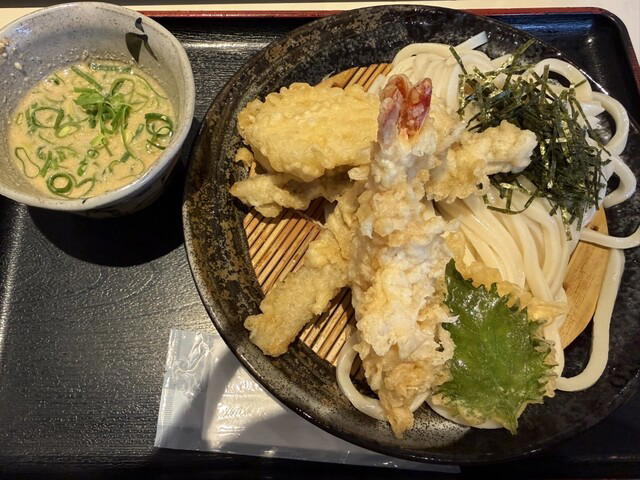
The approach is domestic rather than theatrical: a house-restaurant setting, compact room, counter seats, shared table space, and the quiet choreography of a noodle shop built around lunch, not lingering. In Kawagoe, where old-storehouse tourism can pull dining toward souvenir rhythms, udon remains a local test. The issue is not how elaborate the room feels, but how directly the wheat speaks once the bowl lands.
That is the useful way to read Hasenuma. It belongs to the hand-made udon category, with deep-fried foods as the natural supporting act, and its selection for Tabelog 100 Udon EAST 2024 places it in a regional field where texture and sourcing discipline matter more than luxury cues. This is not the expensive end of Kawagoe dining represented by eel houses such as Kawagoe Ichinoya or Ogakiku; it sits closer to the city’s everyday specialist economy, where focus can carry more critical weight than breadth.
Hand-made udon as Kawagoe's quiet test of wheat and timing
Udon in eastern Japan is judged through chew, surface, and the way broth or dipping sauce clings without smothering the noodle. The ingredient story begins with flour, not garnish. Hand-made udon puts pressure on hydration, kneading, resting, and cutting; small shifts in temperature and humidity can change the result before the kitchen reaches the pot. Serious udon shops rarely need a long supporting cast. The noodle carries the argument.
Hasenuma’s pairing of udon and deep-fried foods follows a familiar Japanese logic: wheat noodles supply structure, fried elements add contrast, and the meal stays in a modest price band. The absence of a luxury tasting format is the point. Kawagoe already has restaurants for destination spending; this room belongs to the specialist lunch tradition, where consistency over years becomes reputation. The opening date, 31 March 2013, matters because noodle houses earn credibility through repetition, not seasonal reinvention.
The Tabelog 100 Udon EAST 2024 selection is the hard trust signal. Tabelog’s Hyakumeiten lists are not Michelin-style star systems, but in Japan they carry weight by gathering high-performing specialists within tight categories. For udon, that focus is useful: a noodle shop is judged against other noodle shops, not fine-dining rooms with larger service teams and broader wine programs. Hasenuma also appeared in Tabelog 100 udon selections in 2018, 2019, 2020, and 2022, pointing to sustained recognition rather than a single-year spike.
The format belongs to the city's specialist middle, not its occasion-dining tier
Kawagoe’s dining map splits into heritage meals tied to the merchant-town image, casual cafés for day-trippers, ramen and udon counters with local repeat business, and a smaller set of higher-spend restaurants for planned meals. Hasenuma sits in the specialist middle: more serious than a convenience stop, less ceremonial than a full evening reservation. That middle tier is often where Japanese regional cities are strongest.
Comparison helps. Ganja Honten anchors another side of Kawagoe’s noodle culture, with ramen carrying a different broth-and-fat vocabulary. Fujidana Udon Kawagoe ten and Inaka Udon Tetsu give the city more than one udon reference point, which matters: a lone specialist can feel accidental, but a cluster suggests a local audience trained to notice texture. Against burger culture at Burger Cafe Honohono or broader restaurant cooking at amrit, the udon shop asks for narrower attention.
There is a practical editorial distinction between cheap food and serious low-cost food. A sub-¥1,000 listing can mean speed, compromise, or volume. In a Tabelog-recognized udon context, it usually signals another Japanese strength: craft compressed into an everyday format. The value is not only that the meal is inexpensive; the category permits a craft-led lunch without a long menu, wine pairing, or formal service arc.
The 21-seat room reinforces that reading. Three counter seats, a long table, and two four-seat tables absorb solo diners, pairs, and small family groups without becoming a large-format hall. Children are explicitly welcome, and the house-restaurant setting keeps the experience grounded. For Kawagoe day-trippers from Tokyo, the stronger choice is usually a focused lunch, then a walk through the historic core, rather than forcing the day around a formal dinner.
How to place it in a Kawagoe eating day
Hasenuma makes most sense as a precise stop, not a grand occasion. Udon is daytime-friendly, and the shop’s identity fits that rhythm. Expect a compact, ingredient-led meal: wheat noodles, fried accompaniments, and drinks such as sake or shochu if the timing suits, rather than a chef-driven progression. The multilingual menu note also lowers friction for visitors who want a local specialist without decoding a long Japanese-only board.
For a broader Kawagoe plan, use the restaurant as the noodle anchor and build around category contrast. The city’s restaurant guide can frame the wider choice set: Our full Kawagoe restaurants guide covers the local dining spread, while Our full Kawagoe hotels guide, Our full Kawagoe bars guide, Our full Kawagoe wineries guide, and Our full Kawagoe experiences guide help turn the meal into a fuller itinerary.
Readers comparing Japanese casual specialists across cities can also look beyond Kawagoe: -Grilled beef Sukiyaki- KAMAKURA TANUKIAN 鎌倉 たぬき庵 in Kamakura. 鮪と炭火焼き うお炭 秋葉原店 in Tokyo.cafe in Osaka.know in Kumamoto, (Shoku) Vietnam in Kawasaki, [Curry Senmon Ten] Maruyama Kyoju. in Sapporo, Jōdo Saké Bar in Los Angeles, and Onigiri Time in Pasadena show how single-category focus travels across different dining contexts.
The critical case for Hasenuma is simple, and stronger for being narrow. Kawagoe does not need every serious meal to be historic, expensive, or elaborate. A recognized udon shop with compact seating, family-friendly access, and a craft category rooted in flour and water gives the city something more useful: a local benchmark for everyday precision.
Fast Comparison
Comparable venues by cuisine and price in the same metro.
| Venue | Cuisine | Price | Notes |
|---|---|---|---|
| Hasenuma | Handmade Udon & Tempura | $ | Hon-Kawagoe |
| Ganja Honten | Tsukemen / Ramen | $ | Shintomi-cho |
| Inaka Udon Tetsu | Rustic handmade udon | $ | Kawagoe |
| Fujidana Udon Kawagoe ten | Traditional Musashino Udon | $ | Shinjuku-cho |
| Kotobuki Seimen Yoshikawa Kawagoe ten | Japanese Ramen | $$ | Minami Otsuka |
| Burger Cafe Honohono | Gourmet Hamburger Cafe | $$ | Motomachi |
Recognition history
Dated appearances from independent guides and award organizations, with the underlying list record or original source where available.
Tabelog 100 #97 · No. 97
Tabelog · Tabelog 100 - Udon - EAST - 2024
Continue exploring
More in Kawagoe
Restaurants in Kawagoe
Browse all →




Bars in Kawagoe
Browse all →



Hotels in Kawagoe
Browse all →




Wineries in Kawagoe
Browse all →
At a Glance
- Cozy
- Classic
- Solo
- Family
- Casual Hangout
- After Work
- Group Dining
- Standalone
- Sake Program
- Beer Program
- Local Sourcing
Current opening hours
- Monday
- Closed
- Tuesday
- Closed
- Wednesday
- Closed
- Thursday
- 11 AM–3 PM
- Friday
- 11 AM–3 PM
- Saturday
- 11 AM–3 PM
- Sunday
- 11 AM–3 PM
Hours can change for holidays and private events. Last verified .