
Kobe’s burger culture sits beside steak houses, kissaten, and late-night bars rather than apart from them. HYOE'S BURGERS + FRIES brings the American-style burger ritual into Sannomiya’s compact dining grid, with Tabelog Hamburger 100 selections in 2024 and 2026 giving it a clear signal beyond casual-snack territory.
Pearl is the En Primeur Club membership app — saves, bookings, and concierge access live there. Same editors, same standards.
- Address
- Japan, 〒650-0004 Hyogo, Kobe, Chuo Ward, Nakayamatedori, 2 Chome−12−10 マンションリーベ 1-A
- Phone
- +81 78-855-5033
- Website
- hyoesburgers.com
 Saves & bookings on Pearl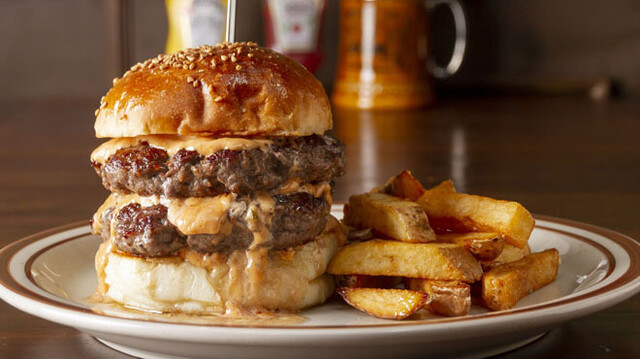
Approaching the Sannomiya side streets, the burger counter feels less like fast food than a compact urban ritual: a small room, counter seating, take-out traffic, and pacing that makes burger lunch feel like a set piece, not an afterthought. Kobe is internationally known for beef, but its everyday dining is broader and more practical. Western-style cooking has long had a foothold here, from yoshoku to coffee-house sandwiches, and the current hamburger scene draws on that history while working with the discipline of small Japanese restaurants.
HYOE'S BURGERS + FRIES is a specialist shop, not a general American diner. Its inclusion in Tabelog’s Hamburger 100 in 2024 and again in 2026 places it in Japan’s narrow national conversation around burger craft, where judgment falls on structure, heat management, bun-to-patty ratio, and repeatability under pressure. In a city where premium beef rooms can become high-spend, the burger format offers another Kobe pleasure: direct, timed, informal, but not careless.
The burger counter as a Kobe dining ritual
The modern Japanese burger shop has its own etiquette. It is neither the American roadside model nor simply yoshoku in a bun. The better versions are small, queue-sensitive, and production-limited, with the kitchen rhythm setting the meal’s tempo. The counter matters because burgers should be eaten quickly after assembly; take-out matters because the format travels better than many plated dishes; solo dining matters because the meal needs no social architecture of a long dinner.
That is where this shop fits Sannomiya’s dining pattern. Kobe’s central district rewards compact formats: beef counters, coffee rooms, curry shops, bars, and small restaurants doing one thing through repetition rather than breadth. HYOE'S BURGERS + FRIES uses the same urban grammar. The appeal is not a long menu narrative or chef mythology; it is ordering, waiting, eating while the build is at its intended temperature, and leaving before the room has to become something it is not.
For travelers, the comparison is useful. Kobe’s high-end beef tradition can feel ceremonial, especially at steak and sukiyaki rooms. A burger counter cuts through that ceremony while keeping the city’s appetite for meat in view. Readers mapping a wider Kobe table can set this beside Aburi Niku Kobo Wakkoku Shinkobe ten and Aburi Niku Kobo Wakkoqu Kitano Sakamoto Ten, where beef follows a different service code. The point is range, not hierarchy: Kobe can do formal beef, quick beef, and Western-style comfort without disconnect.
Why the format matters more than the label
Japan’s specialist burger shops live or die by constraints. A small room limits how many burgers can leave the grill in good condition. A fixed daily rhythm limits drift. The category attracts scrutiny because a hamburger looks simple until details fail: the bun collapses, the patty cools, toppings slide, fries become filler. Recognition from Tabelog’s Hamburger 100 signals performance within a specific category, not general popularity across cuisines.
The ritual is also more democratic than Kobe’s luxury beef circuit. Nearby comparison venues occupy higher spending bands, from baron at JPY 30,000 to JPY 39,999 to Ristorante Hanatani at JPY 10,000 to JPY 14,999 for dinner. Out-of-metro steak and yoshoku references such as Arakawa sit higher again. Against that background, the burger counter is a practical counterpoint: still meat-focused, still craft-dependent, but stripped of ceremony and priced for a shorter meal. That matters for visitors who want a Kobe food day with texture rather than one expensive set piece.
The small room shapes behavior. This is not a place to linger through multiple rounds like a lounge. It belongs to the Japanese custom of respecting turnover in compact restaurants: arrive ready to order, keep the table light, and treat the meal as a focused stop. That ritual is part of the pleasure. The city has slower second acts, from Akaneya Coffee Ten for coffee culture to Akari and Ali's Halal Kitchen for another read on Kobe’s casual dining spread.
How to place it in a Kobe itinerary
Use this address as a mid-day or early-evening anchor in Sannomiya, not the sole purpose of a night out. The district’s strength is density: restaurants, cafés, bars, and transport links sit close enough to pair a meal with another small stop without turning the day into logistics. A nationally recognized burger counter works well between a Kitano walk, a coffee pause, and a later bar reservation. It also breaks tasting-menu fatigue, a real risk in Japan when every meal is planned as an event.
EP Club readers building a broader Kobe plan should treat the burger as part of the city’s everyday premium layer: specific, compact, and more revealing than another generic station-area meal. For context, use Our full Kobe restaurants guide, then cross-check through Our full Kobe hotels guide, Our full Kobe bars guide, Our full Kobe wineries guide, and Our full Kobe experiences guide. Avoid flattening Kobe into beef alone; the city’s better food days move between categories.
Travelers comparing Japanese casual formats beyond Kobe can read across regions: -Grilled beef Sukiyaki- KAMAKURA TANUKIAN 鎌倉 たぬき庵 in Kamakura for another beef-led ritual, . 鮪と炭火焼き うお炭 秋葉原店 in Tokyo for a different casual register.cafe in Osaka.know in Kumamoto, (Shoku) Vietnam in Kawasaki, and [Curry Senmon Ten] Maruyama Kyoju. in Sapporo. Across the Pacific, Jōdo Saké Bar in Los Angeles and Onigiri Time in Pasadena show how Japanese casual formats translate abroad, though Kobe’s version remains rooted in compact, station-adjacent dining habits.
The verdict: choose this for a focused burger stop with recognized category credentials, not a drawn-out restaurant evening. In Kobe, that distinction is useful. The city’s food identity is strongest when ceremonial beef and small-format craftsmanship coexist, and this counter sits squarely in the latter camp.
Style and Standing
Comparable venues to anchor price and recognition.
| Venue | Cuisine | Price | Notes |
|---|---|---|---|
| HYOE'S BURGERS + FRIESThis venue — the venue you are viewing | Specialty Smash Burgers & Fries | $$ | Not listed |
| DAKOTA RUSTIC TABLE | Rustic Hamburger Cafe | $$ | Kita |
| Bar Ciccia | Casual Italian Bar & Trattoria | $$ | Chūō |
| S.B.DINER-KOBE | Gourmet Hamburger Diner | $$ | Chūō |
| La Pierre Blanche Motomachi ten | Artisanal Chocolate & Bonbons | $$ | Chūō |
| Soba Mae Nakate Touha | Traditional soba & soba-mae counter | $$ | Chūō |
Recognition history
Dated appearances from independent guides and award organizations, with the underlying list record or original source where available.
Tabelog 100 #39 · No. 39
Tabelog · Tabelog 100 - Hamburger - 2026
Continue exploring
More in Kobe
Restaurants in Kobe
Browse all →
Bars in Kobe
Browse all →



Hotels in Kobe
Browse all →


At a Glance
- Lively
- Cozy
- Trendy
- Solo
- Casual Hangout
- After Work
- Late Night
- Standalone
- Beer Program
- Local Sourcing
- Street Scene
Current opening hours
- Monday
- 11 AM–3:30 PM, 5–7:30 PM
- Tuesday
- 11 AM–3:30 PM, 5–7:30 PM
- Wednesday
- 11 AM–3:30 PM, 5–7:30 PM
- Thursday
- 11 AM–3:30 PM, 5–7:30 PM
- Friday
- 11 AM–3:30 PM, 5–7:30 PM
- Saturday
- 11 AM–3:30 PM, 5–7:30 PM
- Sunday
- 11 AM–3:30 PM, 5–7:30 PM
Hours can change for holidays and private events. Last verified .
Casual and energetic, with a pub-like, Americana-inspired interior and a focus on counter-style burger service rather than lingering dining.