
Tabelog 100 #1
Our verdict
A compact Sannomiya room for Pakistani, curry, and Indian cooking, Ali's Halal Kitchen belongs to Kobe's more practical dining register: modest spend, clear format, and recognition from Tabelog's Asian and ethnic cuisine list. The appeal is less spectacle than utility, especially for travelers who need halal dining without leaving the central rail-and-hotel corridor.

Pearl is the En Primeur Club membership app, where members save venues, book tables and use the concierge.
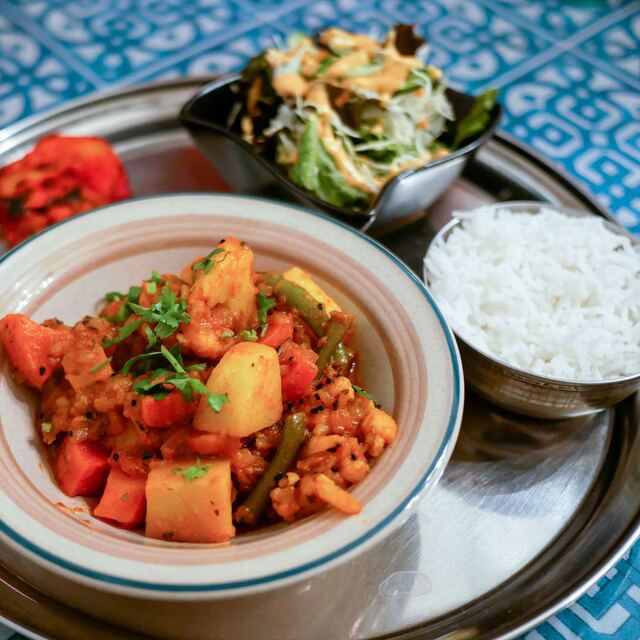
The menu
What to order
- Biryani
- Haleem
- Curries (chicken, mutton, vegetable)
- Kebabs
- Fresh naan
Approaching the dining blocks around Sannomiya, Kobe shifts quickly from department-store polish to small-room eating: curry shops, coffee counters, late-night grills, and family tables packed close enough that menu choices become part of the room's weather. In that setting, Ali's Halal Kitchen reads as a practical address rather than a theatrical destination, with Pakistani, curry, and Indian categories doing the work that Kobe's higher-priced dining often leaves aside: feeding mixed groups, religiously observant travelers, and value-focused diners near the city's main transport spine.
Kobe's restaurant identity is often reduced to beef, but the city has always been more cosmopolitan than that shorthand allows. The port brought foreign communities, trading houses, bakeries, cafés, and non-Japanese dining habits into daily life; Sannomiya and Kitano remain where much of that international register is easiest to read. A halal kitchen in this part of town is not an anomaly. It is part of a broader Kobe pattern in which imported cuisines become neighborhood infrastructure, not novelty.
Halal dining in Kobe without the luxury surcharge
The value proposition here is plain. Kobe can price sharply once beef, counter seating, or tasting-menu discipline enters the frame. Comparison venues show the spread: Yuzaburo sits in a far higher dinner bracket, erre occupies a tasting-menu tier, and Aburi Niku Kobo Wakkoqu Kitano Sakamoto Ten belongs to the city's premium beef conversation. Ali's Halal Kitchen works in another lane, where the point is not ceremony but access: halal rules, South Asian cooking categories, and a price structure that keeps the meal closer to everyday dining than occasion dining.
That distinction matters for travelers. A city with serious restaurants is not automatically easy for everyone to eat in, particularly when pork, alcohol, or meat-sourcing restrictions shape the decision. Japanese curry culture is broad, but halal South Asian dining answers a different need: it gives diners a clearer frame for ingredients and format while staying inside a familiar urban rhythm. The Tabelog 100 selection for Asian cuisine and ethnic cuisine in WEST 2024 gives the room a public trust signal beyond convenience, and repeat selection in 2022 and 2023 suggests the recognition was not a single-year accident.
The category mix also changes the ordering psychology. Pakistani, curry, and Indian labels point toward shared-table eating rather than the one-person precision of ramen or sushi. That makes the room useful for families and small groups, especially when one diner is choosing around halal requirements and others simply want a central, informal meal. In Kobe, where many restaurant narratives drift toward beef lineage and chef counters, this is a less expensive but more flexible form of hospitality.
Sannomiya context: small rooms, transport logic, and immigrant foodways
Sannomiya rewards diners who think in clusters. Coffee can be treated as its own ritual at Akaneya Coffee Ten or anthem; casual Japanese meals sit nearby at places such as Akari; beef specialists pull visitors toward Aburi Niku Kobo Wakkoku Shinkobe ten. Against that background, halal South Asian cooking supplies a different kind of certainty. It is useful before a train, after check-in, or when the group needs a meal that does not require surrendering the evening to a formal counter.
The room's small scale reinforces that role. With 23 seats and private use available for groups within the listed capacity range, it belongs to the compact Kobe restaurant model rather than the banquet-hall model. That can be a strength: smaller dining rooms in Japan often trade breadth for clarity, and in this case the clarity is dietary, regional, and practical. English menu support adds another layer of usefulness for overseas visitors, particularly in a category where ingredient confidence is not a minor concern.
There is also a useful contrast with other forms of travel dining in Japan. A visitor comparing regional meals might chase specialty formats elsewhere, from -Grilled beef Sukiyaki- KAMAKURA TANUKIAN 鎌倉 たぬき庵 in Kamakura to. 鮪と炭火焼き うお炭 秋葉原店 in Tokyo, or casual address-book finds such as.cafe in Osaka.know in Kumamoto, (Shoku) Vietnam in Kawasaki, and [Curry Senmon Ten] Maruyama Kyoju. in Sapporo. Ali's Halal Kitchen fits that same practical map: not the grand meal of a city, but the address that solves a specific dining problem with enough recognition to justify the detour.
How to place it in a Kobe itinerary
The editorial case is strongest when the meal is treated as part of a central Kobe day rather than as a standalone pilgrimage. Pair it with Sannomiya, Kitano, or a low-friction evening between hotel and rail plans. Travelers building a wider city file can use Our full Kobe restaurants guide for dining context, then cross-check stay patterns through Our full Kobe hotels guide. Drinking plans, winery research, and cultural scheduling sit separately in Our full Kobe bars guide, Our full Kobe wineries guide, and Our full Kobe experiences guide.
The better comparison is not with Kobe's luxury beef rooms, but with reliable city restaurants that answer a clear need at a sane tariff. That is where Ali's Halal Kitchen earns its place: it gives halal diners a central option, gives mixed groups a shared-table format, and gives value-minded travelers a meal with external recognition rather than mere convenience. For readers tracking how Japanese cities now serve Muslim travelers and international residents, it is a small but telling Kobe address.
That pattern is not limited to Japan. Specialist, requirement-driven dining often becomes part of a traveler's actual map faster than an acclaimed tasting counter, as seen in practical diaspora and category-led addresses such as Jōdo Saké Bar in Los Angeles or Onigiri Time in Pasadena. The point is not equivalence of cuisine; it is the way a focused format can anchor a day. In Kobe, this kitchen does that work with halal South Asian cooking in the middle of Sannomiya.
Frequently asked questions
What does dinner at Ali's Halal Kitchen typically cost?
Pricing at Ali's Halal Kitchen is listed as JPY 2,000 - JPY 2,999 JPY 1,000 - JPY 1,999.
What are Ali's Halal Kitchen's hours?
Hours at Ali's Halal Kitchen: Mon: 11 AM–2:30 PM, 5:30–9:30 PM; Tue: 11 AM–2:30 PM, 5:30–9:30 PM; Wed: 11 AM–2:30 PM, 5:30–9:30 PM; Thu: 11 AM–2:30 PM, 5:30–9:30 PM; Fri: 11 AM–2:30 PM, 5:30–9:30 PM; Sat: 11 AM–2:30 PM, 5:30–9:30 PM; Sun: 11 AM–2:30 PM, 5:30–9:30 PM.
Where is Ali's Halal Kitchen located?
Ali's Halal Kitchen is located in Kobe.
What's the signature at Ali's Halal Kitchen?
No single named signature is listed in the public record. The draw is the Pakistani, curry and Indian cooking, backed by Tabelog 100 selection for Asian cuisine / Ethnic cuisine WEST 2024. Expect a menu built around that regional brief rather than a dish that has been formally singled out. Check the venue's official channels for the latest details.
Is Ali's Halal Kitchen allergy-friendly?
It is a halal kitchen and the venue notes that alcohol and pork are not served, which will matter for many diners avoiding those ingredients. The restaurant also accepts reservations and lists English menus, but any other allergy handling should be checked directly against the 1 Chome-20-14 Nakayamatedori address details before ordering.
Is Ali's Halal Kitchen suitable for children?
Yes. the public record explicitly marks it family friendly and says children of all ages are welcome, including babies and stroller users. With 23 seats and sofa seating in Kobe's Sannomiya area, it works as a practical lunch or early dinner stop. Check the venue's official channels for the latest details.
Standing Among Peers
Comparable venues to calibrate price, style, and recognition.
| Venue | Cuisine | Price | Awards | Notes |
|---|---|---|---|---|
| Ali's Halal KitchenThis venue (the venue you are viewing) | Halal Pakistani & Indian Curry House | $20–30 | Tabelog 100 #1 | Not listed |
| Karapincha | Sri Lankan rice & curry restaurant and spice shop | $10–20 | Tabelog 100 #94 | Nada |
| Cini CURRY | Pakistani-style Japanese curry | Not listed | Tabelog 100 #84 | Chūō |
| FREUNDLIEB Ikuta ten | German-inspired bakery café in a historic church | Not listed | Not listed | Chūō |
| Akari | Creative Japanese-inspired fusion | Not listed | Tabelog 100 #91 | Chūō |
| 鮨 çç² | japanese | Not listed | Not listed | Higashinada |
Recognition history
Dated appearances from independent guides and award organizations, with the underlying list record or original source where available.
Tabelog 100 #1 · No. 1
Tabelog · Tabelog 100 - Asian cuisine / Ethnic cuisine - WEST - 2024
Continue exploring
More in Kobe
Restaurants in Kobe
All restaurants in Kobe →

Bars in Kobe
Browse all →




Details
- Cozy
- Casual
- Lively
- Family
- Group Dining
- Casual Hangout
- Solo
- After Work
- Celebration
- Standalone
- Zero Proof
- A La Carte
- Set Menu
- Soft Drinks
- Lassi
- Tea
- Halal
- Vegetarian Friendly
Current opening hours
- Monday
- 11 AM–2:30 PM, 5:30–9:30 PM
- Tuesday
- 11 AM–2:30 PM, 5:30–9:30 PM
- Wednesday
- 11 AM–2:30 PM, 5:30–9:30 PM
- Thursday
- 11 AM–2:30 PM, 5:30–9:30 PM
- Friday
- 11 AM–2:30 PM, 5:30–9:30 PM
- Saturday
- 11 AM–2:30 PM, 5:30–9:30 PM
- Sunday
- 11 AM–2:30 PM, 5:30–9:30 PM
Hours can change for holidays and private events. Hours as of .
Cozy, casual, and welcoming dining room with simple table seating, sofa seating, and a family-friendly atmosphere that stays relaxed yet lively during peak hours.