
Holland Ken puts Saitama ramen in a disciplined, small-counter frame: eight seats, a reservation system, and repeat selection for Tabelog Ramen EAST “Tabelog 100” from 2022 through 2025. The draw is not spectacle but ritual, the quick, focused rhythm of a bowl shop where timing, queue etiquette, and counter manners matter as much as appetite.
Pearl is the En Primeur Club membership app — saves, bookings, and concierge access live there. Same editors, same standards.
- Address
- 埼玉県さいたま市岩槻区東岩槻6-1-4 1F
- Website
- tabelog.com
- Directions
- Get directions
 Saves & bookings on Pearl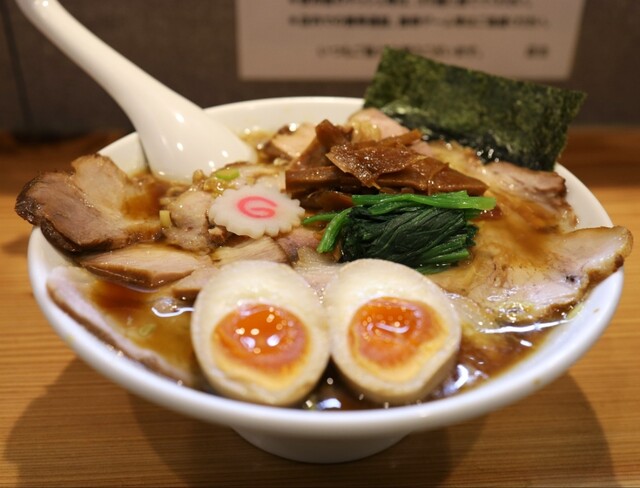
Approaching a serious ramen counter in suburban Saitama differs from entering a destination dining room in Tokyo. The cues are smaller: line discipline, quiet room-reading, quick seat turnover, and regulars who know ramen is eaten with attention rather than ceremony. Holland Ken belongs to that compact world, where a brief meal is highly codified and the counter turns a bowl into a tightly paced kitchen-guest exchange.
Saitama’s better ramen addresses rarely act like tourist restaurants. They sit in commuter towns, residential shopping streets, and station-adjacent routines rather than hotel districts. That makes the category more interesting. The strongest bowls outside central Tokyo must win repeat local traffic before becoming destination meals, and Holland Ken’s repeated selection for Tabelog Ramen EAST “Tabelog 100” from 2022 to 2025 places it in the regional conversation, not the long tail of neighborhood ramen shops.
An eight-seat ramen ritual built around pace, restraint, and counter etiquette
Ramen at this level is a timing exercise. The guest reads the room, sits, orders without delay, eats while the noodles hold their intended texture, and leaves without turning the counter into a lounge. An eight-seat counter sharpens that choreography and changes the meal’s psychology: no private table buffer, no long conversation arc, no leisurely second act. The bowl is the event.
That compactness matters because ramen quality is highly pace-sensitive. Noodles soften in broth, aroma shifts quickly, and the first minutes carry disproportionate weight. Serious ramen-counter custom is not accidental politeness; it protects the food. For travelers used to multicourse dining, the adjustment is useful: a respected ramen shop may deliver its argument in less time than a wine pairing, but the compression is the point.
Holland Ken’s small format also differs from broader casual dining in Saitama. BurgerPOLICE Kasukabe sits in a higher spend bracket, while 3931WORKS. Oak wood, and Niboshi Ranbu occupy more comparable everyday price territory. Kuriya Sawa, with a higher dinner range, belongs to another rhythm. These comparisons underline ramen’s Japanese value proposition: inexpensive by luxury-dining standards yet demanding in access, timing, and etiquette.
The counter-only format filters its audience. This is not a group dinner venue, private-room choice, or lingering date-night setting. It suits diners who understand that Japanese ramen culture prizes concentration. Without table theatrics, the bowl is exposed to judgment, which is why awards and sustained local attention matter in this category.
Saitama ramen beyond the Tokyo gravitational pull
Tokyo dominates international ramen talk, but greater Kanto has dense ramen culture that does not need central-city validation. Saitama’s strongest addresses benefit from lower real-estate pressure than inner Tokyo and a rail-traveling customer base willing to seek a specific bowl. Higashi-Iwatsuki is not a drawback; it fits the pattern. Serious ramen in Japan often asks diners to leave obvious dining districts.
The Tabelog Ramen EAST “Tabelog 100” selection is the clearest public trust signal: category-specific, regionally scoped, and repeated across multiple years. For ramen, that recognition is more useful than broad lifestyle praise because it measures the restaurant against ramen specialists, not general restaurants. The listed Tabelog score of 3.88 adds another signal, especially on a platform where small differences can mark meaningful separation in a crowded field.
There is useful restraint in what is not over-explained. No chef mythology is needed. In ramen, craft often appears through operations: seat count, ordering discipline, service rhythm, and the ability to draw diners to a modest suburban address. The story is the category maturing outside the capital’s obvious circuits, with the restaurant showing that serious ramen travel in Kanto extends beyond the usual Tokyo map.
For a Saitama itinerary, the prefecture’s range becomes clear. Pastry-focused stops such as Acacier Kitaurawa honten and Acacier Urawa ten show another appetite, while casual specialists such as Aki Foods, Bagel Shop vivant, and Beach Story show how much of Saitama’s food culture sits in focused, small-format addresses rather than grand dining rooms.
How to place it in a wider Japan itinerary
The restaurant makes most sense for travelers interested in ramen as regional craft, not just quick lunch. The reward is comparative literacy: seeing how a compact Saitama counter differs from a central Tokyo ramen stop, how rail-based dining shapes demand, and how award lists surface specialist shops beyond usual visitor routes.
That logic applies across Japan. Travelers comparing ramen in Saitama with broader casual formats might also look at (Shoku) Vietnam in Kawasaki, [Curry Senmon Ten] Maruyama Kyoju. in Sapporo.cafe in Osaka, or.know in Kumamoto to see how focused everyday dining changes by city. For higher-commitment meals elsewhere, -Grilled beef Sukiyaki- KAMAKURA TANUKIAN 鎌倉 たぬき庵 in Kamakura and. 鮪と炭火焼き うお炭 秋葉原店 in Tokyo sit in different traditions, useful contrasts rather than direct peers.
Internationally, the comparison sharpens. Jōdo Saké Bar in Los Angeles and Onigiri Time in Pasadena show how Japanese formats translate abroad, often with longer dwell times and different service expectations. A Saitama ramen counter works by the opposite principle: fewer seats, faster rhythm, less explanation, more trust in the diner to know the code.
For planning, Our full Saitama restaurants guide gives dining context, while Our full Saitama hotels guide, Our full Saitama bars guide, Our full Saitama wineries guide, and Our full Saitama experiences guide frame the trip beyond the bowl. The editorial case for the restaurant is simple: repeated category recognition, disciplined small-counter format, and enough regional specificity to justify the detour for diners who care how the ritual works.
Cuisine Context
Comparable options at the same price tier.
| Venue | Cuisine | Price | Notes |
|---|---|---|---|
| Holland KenThis venue — the venue you are viewing | Ramen | $$ | Not listed |
| Jikasei Temomimen Suzunoki | Handmade Flat Noodle Ramen | $$ | Sayamagaoka |
| Niboshi Chuka Soba Senmon Niboshi Maru | Niboshi Ramen | $ | Omiya |
| Komorebi Shokudo + | Healthy Japanese Café & Teishoku | $$ | Urawa |
| Unagi Musashino | Traditional Japanese Eel (Unagi) | $$ | Urawa |
| Ramen Jiro Oomiya kouen ekimae ten | Jiro-style Ramen Shop | $ | Omiya Koen |
Recognition history
Dated appearances from independent guides and award organizations, with the underlying list record or original source where available.
Tabelog 100 #68 · No. 68
Tabelog · Tabelog 100 - Ramen - EAST - 2025







At a Glance
- Well Known
- Cozy
- Solo
- Casual Hangout
- Standalone
Compact, counter-only ramen shop atmosphere with a small number of seats and a no-frills, focused dining experience.