Feinkost Böhm Sushi-Ya occupies an address in Stuttgart's city centre on Kronprinzstraße, sitting within a broader retail and dining tradition that Feinkost Böhm has maintained across multiple formats. As Stuttgart's fine dining scene consolidates around a small number of ambitious kitchens, this Japanese-leaning counter represents a distinct register: more focused in format, different in reference point, and operating at a remove from the city's dominant Franco-German fine dining axis.
Pearl is the En Primeur Club membership app — saves, bookings, and concierge access live there. Same editors, same standards.
- Address
- Kronprinzstraße 6, 70173 Stuttgart, Germany
- Phone
- +497112275629
- Website
- feinkost-boehm.de
- Directions
- Get directions
 Saves & bookings on Pearl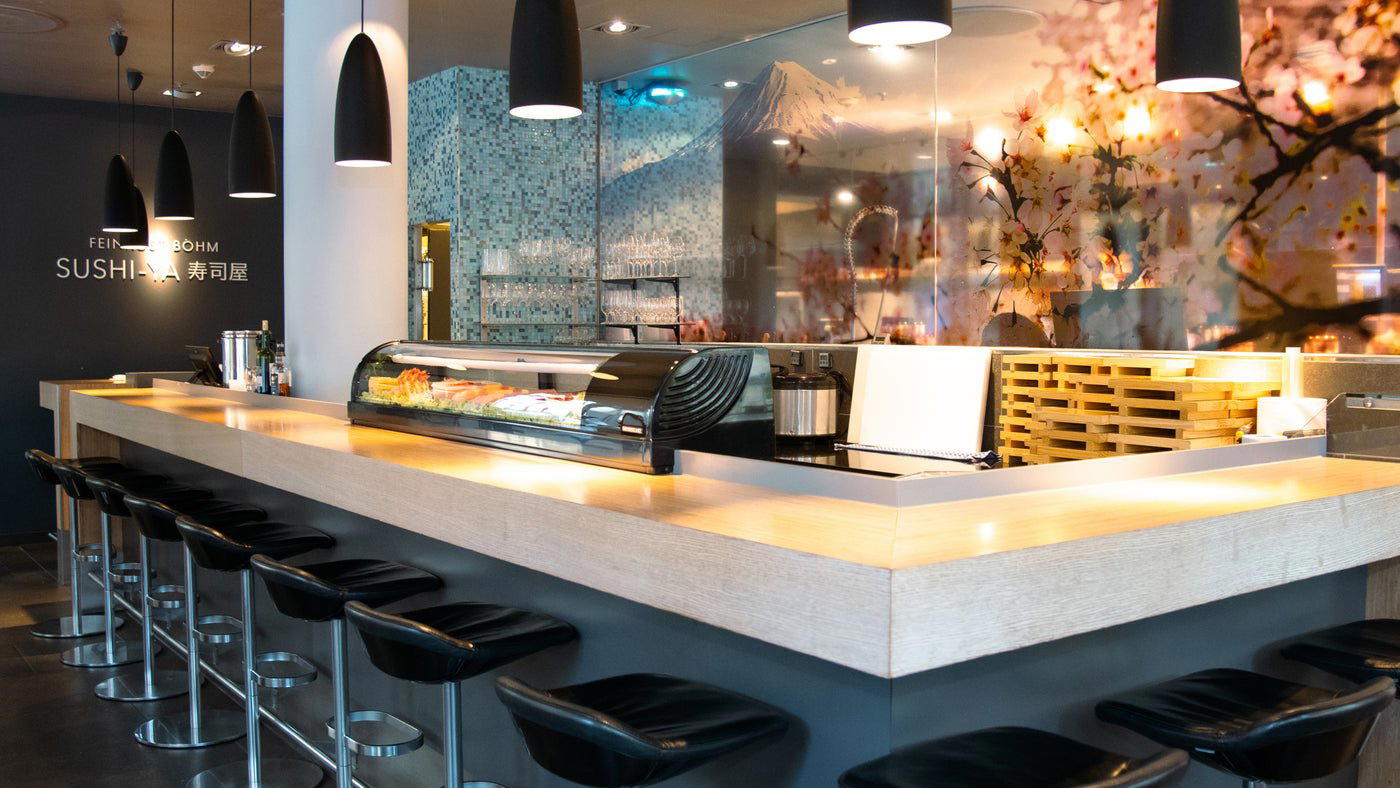
A Different Reference Point in Stuttgart's Dining Room
Stuttgart's serious restaurant culture has long been anchored in the Franco-German tradition. The city's most decorated tables, among them Speisemeisterei and Délice, operate within a recognisable European fine dining grammar: classical technique, regional produce, tasting-menu architecture. Feinkost Böhm Sushi-Ya exists in a separate conversation entirely. Set on Kronprinzstraße in the heart of Stuttgart's centre, it operates under the Feinkost Böhm name, a Stuttgart institution that has historically combined delicatessen retail with dining formats. The sushi counter is one specialist expression of that history, a format that places Japanese fish craft against a city backdrop defined by something quite different.
Stuttgart sits in Baden-Württemberg, a region with substantial purchasing power and an international industrial workforce, conditions that have supported more ambitious Japanese dining than might be expected from a city of its size.
The Lunch Counter vs. the Evening Setting
At lunch, sushi-focused venues in Germany's mid-tier cities tend to operate at a more accessible register: smaller selections, faster pacing, a broader walk-in clientele drawn from nearby offices and retail workers. The mood is lighter, the transactional rhythm more visible. Kronprinzstraße sits in a commercial corridor, and the midday demographic at a Feinkost Böhm address reflects that location, which means the lunch setting at Sushi-Ya likely draws a different crowd than a destination evening booking would.
Evening service shifts the equation. In counter-format sushi, the dinner hour typically unlocks the fuller omakase or set-menu logic, where the kitchen controls pacing and the interaction between diner and chef becomes more central to the experience. This is where the craft argument gets made. Germany has a handful of serious omakase counters, most concentrated in Munich, Berlin, and Frankfurt, with JAN in Munich operating in a premium creative register that shows how far the category can reach. Stuttgart's Japanese dining infrastructure is thinner, which makes an evening at a counter like Sushi-Ya carry a different weight: there are fewer alternatives within the city, so the commitment to the format is proportionally higher.
Where Sushi-Ya Sits in the Broader Stuttgart Picture
Stuttgart's fine dining comparable set operates mostly in the €€€-€€€€ band. Der Zauberlehrling and Hegel Eins represent creative and modern cuisine at that price tier, while 5 adds another contemporary reference point. These are tables where the European tasting-menu convention holds. Sushi-Ya does not compete directly in that space. Its competitive set is defined by format rather than ambition tier: the relevant comparison is other serious sushi counters in Germany, not the city's Michelin-registered creative kitchens.
Across Germany, recognised fine dining addresses span a considerable geographic range. Schwarzwaldstube in Baiersbronn and Waldhotel Sonnora in Dreis represent the classical country-house register. Vendôme in Bergisch Gladbach, Victor's Fine Dining by Christian Bau in Perl, and Aqua in Wolfsburg anchor the country's highest decorated tier. ES:SENZ in Grassau, Schanz in Piesport, and Restaurant Haerlin in Hamburg extend the map. CODA Dessert Dining in Berlin shows how far from the classical template ambitious German dining can travel. Sushi-Ya's point of reference sits closer to Japan than to any of these, which is precisely the point: it occupies a category that Germany's decorated restaurant culture largely does not address.
Internationally, the counter format that Sushi-Ya works within has a well-documented tradition. The discipline of the omakase counter, where a single chef or small team controls every variable of the meal, has become a global benchmark for precision cooking. Venues like Le Bernardin in New York City and Lazy Bear in San Francisco show, in different registers, how tightly controlled formats can produce particularly consistent dining experiences in the world. The counter model succeeds when format discipline is taken seriously. That is the standard against which a sushi counter anywhere should be measured.
Budget Reality Check
Comparable venues nearby, for context on price, style, and recognition.
| Venue | Cuisine | Price | Notes |
|---|---|---|---|
| Feinkost Böhm Sushi-YaThis venue — the venue you are viewing | Gablenberg, Traditional Japanese Sushi | $$$ | Not listed |
| Ampulle – The Dry Gin & Beef Club | Heslach, Dry-Aged Steakhouse & Gin Bar | $$$ | Not listed |
| La Fenice | Gablenberg, Modern Traditional Italian | $$$ | Not listed |
| Yuoki | Not listed | $$ | Viesenhäuser hof, Japanese & Chinese Sushi Grill |
| Sushi Le | Gablenberg, Authentic Japanese Sushi | $$ | Not listed |
| Kicho | Gablenberg, Authentic Japanese | $$$ | Not listed |
Continue exploring
More in Stuttgart
Restaurants in Stuttgart
Browse all →
Bars in Stuttgart
Browse all →


Hotels in Stuttgart
Browse all →


At a Glance
- Modern
- Trendy
- Casual Hangout
- Open Kitchen
Current opening hours
- Monday
- 12–3 PM, 6–10 PM
- Tuesday
- 12–3 PM, 6–10 PM
- Wednesday
- 12–3 PM, 6–10 PM
- Thursday
- 12–3 PM, 6–10 PM
- Friday
- 12–3 PM, 6–10 PM
- Saturday
- 12–3 PM, 6–10 PM
- Sunday
- Closed
Hours can change for holidays and private events. Last verified .
Modern and cool setting integrated into a gourmet food market, ideal for quick bites with a view of the fish counter.