Our verdict
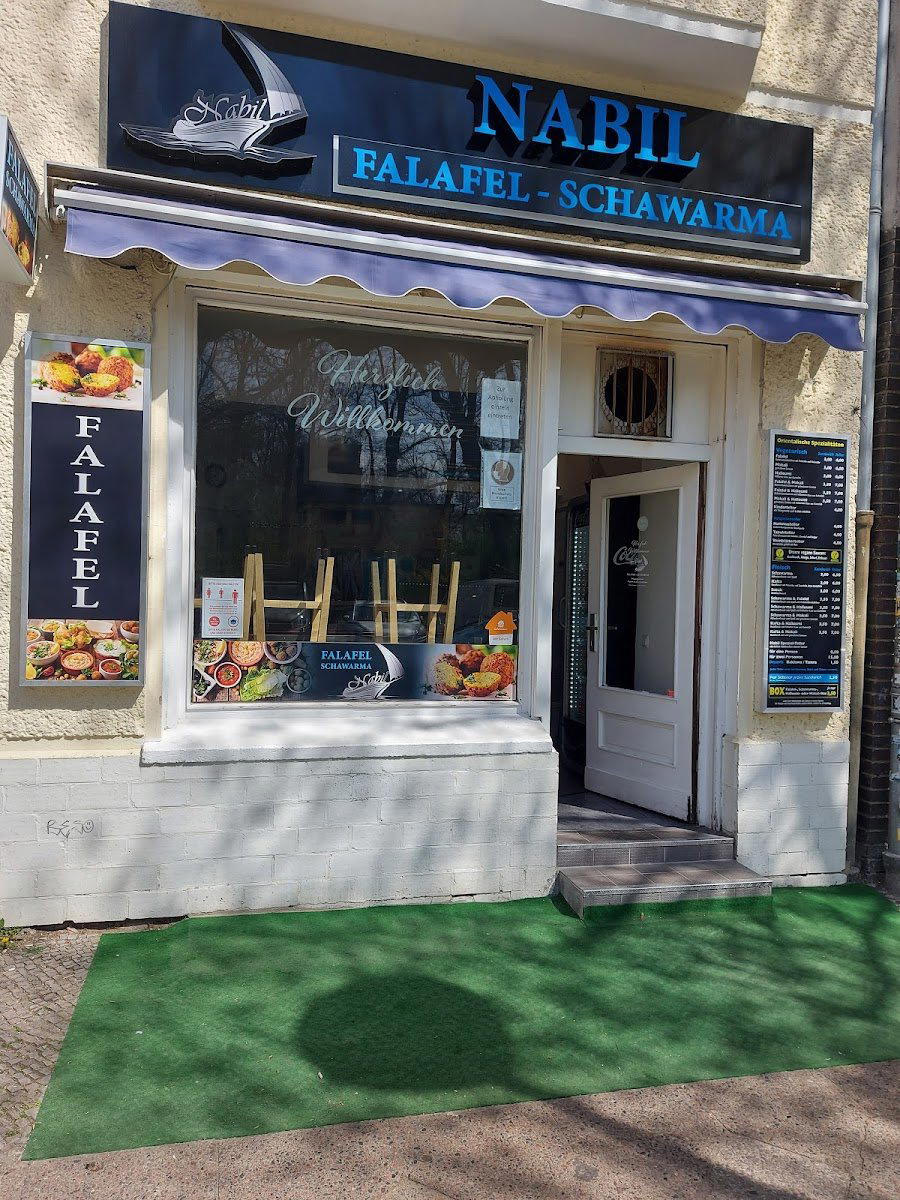
On a quiet Prenzlauer Berg side street, Falafel Shawarma Nabil occupies a position that Berlin's street food scene has always depended on: the neighbourhood spot that earns its reputation through consistency rather than fanfare. Located at Erich-Weinert-Straße 55, it represents the Middle Eastern fast-food tradition that runs as a counterpoint to Berlin's high-end dining circuit, from Michelin-chasing tasting menus to the city's celebrated döner culture.

Pearl is the En Primeur Club membership app, where members save venues, book tables and use the concierge.
The menu
What to order
- Falafel
- Shawarma
- Nabil Spezial-Teller
Prenzlauer Berg's Street Food Logic
Berlin's casual food scene operates on a principle that the city's fine dining establishment rarely acknowledges: the most discussed spots in any neighbourhood are often the ones charging single digits, not triple. Prenzlauer Berg, which spent the post-reunification decades developing from artists' squat territory into one of the city's more settled residential quarters, has always had a parallel food economy running alongside its wine bars and Nordic-inflected café culture. Falafel and shawarma joints are part of that infrastructure, as embedded in the area's daily rhythm as the bakeries on Schönhauser Allee or the market stalls at Kollwitzplatz.
Falafel Shawarma Nabil, at Erich-Weinert-Straße 55, sits within that tradition rather than apart from it. The address places it on a quieter residential artery rather than a high-footfall thoroughfare, which already signals something about how it operates: this is a place built on return visits from the immediate neighbourhood, not on tourist throughput or location advantage.
Berlin's Middle Eastern Food Tradition as Context
To understand where a place like Falafel Shawarma Nabil sits in Berlin's food geography, it helps to understand how the city's Middle Eastern food culture arrived and layered itself over decades. Berlin's large Arab and Turkish communities, concentrated initially in Wedding, Neukölln, and Kreuzberg, created a dense network of falafel shops, shawarma stands, and bakeries that have since spread across the city. The spread into Prenzlauer Berg reflects both population movement and the neighbourhood's appetite for the format.
The category is well-defined and competitive. At the low end of the price spectrum, falafel wraps and shawarma plates in Berlin typically run between three and eight euros, and the competition for neighbourhood loyalty is fought on freshness, spice calibration, and the quality of accompaniments: tahini, pickled vegetables, fresh herb ratios. These details separate the forgettable from the frequently returned-to, and they are not the kind of thing communicated by a menu board. You find out by eating there multiple times.
For context on how far the Berlin dining spectrum extends in the other direction, the city's fine dining scene includes Rutz in Mitte, which holds two Michelin stars and runs one of the city's most considered wine programs, and Nobelhart & Schmutzig on Friedrichstraße, where the tasting menu is built around a strict regional sourcing philosophy. At the creative dessert end, CODA Dessert Dining has earned Michelin recognition for a format that treats patisserie as the primary culinary language. These venues occupy the €€€€ bracket and serve a different Berlin entirely, though they share a city with spots like Nabil that feed the same population on a Tuesday evening.
What the Format Delivers
The falafel and shawarma format has a built-in logic that rewards technical execution over innovation. Falafel, made from ground chickpeas or fava beans with herbs and spices and fried to order, degrades quickly: the window between fresh-fried and stale is narrow, and venues that pre-fry in bulk and hold for service lose the structural contrast between crust and interior that defines the format at its finest. Shawarma depends on the rotisserie stack, the spice marinade, and the carving technique, but equally on what surrounds it: the bread, the sauces, the fresh vegetables that balance fat and richness.
These are not complex culinary problems, but they are consistent ones, and consistency at this price point and volume is itself a form of discipline. The neighbourhood spots that survive in Berlin's residential areas do so because the regulars hold them to a standard. There is no Michelin inspector arriving to assess the tahini ratio, but there is the person who eats there three times a week and notices when something changes.
Compared to the falafel and shawarma operators in Berlin's higher-traffic districts, a Prenzlauer Berg address like Erich-Weinert-Straße represents a specific positioning: lower visibility, higher dependence on local loyalty. The Mitte and Kreuzberg operators benefit from tourist flow and lunchtime office traffic; spots further into residential Prenzlauer Berg earn their volume from the surrounding streets. That dynamic tends to produce a different relationship between kitchen and customer.
The broader Berlin dining picture, for readers planning across the full spectrum, includes strong regional options beyond the city. Germany's three-star circuit extends to Schwarzwaldstube in Baiersbronn, Aqua in Wolfsburg, and Vendôme in Bergisch Gladbach, while Hamburg contributes Restaurant Haerlin to the high-end conversation. Munich's JAN, the Moselle region's Schanz in Piesport and Waldhotel Sonnora in Dreis, and the Saar Valley's Victor's Fine Dining by Christian Bau in Perl complete a national picture that runs from Bavarian Alpine villages to Berlin side streets. For those calibrating a Germany trip against international benchmarks, Le Bernardin in New York City and Lazy Bear in San Francisco offer useful reference points on how high-commitment tasting menus operate outside Europe. And for a full picture of Berlin's dining range, the EP Club Berlin guide covers the city across price tiers and neighbourhoods.
Within Berlin's creative fine dining tier, FACIL at the Mandala Hotel and Restaurant Tim Raue in Kreuzberg occupy distinct positions, as does ES:SENZ in Grassau for those willing to travel for the cooking. Bagatelle in Trier adds a western German option for cross-border itineraries.
Planning a Visit
| Detail | Falafel Shawarma Nabil | Category Norm (Berlin falafel/shawarma) | Berlin Fine Dining (e.g. Rutz, FACIL) |
|---|---|---|---|
| Price tier | Not confirmed | € (typically €3–€9 per item) | €€€€ (tasting menus €100–€220+) |
| Booking | Not confirmed | Walk-in standard | Advance booking required, weeks to months |
| Location type | Residential side street, Prenzlauer Berg | Neighbourhood operator | Central or hotel-adjacent |
| Lead time | Minimal expected | None typically required | 2–8 weeks minimum |
Frequently asked questions
What part of town is Falafel Shawarma Nabil in?
Falafel Shawarma Nabil is located at Erich-Weinert-Straße 55, 10439 Berlin, Germany, Berlin.
Is Falafel Shawarma Nabil a neighbourhood spot or does it draw visitors from across Berlin?
Based in Prenzlauer Berg at Erich-Weinert-Straße 55, the venue operates in a residential district rather than a high-traffic tourist corridor, which places it primarily in the neighbourhood operator category. Berlin's Middle Eastern street food scene draws cross-city visitors mainly to Neukölln and Kreuzberg, where the density of comparable counters is higher. Nabil's Prenzlauer Berg address suggests it serves a local catchment first, making it most relevant to visitors already in that part of the city.
What's the best thing to order at Falafel Shawarma Nabil?
At falafel and shawarma counters of this type in Berlin, the core items, falafel in flatbread and shawarma wraps, are the format's reference points. Ordering those gives you the clearest read on technical execution: herb balance in the falafel blend, temperature control in the shawarma carve, and sauce ratio. Start with the fundamentals rather than any add-ons.
How far ahead should I plan for Falafel Shawarma Nabil?
Queues at Berlin's better-regarded falafel counters tend to peak at lunch and early evening on weekdays, with weekend midday being the busiest window. Arriving outside those windows is the practical approach; no reservation infrastructure is standard for this format in the neighbourhood.
A Quick Peer Check
| Venue | Cuisine | Price | Awards | Notes |
|---|---|---|---|---|
| Falafel Shawarma NabilThis venue (the venue you are viewing) | Levantine Street Food | $10–20 | Not listed | Not listed |
| CODA Dessert Dining | Dessert-Inspired Fine Dining | $200–300 | 2 Michelin Stars · World's 50 Best #82 | Creative |
| Rutz | Modern German Fine Dining | $200–300 | 3 Michelin Stars · La Liste Top Restaurants | Modern European, Modern Cuisine |
| Nobelhart & Schmutzig | Hyper-Local Modern German Fine Dining | $100–150 | 1 Michelin Star · World's 50 Best #76 | Modern German, Creative |
| FACIL | Modern Fusion Fine Dining | $200–300 | 2 Michelin Stars · La Liste Top Restaurants | Contemporary European, Creative |
| Horváth | Modern Austrian Vegetable Cuisine | $200–300 | 2 Michelin Stars · La Liste Top Restaurants | Modern Austrian, Creative |
Continue exploring
More in Berlin
Restaurants in Berlin
All restaurants in Berlin →
Bars in Berlin
All bars in Berlin →
Details
- Cozy
- Casual Hangout
- Family
- Standalone
- A La Carte
- Vegetarian Friendly
- Vegan Options
Current opening hours
- Monday
- 11 AM–10 PM
- Tuesday
- 11 AM–10 PM
- Wednesday
- 11 AM–10 PM
- Thursday
- 11 AM–10 PM
- Friday
- 11 AM–10 PM
- Saturday
- 11 AM–10 PM
- Sunday
- 11 AM–10 PM
Hours can change for holidays and private events. Hours as of .
Inviting casual atmosphere with warm hospitality.