Confeitaria Colombo
Our verdict
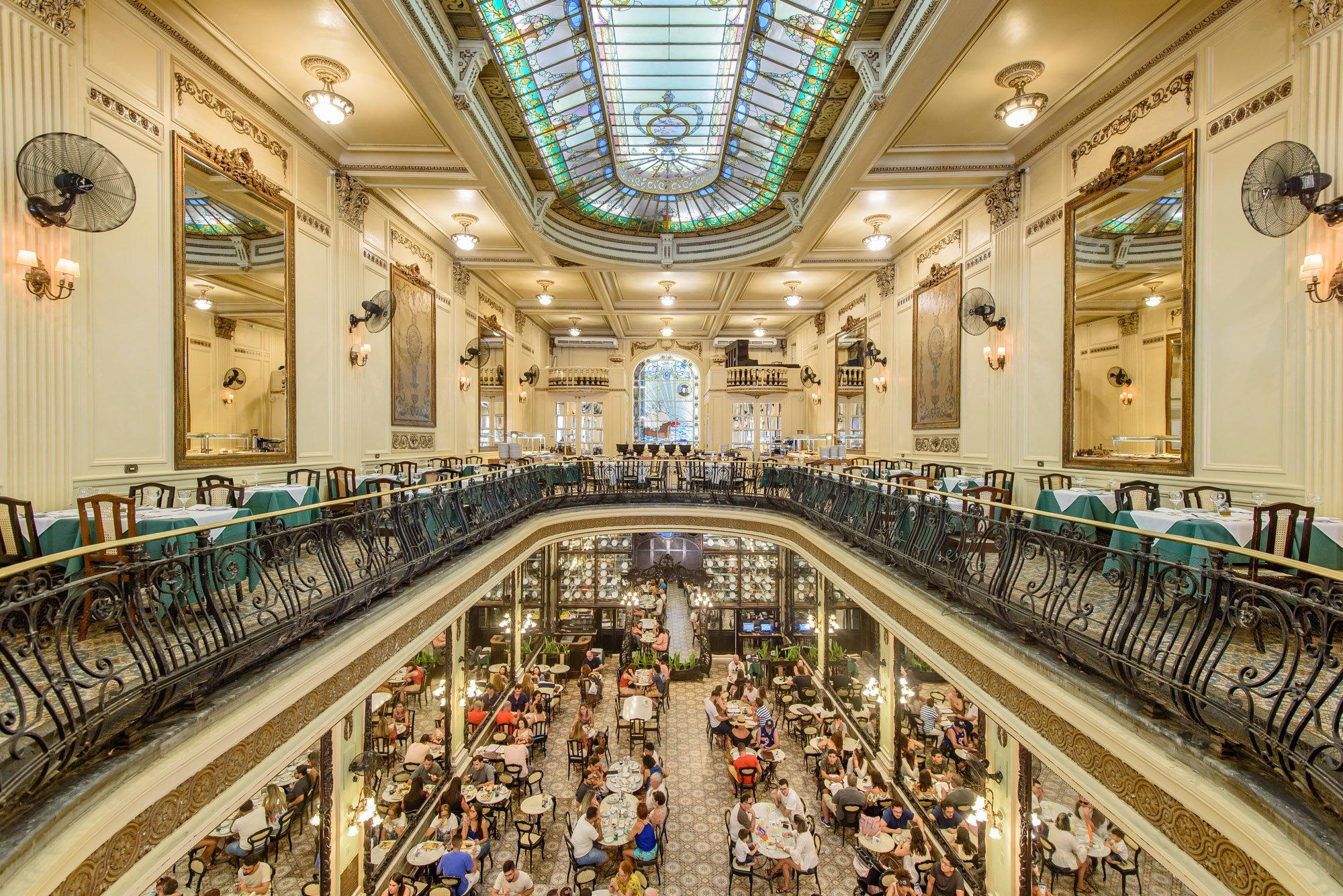
Confeitaria Colombo has anchored Rio de Janeiro's Centro district since the late nineteenth century, operating as one of Brazil's most recognisable period confectioneries. The Belle Époque interior, with its Belgian mirrors, jacaranda woodwork, and stained-glass skylights, frames a café and pastry tradition that predates the city's modern dining scene by generations. It sits on Rua Gonçalves Dias, 32, within walking distance of the historic Lapa arches.

Pearl is the En Primeur Club membership app — saves, bookings, and concierge access live there. Same editors, same standards.
- Address
- R. Gonçalves Dias, 32 - Centro, Rio de Janeiro - RJ, 20050-030, Brazil
- Phone
- +55 21 2505 1500
- Website
- confeitariacolombo.com.br
- Directions
- Get directions
The menu
What to order
- Pastel de Nata
- Feijoada
- Empanadas
- Thousand-Layer Cakes
- Bobó de Camarão
- Chá da Tarde
A Room That Predates Modern Rio
In many cities, heritage cafés survive as curiosities, stripped of function and propped up by foot traffic alone. Confeitaria Colombo, on Rua Gonçalves Dias in Centro, is something different: a working confectionery and café that has remained in continuous operation since 1894, and whose interior remains one of the most complete examples of Belle Époque commercial design in South America. The Belgian bevelled mirrors reach floor to ceiling. The jacaranda woodwork, darkened with age, runs along the balustrades of a second-floor mezzanine that overlooks the ground-floor café below. Stained-glass skylights filter the afternoon light into the room in a way that no renovation has managed to improve upon, because none has tried to. Arriving here is an exercise in spatial disorientation: this is a nineteenth-century room that has simply continued being used.
The Cultural Weight of the Brazilian Confeitaria
The confeitaria tradition in Brazil arrived with Portuguese colonists and was refined across the nineteenth century as Rio's café culture developed alongside the imperial court. When Dom Pedro II ruled from the nearby Paço Imperial, the city's confectioneries occupied a social role closer to the Viennese kaffeehäuser than to the modern pastry shop: they were meeting rooms for commerce, politics, and literature. Colombo entered that tradition at its peak, opening in 1894 just as Rio was transitioning from imperial capital to republican city, and its address in Centro placed it at the centre of that transition. The confectionery became a gathering point for writers, politicians, and society figures during the early republic period, a function that left its mark on the physical space: the room is designed for lingering and display, not throughput.
That tradition gives Colombo a different cultural register than the tasting-menu restaurants that now define Rio's premium dining tier. Lasai, Oteque, and Oro address an international conversation about what Brazilian ingredients and technique can produce at the highest level. Colombo addresses a different question entirely: what Brazilian café culture looked like at the moment it was consolidating its own identity. The comparison is not about quality ranking but about what each type of venue is for. Similarly, Casa 201 and Cipriani occupy formal dining registers that place them in a separate conversation from a historic confectionery operating across morning and afternoon café hours.
What the Room Is Doing
The ground floor operates as the primary café space, where tables beneath the mirrors serve coffee, pastries, and light savoury items through the day. The mezzanine level, accessible by a central staircase, offers a slightly more removed vantage point over the room below and is used for more formal tea service. The physical arrangement — ground floor for quick café use, upper level for longer sittings — mirrors the layout of grand European confectioneries of the same period, where the architecture itself sorted visitors by pace and intention.
Heritage cafés of this age tend to fall into one of two operational categories: those that have frozen their format and now feel like museums, and those that have adapted their offer while preserving the physical fabric. Colombo sits closer to the latter. The pastry and confectionery offer has continued to evolve alongside Brazilian pastry conventions rather than treating 1894 as a permanent menu date. This is not a reconstruction or a themed experience but a functioning business that happens to operate inside a preserved room of considerable historical significance.
Visitors from outside Brazil often compare Colombo to Café Central in Vienna, Café de Flore in Paris, or A Brasileira in Lisbon. The comparison holds at the level of cultural function, all are period rooms that carry the sediment of a city's intellectual and social history, but Rio's café tradition developed independently and reflects a different set of colonial, imperial, and republican pressures. Understanding Colombo through the lens of European café culture is a useful starting point, but the room has its own logic. The weight of the Brazilian monarchy, the abrupt shift to the republic, and Rio's specific geography as a tropical port city shaped the confectionery tradition in ways that have no direct European equivalent. Restaurants such as D.O.M. in São Paulo and Manga in Salvador represent later chapters in how Brazilian food culture has interpreted itself; Colombo represents an earlier one.
Centro as Context
The Centro district around Rua Gonçalves Dias is Rio's commercial and administrative core, occupying the flat ground between the hills and the bay that defined the original colonial settlement. During business hours on weekdays, the streets carry the pace of a working city centre. On weekends, the neighbourhood quiets considerably, and Colombo draws a different visitor profile: a mix of Cariocas making a deliberate trip to a city landmark and international travellers working through the historic centre. The nearby Lapa arches, the Municipal Theatre, and the National Library sit within the same urban cluster, making Colombo a natural point in a walking circuit of Rio's nineteenth- and early-twentieth-century built fabric. For anyone spending time with venues in other Brazilian cities, the contrast with the regional cooking traditions documented in places such as Orixás in Itacaré, Manu in Curitiba, or Mina in Campos do Jordão illustrates how differently Brazilian food culture expresses itself across geography and register.
Planning a Visit
Colombo's Centro address means it follows a weekday-weighted rhythm tied to the surrounding commercial district. Weekend mornings are the quieter window for experiencing the room without the midweek pace, and the upper mezzanine offers the longest dwell time with the least interruption. The venue does not require a reservation for standard café seating, though organised visits and groups should plan accordingly. The address, Rua Gonçalves Dias, 32, Centro, is accessible from the Carioca metro station, which reduces the Centro navigation to a short walk. For a broader picture of Rio's dining options across price and register, our full Rio de Janeiro restaurants guide covers the range from historic venues to current fine-dining programmes. Readers tracking Brazil's wider restaurant scene will find additional reference points at Birosca S2 in Belo Horizonte, Primrose in Gramado, Olivetto in Campinas, Castelo Saint Andrews in Vale do Bosque, and State of Espírito Santo in Rio Bananal. For international comparison at the level of sustained institutional reputation, Le Bernardin in New York and Lazy Bear in San Francisco represent the kind of long-running format coherence that heritage venues in any country tend to be measured against.
Frequently asked questions
What's the address for Confeitaria Colombo?
Confeitaria Colombo is located at R. Gonçalves Dias, 32 - Centro, Rio de Janeiro - RJ, 20050-030, Brazil, Rio De Janeiro.
Is Confeitaria Colombo in Rio de Janeiro open on weekends, and what is the atmosphere like?
Colombo's Centro location on Rua Gonçalves Dias follows the rhythms of Rio's commercial district, meaning weekday hours draw the densest crowd from nearby offices and institutions. Weekend mornings are the quieter window, with reduced foot traffic that allows more time in the ground-floor mirrored salon. The atmosphere shifts from bustling city-centre café during the week to something closer to a leisurely heritage visit on Saturday or Sunday.
What dish is Confeitaria Colombo famous for?
Colombo's ground floor counter has long been associated with traditional Brazilian pastries and confections rooted in the Portuguese confeitaria tradition — the category of sweets and baked goods that gave the café its name. Coffee service alongside pastries remains the daily anchor of the operation at the Rua Gonçalves Dias address in Centro. Specific seasonal or signature items change with the kitchen's offering rather than being fixed to a single dish.
How far ahead should I plan for Confeitaria Colombo?
The ground-floor café operates on a walk-in basis tied to Centro's commercial rhythm, so weekday visits during business hours carry the heaviest foot traffic from the surrounding district. Weekend mornings offer a quieter window with shorter waits.
What is Confeitaria Colombo known for?
Colombo is known for its 1894 ground-floor salon in Rio de Janeiro's Centro district — a room lined with Belgian mirrors and carved jacaranda woodwork that has remained a functioning café rather than a museum piece. The address on Rua Gonçalves Dias places it at the heart of Rio's historic commercial core, and the venue represents the Brazilian confeitaria tradition that developed through Portuguese colonial influence across the nineteenth century.
Can Confeitaria Colombo adjust for dietary needs?
Traditional confeitaria menus are built around pastry, dairy, and egg-heavy preparations rooted in Portuguese technique, which limits the range of available substitutions. Visitors with specific dietary requirements should check the venue's official channels at R. Savoury light items are served alongside the sweet offering, which broadens options to some degree.
Is Confeitaria Colombo overpriced or worth every penny?
Colombo occupies a category where the room itself is part of the transaction — a preserved Belle Époque interior operating as a daily café in Centro rather than a ticketed attraction. Pricing for coffee and pastries at a historic address in Rio's commercial district typically sits above a neighbourhood bar but below a full-service restaurant. The question is less about value per plate and more about whether a working 19th-century café interior carries weight for the visitor.
Budget Reality Check
| Venue | Cuisine | Price | Awards | Notes |
|---|---|---|---|---|
| Confeitaria ColomboThis venue — the venue you are viewing | Portuguese-Brazilian Pastries & Café | $10–20 | Not listed | Not listed |
| Oteque | Modern Seafood Fine Dining | $100–150 | 1 Michelin Star · World's 50 Best #38 | Modern Brazilian, Modern Cuisine |
| Lasai | Modern Brazilian Fine Dining | Not listed | 2 Michelin Stars · World's 50 Best #28 | Regional Brazilian, Modern Cuisine |
| Oro | Brazilian Vanguard Fine Dining | Not listed | 2 Michelin Stars · La Liste Top Restaurants | Contemporary Italian, Brazilian, Modern Italian |
| Lilia | Modern Brazilian Creative | $20–30 | Michelin Plate | Italian, Brazilian |
| Mee | Pan-Asian Fusion with Japanese Influence | $50–100 | 1 Michelin Star | Asian Influences |
Continue exploring
More in Rio de Janeiro
Restaurants in Rio de Janeiro
Browse all →
Bars in Rio de Janeiro
Browse all →
Details
- Well Known
- Classic
- Elegant
- Cozy
- Brunch
- Casual Hangout
- Group Dining
- Family
- Historic Building
- Private Dining
- A La Carte
- Buffet
- Brazilian Coffee
- Tea
Historic and refined with Belle Époque architecture, crystal mirrors from Antwerp, jacaranda wood framing, and elegant afternoon tea service on delicate china.